
When a company first decides to expand internationally, the initial approach to translation is often painfully manual. Marketing teams find themselves drowning in endless Excel spreadsheets, copying and pasting copy from their CMS, emailing files to freelance translators, and manually re-uploading the localized text.
While this might work for a single landing page, it is completely unsustainable for continuous growth. Manual workflows lead to version control disasters, broken website formatting, inconsistent brand messaging, and heavily delayed time-to-market.
To scale globally without multiplying your operational overhead, you need a robust localization pipeline. Here is how to set up a seamless content adaptation process that bridges the gap between your development, marketing, and linguistic teams.
1. The Core of Your Operations: The Translation Management System (TMS)
If you are serious about global expansion, you must ditch the spreadsheets. The foundation of any professional localization workflow is a Translation Management System (TMS). Platforms like Lokalise, Crowdin, Phrase, or Smartling act as the central hub for all your multilingual content.
A TMS provides a centralized environment where:
- Developers can push and pull code strings via API without worrying about the actual translation process.
- Marketers can manage the overall project, track progress, and assign tasks.
- Translators and Reviewers can work directly on the text in a unified interface equipped with built-in glossaries and translation memories.
By routing all content through a TMS, you create a single source of truth for every language, drastically reducing administrative bottlenecks.
2. Automating the Flow: CMS and API Integrations
The biggest time-sink in localization is data transfer. Your workflow should be designed to eliminate the «copy-paste» phase entirely.
To achieve a seamless process, connect your TMS directly to your Content Management System (whether that’s WordPress, Webflow, Contentful, or a custom backend) and your design tools (like Figma or Sketch).
- Design Phase: With a Figma-to-TMS integration, designers can pull preliminary translations directly into their mockups. This allows the team to spot layout-breaking text expansion before a single line of code is written.
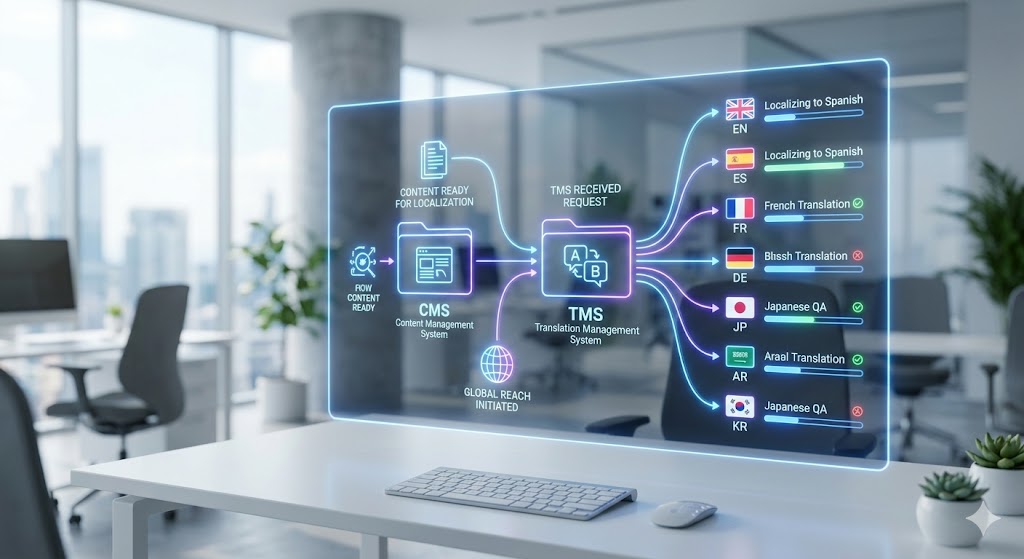
- Content Phase: When a marketer publishes a new blog post in English on your CMS, an automated trigger should immediately send the content to the TMS, notify the translation team, and push the localized versions back to the CMS once approved—ready for publishing.
3. The Modern Linguistic Approach: MTPE (Machine Translation Post-Editing)
Efficiency in content adaptation is about allocating your resources smartly. Not every piece of content requires a high-end, human-only transcreation process. The most cost-effective workflow today leverages a hybrid model known as MTPE.
- Machine Translation (MT): Use advanced neural machine translation engines (like DeepL or Google Cloud Translation) connected to your TMS to do the initial heavy lifting. This provides a baseline translation instantly.
- Post-Editing (PE): Professional human linguists then step in to review, refine, and adapt the machine-translated text. They ensure the tone of voice matches your brand guidelines, fix cultural nuances, and polish the marketing copy.
This workflow can increase translation speed by up to 60% while maintaining the high quality expected by your target audience.
4. Establishing Context and Quality Assurance (LQA)
Translators cannot work in a vacuum. A word in English can mean ten different things depending on where it appears on a webpage. If a translator only sees a list of isolated words, the final result will be a disjointed user experience.
- Visual Context: Choose a TMS that provides «In-Context Editors.» This feature allows linguists to see exactly how their translations will look on the live website or app interface as they type.
- Glossaries and Style Guides: Before you start translating, build a comprehensive brand glossary. It should define how your company name, product features, and key industry terms should be handled (e.g., should «Spectrum Media Labs» be translated, or kept in English?).
- Linguistic Quality Assurance (LQA): Implement a final review stage where native speakers test the localized content directly within the staging environment to catch any UI overlaps or contextual errors before going live.
The Ideal Workflow: Step-by-Step
To summarize, a highly efficient content adaptation pipeline looks like this:
- Creation: A new feature or article is created in the primary language (CMS/Figma).
- Sync: The content is automatically pushed to the TMS via integration.
- Pre-translation: Translation Memory fills in previously translated sentences, and Machine Translation handles the new text.
- Human Review: Linguists refine the text, utilizing visual context and brand glossaries.
- Approval & Deployment: Approved translations are automatically pulled back into the CMS/Codebase, ready for the global audience.
By investing in the right tools and structuring a logical operational flow, content localization shifts from being a logistical nightmare to a smooth, automated machine that drives international revenue.







Add comment