
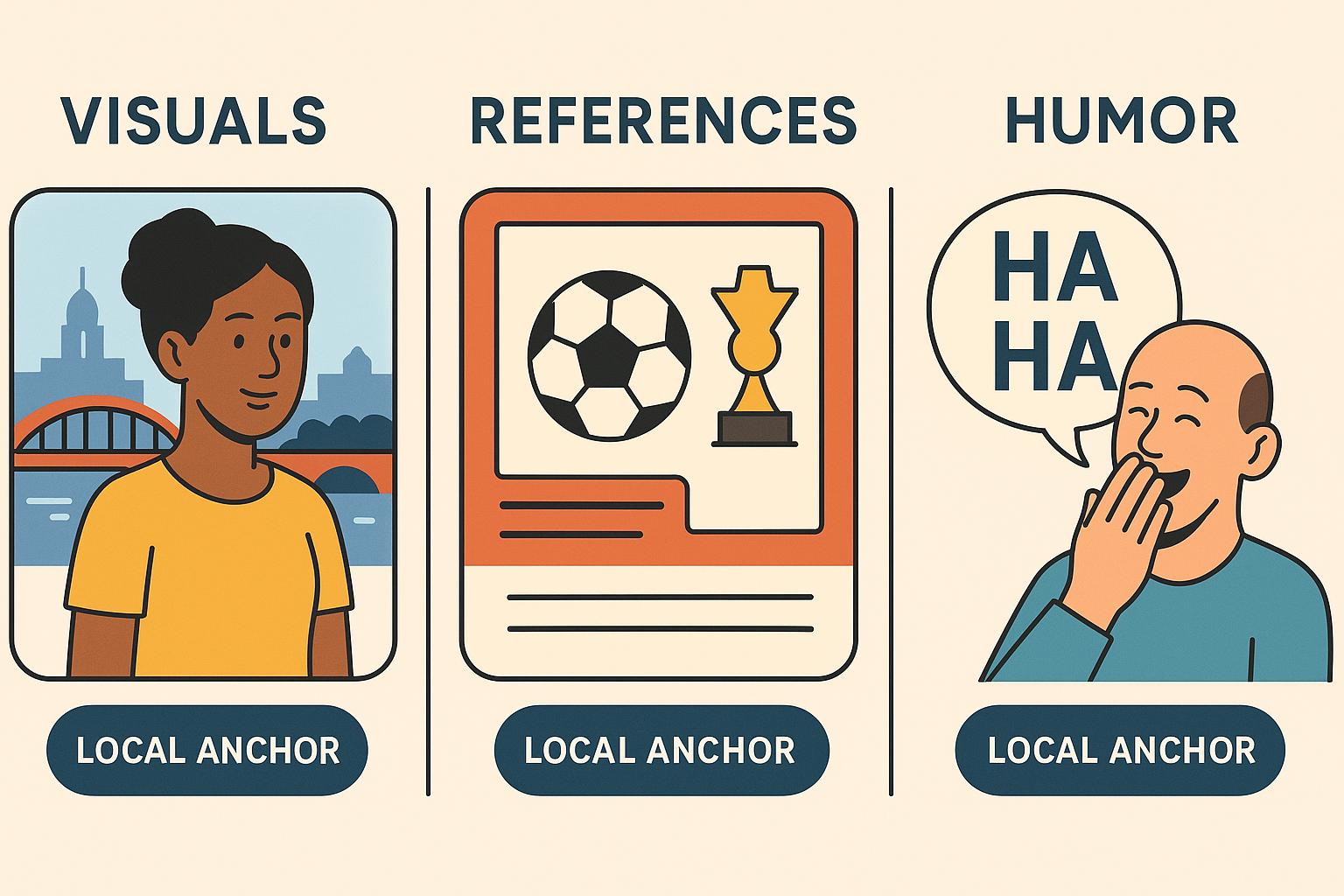
Most teams localize words and stop there. But what actually drives attention and conversion across markets is the creative substrate—the visuals, cultural references, and humor styles that make an idea feel native. When those miss, the copy can be flawless and still flop. When they land, you unlock relevance that straight translation can’t buy.
This playbook shows how to design, review, and measure creative that travels—without becoming bland “global vanilla.”
1) Start from meaning, not aesthetics
Before you translate anything, write a Creative Intent Brief answering three prompts:
- What must the audience feel? (security, pride, FOMO, relief)
- What proof makes that feeling credible here? (peer logos, certifications, public data, authority figures)
- What cultural pitfalls exist? (taboos, politics, rivalries, overused tropes)
This brief becomes the North Star for visuals, references, and jokes. Aesthetics are the vehicle; meaning is the cargo.
2) Visuals: from stock to situated
Choose the right visual dialect
- Color & contrast. Preferred palettes vary by market (e.g., high-contrast brights in parts of LATAM and Southeast Asia; muted, typographic systems in DACH/Nordics). Maintain brand core hues, but tune saturation and contrast to local norms.
- Iconography. Avoid idioms that don’t exist (e.g., “mailbox flag” for unread messages). Use system icons with local familiarity (e.g., payment logos, transit symbols).
- People imagery. Cast for local demographic reality (skin tones, age mix, attire), but avoid costume clichés. Represent contextual cues—office layouts, devices, signage—that instantly signal place.
- Numeracy. Screenshots and graphs should use local formats (1 234,56 vs. 1,234.56; currency symbol position; week start day; 24h time). Don’t rely on CSS swaps—bake it into the artwork.
Design operations that scale
- Build layered master files (Figma/PSD) with slots for: headline, subhead, CTA, number formats, currency, and regional badges.
- Maintain a “Do/Don’t” visual board per market—side-by-side examples with reasons.
- Create a component library of localized backgrounds, textures, and UI elements (e.g., local keyboards, receipt formats, electrical plugs) to drop into scenes.
3) References: move from “known” to knowable
References create instant affinity—until they don’t. Swap celebrity/in-joke references for shared cultural anchors that are knowable in a scroll:
- Sports → rituals. Instead of a niche team meme, use match rituals (penalty shootout tension, victory lap) that a casual fan understands.
- TV/film → genres. Rather than referencing a specific show, evoke the genre grammar (heist title cards, telenovela split-screens, K-drama reaction beats).
- Work culture → artifacts. Swap US-centric artifacts (Post-it everywhere, open-plan tropes) for local ones (stamps, red chop in East Asia; Fahrplan boards in DACH).
- Authority cues. Use locally resonant validators: standards bodies, marketplaces, awards, or media outlets. A single local logo can beat ten global ones.
Rule of 3: your key creative should contain at least one local anchor (place/ritual/validator), one brand anchor (consistent typography/mark), and one universal anchor (emotion or task).
4) Humor: calibrate for risk and rhythm
Humor is a force multiplier—and a minefield. Make it a system, not a gamble.
Humor spectrum by risk
- Low-risk: Observational friction (everyday pain), visual exaggeration, gentle irony. Works almost everywhere.
- Medium-risk: Wordplay, slapstick, sarcasm—localization requires linguistic precision and performance timing.
- High-risk: Satire, politics, stereotypes, self-deprecation tied to identity. Use only with in-market creatives and legal review.
Craft techniques that travel
- Setup → turn → truth. A three-beat rhythm (problem, twist, useful insight).
- Physical beats over verbal puns. GIF loops, animated UI mishaps, prop comedy in product demos.
- Reaction faces. Universally readable micro-expressions turn mid-tier jokes into shareable ones.
Guardrail: Punch up, not down. Laugh at complexity, bureaucracy, or your own product limitations—then show the fix.
5) Workflow: creative localization as an operating loop
- Prototype in English (or source language) with neutral assets (no risky references).
- Local creative jam (60–90 min): regional marketer + designer + copy + legal. Replace neutral placeholders with market-specific anchors.
- Quick audience check: 5–10 in-market reviewers score Clarity (0–5) and Charm (0–5); collect “tripwire” notes.
- Ship two variants per market at most (avoid “variant inflation”).
- Archive and tag in your DAM with: country, reference type, humor level, performance notes.
6) Formats and channels: what to adapt, what to keep
- Short video (6–20s): Localize opening 2 seconds (hook) and final frame (CTA + legal); keep middle product proof identical to preserve production velocity.
- Carousels & infographics: Localize examples and numerics, not the structure. A consistent sequence builds global brand memory.
- Landing pages: Maintain content parity across markets (same sections), but swap proof blocks (logos, testimonials, guarantees).
- Out-of-home: Re-shoot for site lines (reading distance, traffic flow) and regulatory copy. Avoid small text; assume 2-second glance.
7) Measurement: prove taste, not just traffic
Track creative fit with metrics beyond CTR:
- Clarity/Charm delta: quick panel scores from in-market testers vs. control.
- Save & share rates on social (humor and reference resonance).
- Replay rate on short video (did the beat land?).
- Localized proof lift: CTR on local logos/testimonials vs. global ones.
- Complaint ratio: support tickets or comments flagging cultural misses (goal: <0.5% of impressions).
- Conversion & AOV by market when humor is present vs. neutral creative.
Report wins and near-misses as patterns (e.g., “genre parodies outperform celebrity nods in FR; deadpan > slapstick in JP”).
8) Legal & brand safety essentials
- Clear rights for likeness, artwork, and fonts in each territory.
- Double-check parody laws and comparative advertising rules.
- Maintain a “red-list topics” doc per market (political events, tragedies, religious holidays) with lookback windows.
- Add a pre-flight cultural review step for anything labeled “humor: medium/high risk.”
9) Tooling you actually need
- Figma libraries with locale tokens (typography, numerics, date formats).
- Caption templates in multiple line heights (EN often longer words than ES/FR; DE tends to run long).
- Subtitle pipeline (SRT + burned-in variants) with line-break rules per language.
- Motion system with editable timing markers (humor beats live in milliseconds).
10) Anti-bland rules (so “global” doesn’t mean “gray”)
- Every market asset must contain at least one local anchor or one local proof.
- Never ship a literal translation of a joke. Either rebuild the joke or strip humor entirely.
- If your team debates whether a reference is “too local,” ship two hooks: one local, one universal; compare results.
- Avoid world-tour collages (flags, landmarks) unless the message is about “globalness.” Specificity wins.
Copy-paste checklists
Creative Jam Checklist
- Define desired feeling and proof.
- Replace neutral placeholders with one local anchor.
- Choose humor level (low/med/high) + technique.
- Validate numerics, time/date, currency, keyboards, signage.
- Approve rights and legal lines.
Review & QA
- Clarity ≥4/5; Charm ≥3.5/5 from in-market panel
- No red-list topics or risky stereotypes
- Subtitles/alt text localized; CTA phrasing legal
- Proof blocks use local validators
- Archive with tags + performance note






Add comment