
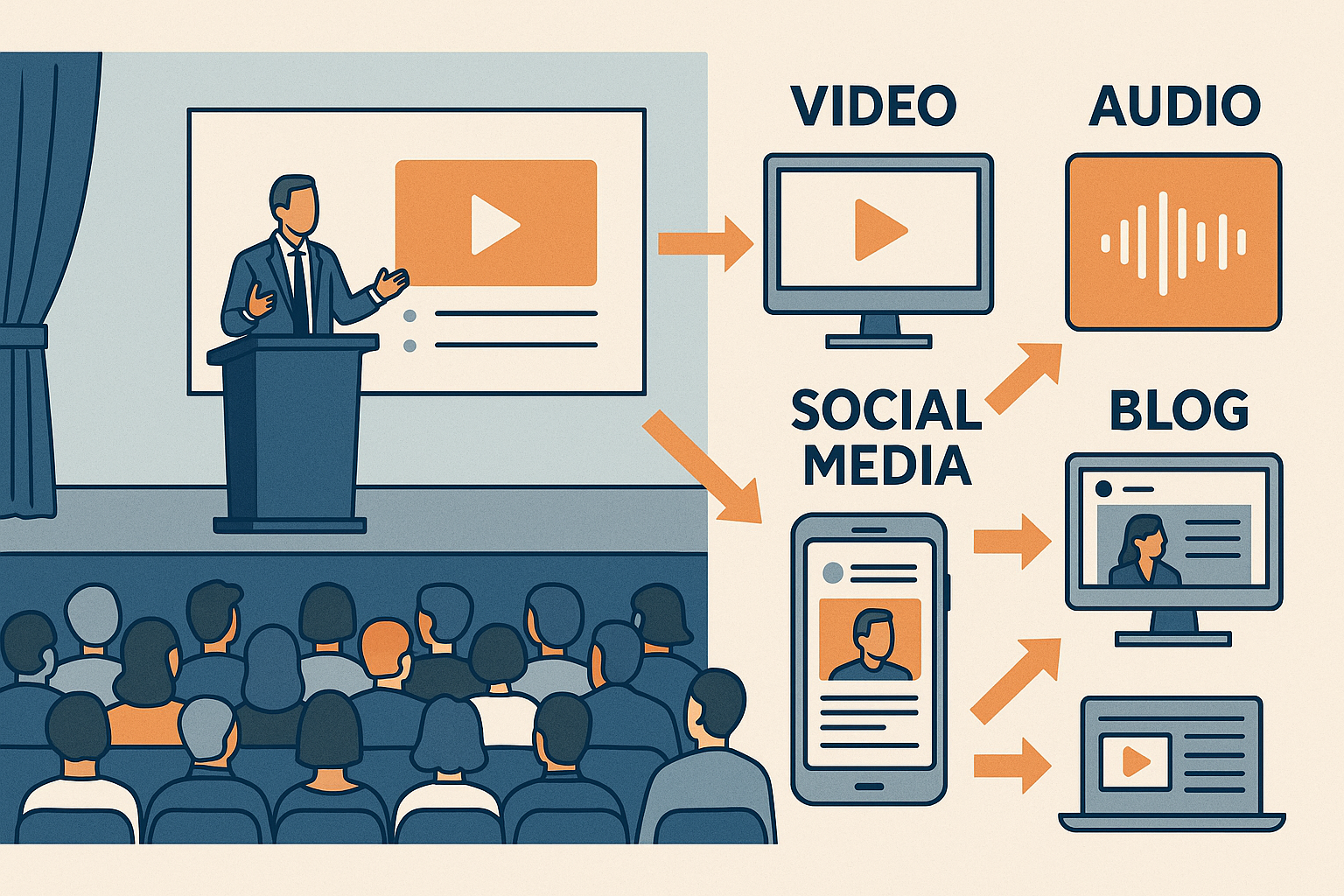
A stage is not a one-hour experience — it’s a one-year asset.
Modern marketing teams no longer treat events as endpoints; they’re content engines.
Each talk, demo, or fireside chat is a goldmine of micro-moments — if you architect capture and repurposing upfront, not after applause.
Here’s how high-performing teams turn a single event into 30+ publishable assets that feed social, SEO, sales enablement, and community for months.
1. Shift from “event as show” to “event as dataset”
Every minute of your stage contains four data layers:
- Visuals — faces, slides, gestures, demos.
- Audio — tone, quotes, phrasing.
- Interaction — Q&A, chat, applause, polls.
- Context — who said it, when, to which audience.
Instead of filming for documentation (“for those who missed it”), film for recombination.
That means multiple camera angles, clean isolated audio tracks, and real-time metadata tagging (speaker, topic, timestamp).
Treat the event not as a single deliverable but as a structured data capture session.
2. Pre-plan capture: your “repurpose matrix”
Before the event, define your content tiers:
| Tier | Format | Output | Frequency | Owner |
|---|---|---|---|---|
| Tier 1 | Full sessions | YouTube, on-demand hub | 3–5 videos | Video team |
| Tier 2 | Highlights & snippets | LinkedIn, Instagram, TikTok | 10–15 short clips | Social |
| Tier 3 | Quotes, visuals | Carousels, tweets, blog headers | 10–20 assets | Design |
| Tier 4 | Derivative content | Articles, playbooks, case studies | 3–6 longform | Editorial |
That’s your 30+. Most of it comes from slicing and sequencing, not reshooting.
3. Stage design for content capture
Your production should serve the lens, not just the live audience.
- Lighting: flat, even front lighting; avoid deep shadows and LED color shifts that kill color balance in edits.
- Backdrop: minimal and brand-consistent — no dates or busy logos. That way clips stay evergreen.
- Camera plan:
- 1 wide static for continuity.
- 1 medium for gestures.
- 1 roaming for reactions / crowd.
- Optional: 1 feed for slides.
Mark cameras in the ROS (“Run of Show”) so operators know when to zoom or cut.
4. Live documentation: the “scribe team”
Have a 2-person microteam doing live note capture:
- Timestamp key quotes (“11:24 — ‘AI won’t replace marketers…’”).
- Flag emotion spikes (applause, laughter).
- Log audience Q&A (for later social threads or FAQ articles).
Those notes are your editing map. They save days in post-production.
5. The 30-asset model: what to create
Here’s a proven output map from one 45-minute panel or keynote:
🔹 Video (8 assets)
- Full replay
- Highlight reel
- Speaker intro clip
- Best quote montage
- One “myth vs. fact” snippet
- 3–4 vertical clips (Reels/Shorts/TikTok)
🔹 Audio (3 assets)
- Podcast episode
- 3–5 soundbites for social
- Optional remix for internal radio or Spotify
🔹 Visual (9 assets)
- Quote cards (3–5)
- Carousel: “Top 5 insights”
- Infographic: key frameworks
- Slide deck (branded PDF)
- Thumbnail kit for YouTube & social
- Behind-the-scenes photo set
- Speaker headshots
- Speaker quote poster for print/social
- Stats graphic (“87% of attendees said…”)
🔹 Written (7 assets)
- Blog summary
- Medium/LinkedIn article
- Newsletter feature
- “3-minute recap” thread
- Event transcript SEO page
- Internal enablement doc (“How to explain this to clients”)
- Case study variant (if product-centric)
🔹 Interactive & Owned (3 assets)
- Replay hub with chaptered timestamps
- Notion/Miro summary board
- Poll recap report
🔹 Evergreen & Nurture (up to 5 assets)
- “Best of 2025” compilation
- Onboarding sequence email
- Persona-targeted clips for nurture campaigns
- Paid retargeting ads built from clips
- “Behind the talk” mini-interview
6. Post-production pipeline
Your editing shouldn’t start from scratch—it should flow like a factory.
- Ingest & label: All footage named with timestamps + speaker codes.
- Auto-transcribe: Tools like Descript or Riverside.
- Tag themes: Growth, data, design, etc. (for reuse in SEO).
- Clip priority: Pull moments with human faces + emotional spikes.
- Visual layer: Add subtitles, motion text, or waveform overlays.
- Brand layer: Intros, outros, logo stings.
- Approval flow: Editorial sign-off → brand → legal → publish.
Automation + templates save weeks once standardized.
7. Distribution sequencing
Treat your event as a 90-day content campaign, not a one-day drop.
| Week | Focus | Channels | Sample asset |
|---|---|---|---|
| 1 | Replay + Recap | YouTube, Blog | “Full session: The Future of Brand Partnerships” |
| 2–3 | Highlights | LinkedIn, IG Reels | “3 Lessons from our Panel on Creative Ops” |
| 4–6 | Quotes + Clips | Twitter, Threads | “You don’t scale creativity—you systematize it.” |
| 7–9 | Deep Dives | Blog, Podcast | “How our speakers built hybrid content pipelines.” |
| 10–12 | Compilation | Newsletter, Paid | “Top 10 Insights of the Quarter” |
Keep one hero CTA throughout (e.g., “Subscribe for the full replay hub”).
8. Governance & rights
Repurposing only works when rights and credits are clear:
- Secure speaker consent for derivative content.
- Attribute co-branding when using partner footage.
- Track licensed visuals, music, or slides.
- Keep a “usage log” linking each clip to original recording.
This avoids re-edit headaches later and keeps the brand safe.
9. Measure what matters
- Time-to-first asset: hours, not days.
- Asset-per-session ratio: goal = ≥20.
- Replay-to-lead conversion: track CTAs in replays.
- Retention: watch % past 30 seconds on short clips.
- SEO impact: new keywords indexed from transcripts.
If you can measure, you can industrialize.
10. The cultural shift: from event team → media team
The most successful event marketers think like showrunners.
Their mindset:
“Every stage is a studio. Every talk is a season pilot.”
That means:
- Capture with multi-format intent.
- Tag and store with metadata discipline.
- Republish with rhythm, not random bursts.
Once your event ops run like a newsroom, every stage becomes an engine of ongoing reach.
Implementation checklist
- Map repurpose tiers before event.
- Capture 3+ camera angles.
- Log timestamps + quotes live.
- Secure speaker rights for reuse.
- Standardize editing templates.
- Sequence content over 90 days.
- Measure asset-per-session ratio.
Add comment