

The quality of a panel depends less on the stage setup and more on the sourcing discipline behind it. “Get me three speakers” isn’t sourcing—it’s booking bodies. Great panels balance expertise, perspective, diversity, and chemistry. They feel like discovery, not performance.
Whether you’re curating for a webinar, conference, or brand event, speaker sourcing is an operational process that can—and should—be measured, optimized, and scaled.
The strategic shift: from “known names” to “known insights”
Too many events chase headliners because they seem safe. But familiarity doesn’t equal relevance. Audiences today reward fresh, specific intelligence over brand logos on a slide.
The modern sourcing brief asks:
- What question does this panel answer that hasn’t already been answered 100 times?
- Which voices have firsthand data, experience, or perspective on that question?
- How do their motivations align with our event’s goal (educate, recruit, convert, inspire)?
When you start with the question, not the title, you get panels with depth—where speakers reveal new ideas, not repeat talking points.
Step 1. Define the intellectual architecture
Before you invite anyone, define your content spine:
- Core thesis: What truth or tension does the panel unpack?
Example: “AI won’t replace marketers—but bad marketers who ignore it will.” - Sub-angles: 2–3 tension points or counterpoints (e.g., creativity vs. automation, speed vs. quality).
- Outcome: What should the audience leave ready to do or think differently?
This clarity lets you target speakers who represent poles on that spectrum, not carbon copies.
Step 2. Build the sourcing matrix
Treat speaker sourcing like pipeline development. Map each role you need to fill.
| Role | Purpose | Ideal Profile | Screening Question |
|---|---|---|---|
| Anchor (Expert) | Delivers core knowledge, frameworks, credibility | Practitioner with measurable results | “What’s a data point or process you can share publicly?” |
| Contrarian (Challenger) | Creates productive tension | Startup founder, journalist, or critical analyst | “Where do you disagree with the dominant narrative?” |
| Connector (Context) | Bridges theory to practice | Corporate operator or consultant | “How have you seen this play out at scale?” |
| Voice of the Customer/User | Grounds discussion in reality | Actual user of solution, client, student | “What’s the biggest friction or surprise in your experience?” |
Aim for at least one non-obvious pick—someone outside the industry echo chamber.
Step 3. Outreach that attracts—not extracts
Your sourcing emails should sound like collaboration, not PR extraction.
A good first line:
“We’re building a conversation around [tension or question]. You’ve written/shared/worked on [specific example], and we think your angle could shape the debate.”
Attach a mini brief (one page max) with:
- The working title and question.
- Audience profile and size.
- Format and prep expectations (live vs. pre-recorded, 20 or 45 minutes).
- Why they’re uniquely relevant.
Avoid over-templated invites. Personalization is credibility.
Step 4. Vet for both expertise and chemistry
Expertise is table stakes; chemistry is the multiplier.
Run quick 10–15 minute pre-calls with each confirmed speaker:
- Listen for speaking rhythm and clarity.
- Test overlaps and potential friction points with other speakers.
- Gauge responsiveness and reliability.
Document these impressions in your event CRM—track “fit,” “energy,” and “content density.”
Over time, you’ll build a speaker quality database: who performs, who cancels, who elevates others.
Step 5. Diversity as design principle
Diversity isn’t a checkbox—it’s signal amplification. Homogeneous panels shrink insight bandwidth.
Aim for variety across:
- Function: Mix builders (doers) and thinkers (analysts).
- Industry: Adjacent sectors often spark fresh analogies.
- Demographics: Gender, geography, age, ability—visible diversity improves credibility and resonance.
- Viewpoint: Ideological diversity (optimist/skeptic, traditional/disruptive) drives engagement.
To source inclusively:
- Build a running “voice radar” doc of emerging talent—LinkedIn creators, Substack writers, meetup organizers, internal SMEs.
- Tap your audience: end each event with “Who should we hear from next time?”
Step 6. Prep for substance, not scripts
Your goal isn’t to make speakers sound polished; it’s to make them sound real.
Send a discussion guide, not questions in advance. Structure it as:
- Set-up statement (“Some teams say X…”)
- Challenge question (“Do you agree—or is that outdated?”)
- Next step (“If you disagree, what should we do differently?”)
Encourage conflict—professionally.
Rehearsal ≠ scripting. Use prep calls to align tone, flow, and timing, not to pre-approve answers.
Step 7. Stage balance & moderation
Moderators are architects of energy. Choose one who can:
- Draw in quieter voices.
- Cut off ramblers gracefully.
- Pivot from theory to actionable takeaway.
- Summarize live (“So we’re hearing X tension between Y and Z—let’s unpack that”).
Brief them to seek tension early, not bury it under polite agreement.
Step 8. Post-panel value loop
The end of the event is the beginning of the content cycle.
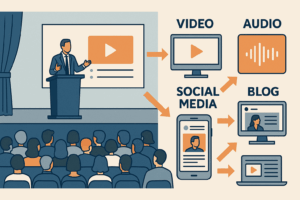
Repurpose panels into:
- Mini case videos: 60–90 sec clips of each speaker’s strongest take.
- Quote cards and LinkedIn carousels (data + perspective).
- Email drips: “3 takeaways from our AI marketing debate.”
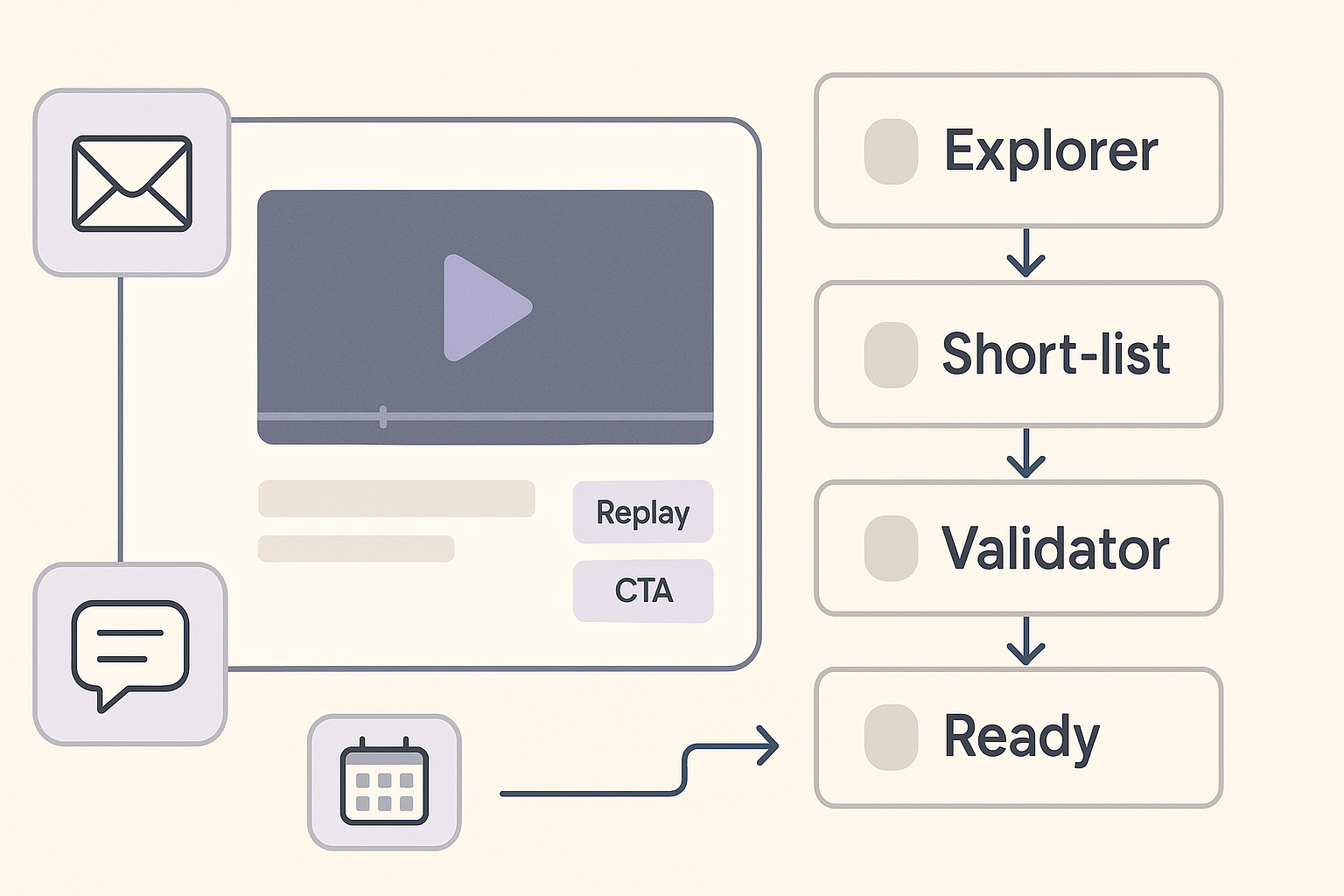
- Pitch assets: Include the panel replay in nurture flows for leads in related verticals.
Add metadata in your content library so clips are searchable by topic and speaker.
Quality metrics to track
- Engagement rate: % of audience watching beyond 20 min (for digital panels).
- Unique insights per minute: measure by number of non-redundant ideas surfaced.
- Speaker diversity index: % of first-time or underrepresented voices.
- Replay conversion: viewers who take next-step actions (subscribe, book, trial).
- Speaker NPS: post-event feedback from panelists themselves—how supported they felt.
Panels are not “one and done.” They’re ecosystems of relationships, data, and recurring thought leadership.
Pitfalls to avoid
- Inviting only your existing network (“conference monoculture”).
- Over-scripting to control outcomes.
- Ignoring chemistry during prep.
- Failing to brief moderators.
- Treating diversity as decoration.
Implementation checklist
- Define the central question + sub-tensions.
- Build a 4-role sourcing matrix (anchor, contrarian, connector, user).
- Draft personalized outreach briefs.
- Vet for chemistry via pre-calls.
- Ensure diversity across 3+ axes.
- Prep discussion guide (no full scripts).
- Coach moderator on tension-first dynamics.
- Repurpose content post-event.
- Track insights, diversity, and replay metrics.
Add comment