
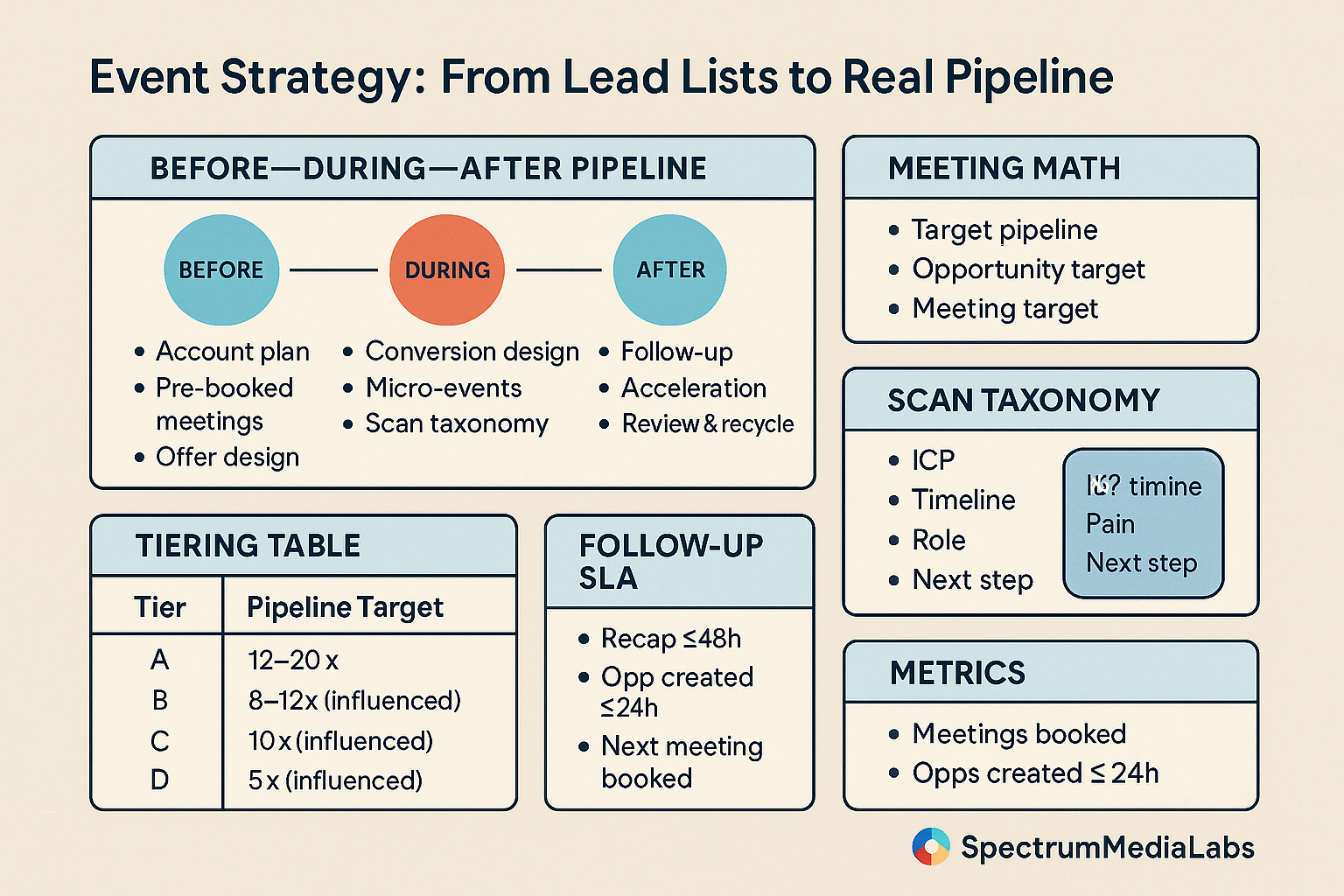
Most event programs die the same death: a gorgeous booth, a full badge scanner, and three weeks later… a CSV graveyard. If SpectrumMediaLabs wants events to sell, we need to treat them like product launches with clear ICP focus, conversion design, and a rigorously executed “before → during → after” revenue play. This guide is a field-tested operating model you can apply to trade shows, roadshows, user conferences, and sponsored meetups.
1) Define the job of events (and the dollar target)
Events can do many things; your plan should do one primary job at a time:
- Net-new pipeline (first-touch or qualified multi-touch)
- Deal acceleration (stalled opportunities advance a stage)
- Expansion (cross-sell/upsell in customer accounts)
- Category creation/PR (measured in influenced opportunities)
Pick one as the primary, the rest are bonus. Then set a dollar target:
- Target pipeline = Budget × Coverage multiplier
- For sponsored shows with lead capture: 6–10×
- For proprietary/user events with deep access: 10–20×
- Opportunity target = Target pipeline ÷ Avg. opportunity value
- Meeting target (on-site or within 10 business days) = Opportunity target ÷ Meeting→Opp conversion
If you can’t make the math pencil, change the event tier (smaller footprint, more targeted) or skip it.
2) ICP trimming beats bigger booths
Not everyone at a show is your buyer. Define:
- Accounts: industry, employee range, tech stack, geo, compliance regime
- Buying group roles: economic buyer, technical evaluator, champion, procurement
- Signals to prioritize: existing intent (content downloads, ABM engagement), current vendor pain, adjacent tooling
Rule: If a badge scan doesn’t map to ICP account + buyer role, it is not a marketing-qualified lead. It can be nurtured, but it doesn’t hit the event’s success math. Put that in writing before the show.
3) Event tiering and goals
Create a small service catalog for events with pre-set goals and playbooks:
| Tier | Example | Primary Job | Coverage Target | On-site Meeting Goal |
|---|---|---|---|---|
| A Flagship (user conference, owned summit) | Generate & accelerate | 12–20× | 40–80 meetings | |
| B Major industry trade show (sponsor + speaking) | Net-new pipeline | 8–12× | 25–50 meetings | |
| C Field dinners / meetups (20–50 ppl) | Accelerate/expand | 10× (influenced) | 8–15 meetings | |
| D Community talks / partner webinars (no booth) | Education/PR | 5× (influenced) | 3–8 meetings |
Tie staffing, budget, SLAs, and expectations to the tier.
4) “Before–During–After” as a revenue system
BEFORE (T-90 to T-1)
Account plan
- Build a must-win list (50–150 accounts) with buying group contacts.
- Pull intent + product signals to craft 3 talk tracks (Pain, Initiative, Objection).
Pre-booked meetings
- Goal: ≥40% of meeting target booked before day 1.
- Outreach sequence (mix of AE + SDR + Partner):
- T-30: value email (“3 benchmarks we’ll review at Booth 312”).
- T-21: social DM/LI voice note.
- T-14: door-opener incentive (VIP demo, founder time, co-sell with partner).
- T-7: calendar link with named slot options (10:10, 10:40, 11:10…).
Offer design (reason to meet)
- 15-minute benchmark audit, ROI calculator run-through, integration check, or a “technical debt” teardown.
- Deliverable promised in writing (PDF/ Loom recap within 48h). Meetings without value props become chit-chat.
Booth & content
- Build a single story spine (3 slides, 90-second demo).
- Prep a deal acceleration track for current opps (new feature preview, roadmap NDA, security face-time).
- Set up a scan taxonomy (see below) and create a short notes macro for reps.
Logistics for pipeline
- Calendar blocks for on-site meetings (15 min slots + 5 min buffer).
- Meeting rooms near the booth; QR check-in to push notes to CRM.
- Routing rules finalized (who owns scans, MQL threshold, meeting SLA).
DURING (T-0)
Conversion design on the floor
- Two zones: Attract (first 30 seconds) and Convert (scheduled demos + meetings).
- No fishing. The opener line is a question anchored to your ICP:
- “Which data team do you lean on for campaign lift?”
- “What’s your biggest bottleneck in short-form production: rights, motion, or localization?”
- If the answer is outside ICP, route to swag + nurture; don’t burn AE time.
Scan taxonomy (required fields)
ICP (y/n),Role,Timeline(active project ≤6 months?),Pain(pick list),Next step(booked slot, send asset, partner intro),Notes.- Use 3—5 dropdown fields + a single open note. This converts booth chaos into structured data Sales can act on.
Micro-events
- Run mini sessions at set times (10:30, 1:30, 3:30): “5-minute teardown,” “ROI in 90 seconds,” “Ask the architect.”
- Invite prospects during floor conversations to a specific time.
Real-time triage
- A pod leader watches the meeting board; fills holes; reassigns overflow to next day.
- Flag “hot” scans (project + budget + timing) to same-day meetings.
AFTER (T+1 to T+30)
Day 1–2: High-velocity follow-up
- Every meeting gets a recap within 24–48h: key pains, agreed plan, assets, and the next date.
- Non-meeting ICP scans get a 3-step sequence (value email with bookmarked clip, LI connect from the assigned AE, phone/SMS for those who opted in).
- Routing SLA:
- Hot ICP → AE within 2 business hours
- Warm ICP → SDR follow-up within 24 hours
- Non-ICP → nurture track; no AE task
Week 2: Acceleration
- Invite all open opps to a post-event clinic (virtual) with a named expert.
- Use social proof posts tagging customers/partners met at the event (with approvals).
Week 3–4: Review & recycle
- Kill non-responsive leads after 2 weeks into nurture; keep the board clean.
- Publish a 1-pager: What We Learned (top pains, talk-tracks that worked, objections).
5) The 90-second demo (and when to stop)
- Hook (0–15s): Problem flip with a number (“Most teams waste 30% of their edit time on versioning. Here’s the 1 screen that kills it.”)
- Proof (15–45s): Single workflow with before → after contrast; say what is automatic vs manual.
- Payoff (45–75s): Quantify the gain (“Time-to-variant in 2 days; reuse rate 85%”).
- Close (75–90s): Ask for one next step (“Want us to run your asset library through the readiness check next week?”)
Stop if the buyer leans in; switch to their data. Demos that run past 3 minutes leave with a polite nod and no meeting.
6) Roles, staffing, and SLAs
RACI at the show
- AE (A/R): on-site meetings, deal acceleration, hot ICP follow-ups
- SDR (R): floor triage, booking, recap drafts
- PMM/SE (R): demo owner, teardown sessions, proofs
- Event Lead (A): schedule, targets, floor discipline, daily stand-ups
- Ops (R): routing rules, CRM fields, reporting, badge import QA
- Partner manager (C): co-selling schedules and intros
SLA basics
- Meeting recap ≤48h; opportunity creation ≤24h after qualifying call; opp stage updated same day; no “TBD” notes.
7) Data model: make leads actionable
CRM objects & required fields
- Lead/Contact:
ICP,Role,Pain,Timeline,Source: EventName,Consent - Campaign member status:
Invited,Booked,No-show,Met (booth),Met (meeting),Follow-up sent - Opportunity link: add contact roles (econ buyer/tech/biz), stage, ARR estimate, Event influence checkbox
- Meeting object: date/time, owner, notes, “deliverable promised” field with due date
Automation
- Missed recap due date → Slack alert to AE + manager
- Hot ICP with no meeting → auto task for SDR + fallback to AE if >24h
8) Partner leverage (pipeline multiplier)
- Pre-event: exchange must-win accounts, align messaging, book joint meetings.
- On-site: daily “power hour” where partner AEs sit in your booth to qualify their accounts for your solution (and vice versa).
- Post-event: co-branded follow-up and shared dashboards of influenced pipeline. Tie a spiff to meetings sourced for each other.
9) Content that actually helps Sales
Pre-built assets
- Benchmark 1-pager with editable fields
- ROI calculator (5 inputs, instant PDF)
- Security FAQ (Procurement loves this)
- 3 Looms: 90-sec demo; 3-min teardown; 2-min integration walk-through
- Objection cards for reps (price, migration, “we have an agency”)
Post-event deliverable templates
- Meeting recap email (paste below)
- “Thanks for the chat” for scans without meetings (value asset + link)
Recap email template
Subject: Next steps from [Event] – your [pain] plan
Hi [Name], great meeting at [Booth/Room]. We captured [pain/goal] and agreed to [next step/date].
Attached: [benchmark/ROI/FAQ].
Here’s a 2-minute Loom with the flow we reviewed.
—[AE], SpectrumMediaLabs
10) What to measure (and what to ignore)
Leading indicators (during/Week 1)
- Meetings booked (pre + on-site), show rate, percent ICP, notes completeness
- Median time to recap, percent with next date scheduled
Lagging indicators (Week 2–8)
- Qualified opportunities created (new + accelerated)
- Pipeline $ from the event (first-touch, last-touch, multi-touch)
- Stage velocity for accelerated opps (days between stages before vs after)
- Win rate and ACV vs non-event benchmarks
Ignore vanity metrics: raw scans, swag taken, hallway selfies.
11) Budget design that protects ROI
- Spend on meeting capacity (quiet rooms, calendar tooling), demo quality, recording/recaps, and partner slots.
- Save on booth theatrics past the first 3 seconds of attraction; save on giveaways that attract the wrong traffic.
- Add a contingency (10%) for nightly client dinners with live opps—this is pipeline, not “misc.”
12) 30/60/90 plan for SpectrumMediaLabs
Days 1–30 (Foundation)
- Tier events; set coverage multipliers and ICP rules.
- Build the 90-second demo, recap template, and three talk tracks.
- Configure CRM fields, campaign statuses, and routing automation.
- Publish the outreach sequence; book first 30% of meeting goal.
Days 31–60 (Execution discipline)
- Run the event with daily stand-ups (15 minutes): targets, gaps, schedule fill.
- Track notes completeness and recap SLAs live.
- Host two micro-sessions per day; gather objections and update talk tracks nightly.
Days 61–90 (Conversion & learning)
- Hold a virtual clinic for all active opps; log stage movement.
- Close the loop with a “What We Learned” report: pains, messages that landed, partner impact, pipeline coverage, ROI.
- Update the event playbook; schedule 1:1s with AEs to fix missed SLAs.
13) Copy-paste checklists
Booth readiness
- 90-sec demo + hotkeys
- Scan taxonomy configured
- Meeting board + QR check-in live
- Objection cards printed
- Partner schedule confirmed
- Notes macro in CRM mobile app
Follow-up discipline
- Recap ≤48h with deliverable
- Opportunity created with contact roles
- Next meeting on calendar
- Non-ICP to nurture (no AE tasks)
- Lessons logged to playbook
Bottom line
Events create pipeline when they’re treated as conversion systems, not branding field trips. Tight ICP, pre-booked meetings, a 90-second demo with a real deliverable, ruthless triage on the floor, and 48-hour recaps turn badges into opportunities—and opportunities into revenue. Ship the system once; then every event you touch compounds.
Add comment