
Introduction
Partnerships multiply your reach—or your risk. The hardest skill in Partner Ops isn’t closing a logo; it’s saying no to the wrong ones without torching the relationship. A clean “no” preserves optionality, protects brand integrity, and saves teams from months of busywork. This expert guide gives you a fit framework, a decision ritual, and copy‑ready scripts so you can vet fast, decide clearly, and decline with respect.
Why Most “Nos” Go Wrong
- Squishy criteria: “Looks interesting” becomes six meetings and a vague LOI.
- No single decision owner: sales wants now, product wants later, legal says maybe.
- Fear of reputational fallout: teams hedge, dragging things out until the partner gives up.
- Silence instead of closure: ghosting kills credibility and burns bridges.
Principle: Decide in public, document the why, and communicate the “no” with a useful next step—redirect, refer, or revisit.
The F.A.I.R. Fit Score (5×5 rubric)
Score each dimension 0–5. Require an average ≥3.5 and no zeros. Total out of 25.
- F — Fit (ICP & Workflow): Shared ICP ≥60%? Integration lives where the buyer works?
- A — Advantage (Mutual Value): Clear outcome lift vs solo (win‑rate, cycle time, attach rate).
- I — Integrity (Brand & Risk): Compliance posture, reputational checks, conflict with values/claims.
- R — Readiness (People & Ops): Named owners, enablement assets, security review, PRM/CRM wiring.
Risk multipliers (×0.5 to ×1.2): regulatory exposure, data handling scope, exclusivity demands, channel conflict. A single critical risk sets the proposal to Hold pending mitigation.
Example scoring
- Fit 4, Advantage 3, Integrity 5, Readiness 2 → Avg 3.5, but Readiness=2 → Conditional No with a readiness checklist.
The 30‑Minute Vetting Call (Agenda + Questions)
Goal: reach Provisional Yes, Conditional No, or Decline.
- Context (5 min): their ICP, top use cases, success metric.
- Proof (7 min): 2 named customers, numbers with dates, support model.
- Go‑to‑market (7 min): routes (co‑sell/co‑market/marketplace), owners, cadence.
- Risks (6 min): exclusivity asks, data flows, legal/brand concerns.
- Next step (5 min): agree on doc exchange and decision date.
Questions to ask
- “Which specific accounts overlap in the next 90 days?”
- “Where does our integration live in the user’s day—two clicks or a new tab?”
- “What asset(s) are ready: solution page, demo, certification?”
- “Who is your exec sponsor and partner AE?”
- “Any exclusivity, category conflicts, or marketplace constraints?”
Due Diligence Checklist (Copy/Paste)
Decision Types (and What to Send)
1) Provisional Yes (Pilot)
Criteria met; limited scope and timeline. Send a 1‑page Pilot SOW: scope, accounts, assets, SLAs, success metric, 45‑day review.
2) Conditional No (Readiness Gap)
Missing assets or owners. Send a Readiness Checklist with 3–5 items and a date to revisit.
3) Decline (Strategic Misfit/Risk)
Low score or high risk. Send a Respectful Decline with a redirect (e.g., partner directory, community) and an invite to share wins later.
Email Scripts (Steal These)
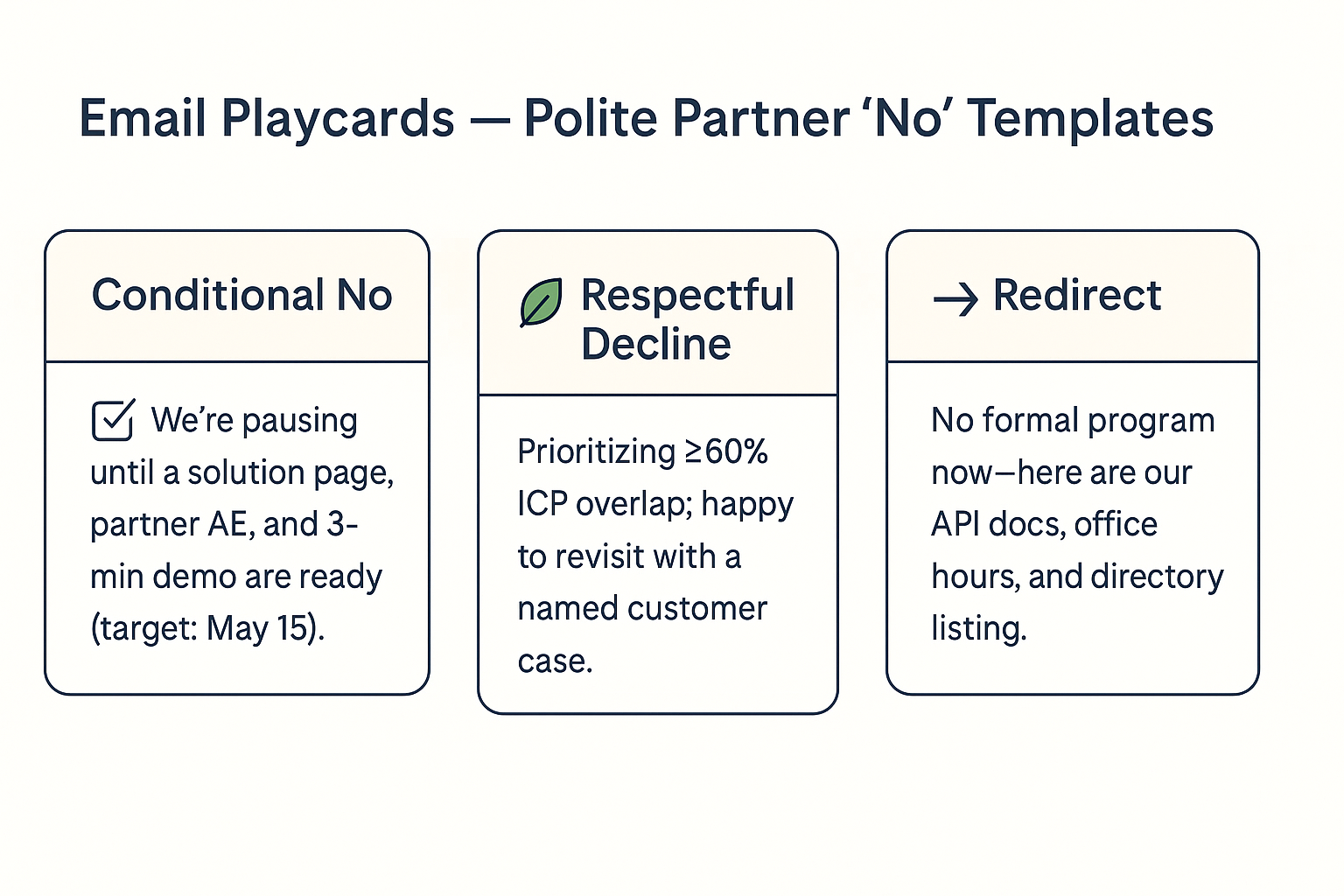
A) Conditional No (kind + specific)
Subject: Next step on a potential partnership
Hi [Name], thanks for walking us through your plan. We score partner fit on Fit/Advantage/Integrity/Readiness. You’re strong on Fit and Integrity; the gaps are Readiness items we need before we can move:
- A solution page that shows the workflow and CTA.
- A named partner AE and deal‑reg flow.
- A short demo or screens.
If you can share these by [date], we’ll gladly reconvene. Until then, we’re pausing to keep you from chasing a moving target.
— [You], Partner Ops
B) Respectful Decline (keep the door open)
Subject: Thank you—declining for now
Hi [Name], we appreciate the time. After internal review, we’re declining a formal partnership. We prioritize partners with ≥60% ICP overlap and a clear joint outcome we can prove this quarter; we couldn’t get there here. Two options that may still help:
• We can list you in our ecosystem directory (no commitments).
• If you publish a case with numbers, send it—we’re always open to revisit with proof.
Thanks again for reaching out, and best of luck with [their focus].
— [You]
C) Redirect to Community/DIY
Subject: Resources you can use today
Hi [Name], while a formal program isn’t the right fit now, here’s our integration guide + API docs + office hours if your team wants to build a lightweight connector. If it resonates with mutual customers, let’s revisit with data.
— [You]
“No” Without Bridge‑Burning: Five Rules
- Decide fast (≤10 business days from first call). Slow “maybes” are worse than a clear “no.”
- Be specific about the gap (assets, ICP, risk).
- Offer a next action (pilot, checklist, directory, data you’d need).
- Leave the compliment—praise the credible part of their story.
- Log it in PRM/CRM with a revisit date; future you will thank you.
Red Flags (Hard Stops vs. Soft Stops)
Hard stops
- Requires exclusive category access or price parity across your channels.
- Unlicensed IP, vague data handling, or a pattern of misleading claims.
- Brand conflict (claims contradict your product promises).
- No named owners or unwilling to share even a light metrics pack.
Soft stops
- Low ICP overlap (<40%), thin case studies, heavy services with no product anchor.
- “Webinar‑only” plans with no solution page or ROI story.
- MDF ask without a plan to measure qualified opportunity creation.
Turn soft stops into a Conditional No with a checklist; hard stops → Decline.
What to Offer Instead of “No” (Alternatives)
- Directory listing in your ecosystem page (self‑serve).
- Community talk slot or blog guest post with clear rules.
- API/Integration guide for DIY; spotlight if adopted by customers.
- Open data brief (anonymized) they can cite to strengthen their story.
These keep goodwill alive without over‑committing.
Metrics: Proving Your Nos Are Working
- Decision time (median) from first call to yes/no. Target: ≤10 business days.
- Revisit rate (declined → later qualified) and time to revisit.
- Bridge health: % of declined partners who still engage in community/resources.
- Pilot success rate: Provisional Yes → scaled partnership in 90 days.
- Opportunity cost saved: hours avoided vs historical meandering deals (estimate).
30‑Day Implementation Plan
Week 1 — Define: publish the F.A.I.R. rubric, red‑flag list, and email scripts in your partner wiki.
Week 2 — Wire: add PRM/CRM fields for fit score, decision type, and revisit date.
Week 3 — Train: run a 45‑minute role‑play on the vetting call + delivering a “no.”
Week 4 — Launch: start logging all inbound partner requests; publish a monthly Nos & Whys summary to execs.
Case Mini‑Examples
- Services firm, low ICP overlap: Scored 2.6 average; redirected to API + office hours; 4 months later, they returned with a working integration and a named customer—moved to Pilot.
- ISV, high risk: Great fit but insisted on 12‑month exclusivity in two core verticals. Declined with thanks; we maintained a friendly thread and featured their general research in a community session (no co‑branding).
- Startup with proof but light assets: Conditional No with a 3‑item checklist; they delivered in 10 days; we ran a 45‑day pilot that closed two co‑sell deals.
Conclusion
Saying no is a growth skill. With a simple rubric, a tight vetting ritual, and a respectful script, you’ll protect your roadmap, keep brand risks low, and still earn goodwill. Great partners will appreciate clarity; the rest will self‑select out. And when a “no” turns into a “not yet,” you’ll be ready with a faster yes.
Add comment