
Introduction
Trust is earned twice: first by what you do, then by what others say you did. Third‑party validation converts your internal wins into external credibility. Done well, certifications reduce risk for buyers, awards open doors, and analyst relationships anchor you in the category narrative. Done poorly, they become expensive badges with little impact.
This guide shows how to prioritize the right validations, execute efficiently, and package the outcomes so customers, partners, and press can use them.
The Validation Ladder
Move in order—each rung multiplies the one below:
- Operational proof: reliability, security, customer outcomes, case studies.
- Compliance proof: audits/attestations that systems meet a standard.
- Reputation proof: awards and independent rankings.
- Category proof: analyst coverage that explains where you fit and why.
If rung 1 is weak, rungs 2–4 wobble. Start with the basics: measurable outcomes and clean documentation.
Certifications: What Buyers Actually Ask For (and Why)
Map each certificate to a buyer risk question. If the question isn’t asked in your deals, reconsider the pursuit.
Security & Cloud (software/SaaS)
- SOC 2 Type I / Type II: Independent attestation of controls for security, availability, processing integrity, confidentiality, privacy. Type I = design at a point in time; Type II = design + operating effectiveness over a period.
- ISO/IEC 27001: Information security management system (ISMS) certification; often paired with 27017 (cloud) and 27018 (PII in the cloud).
- PCI DSS (if handling cards), HIPAA/HITECH (health data), CSA STAR (cloud security assurance).
- Privacy frameworks: not true “certs” in many regions, but demonstrate alignment (GDPR/CCPA readiness assessments, DPA library, data maps).
Product, Hardware, and Quality
- ISO 9001 (quality management), CE marking (EU safety/health/environmental requirements), UL/ETL (safety testing), FCC (US emissions), RoHS/REACH (substances), Energy Star (efficiency). Choose by market and device type.
Sustainability & Governance
- ISO 14001 (environmental management), ISO 50001 (energy), B Corp (verified social/environmental performance), and sector‑specific eco labels. Confirm relevance to your buyers before investing.
Effort, Cost, and Readiness (Reality Check)
- Gap assessment → remediation → audit. Budget time for policy writing, control automation, and evidence collection.
- Type I vs. Type II: many teams ship Type I in months; Type II typically requires an observation window.
- Audit hygiene: ticketing, change management, access reviews, vendor risk, incident runbooks—if these are manual, plan for tooling or process changes.
Packaging for Sales & Trust
- Build a Trust Center: public page with audit summaries, certificates/letters (redacted where necessary), security architecture diagram, DPAs, sub‑processor list, uptime history, and a NDA‑gated portal for detailed reports.
- Write buyer‑centric blurbs: “What it is, why it matters, what we cover, what we don’t.”
- Keep dates prominent: standard + scope + last audit + next due.
Awards: From Vanity to Value
Awards work when they validate a result others care about—customer impact, innovation with evidence, or workplace outcomes.
Choosing Where to Play
- Strategic fit: Does the award influence your buyers or talent pool?
- Judging model: Peer‑reviewed panels and transparent criteria > pay‑to‑play lists.
- Category timing: Align submissions with product or data releases so you can bring fresh proof.
Winning Entries (Reusable Structure)
- The problem + stakes (why now)
- What you did (method/process)
- The proof (numbers with windows + named customer)
- The change (before → after)
- What’s next (roadmap, learning)
Evidence pack: 1‑pager factsheet, 2 charts (SVG), short customer quote with full name/title (or clear reason for anonymity), links to public docs.
After You Win (or Finalist)
- Coordinate an embargoed press note with the organizer’s timeline.
- Update bios, decks, website trust badges (footer minimal, trust page detailed).
- Create a sales enablement card: when to mention, one‑liner, and a QR to the proof.
- Measure: referral traffic from the award site, recruiting applies, win stories citing the award.
Analyst Relations (AR): Earning Category Credibility
Analysts help buyers navigate risk and complexity—they synthesize markets, not press releases.
Who’s Who (patterns, not endorsements)
- Top‑tier research firms: e.g., firms known for Waves/Quadrants/MarketScapes. Expect structured briefings, long research cycles, and strict quote policies.
- Review platforms: e.g., G2/Capterra/TrustRadius—user‑driven validation that influences shortlists.
- Niche/independent analysts & newsletters: high signal for specific domains; faster cycles and deeper conversations.
AR Operating System
- Calendar: track report cycles and submission deadlines; align your roadmap and customer references.
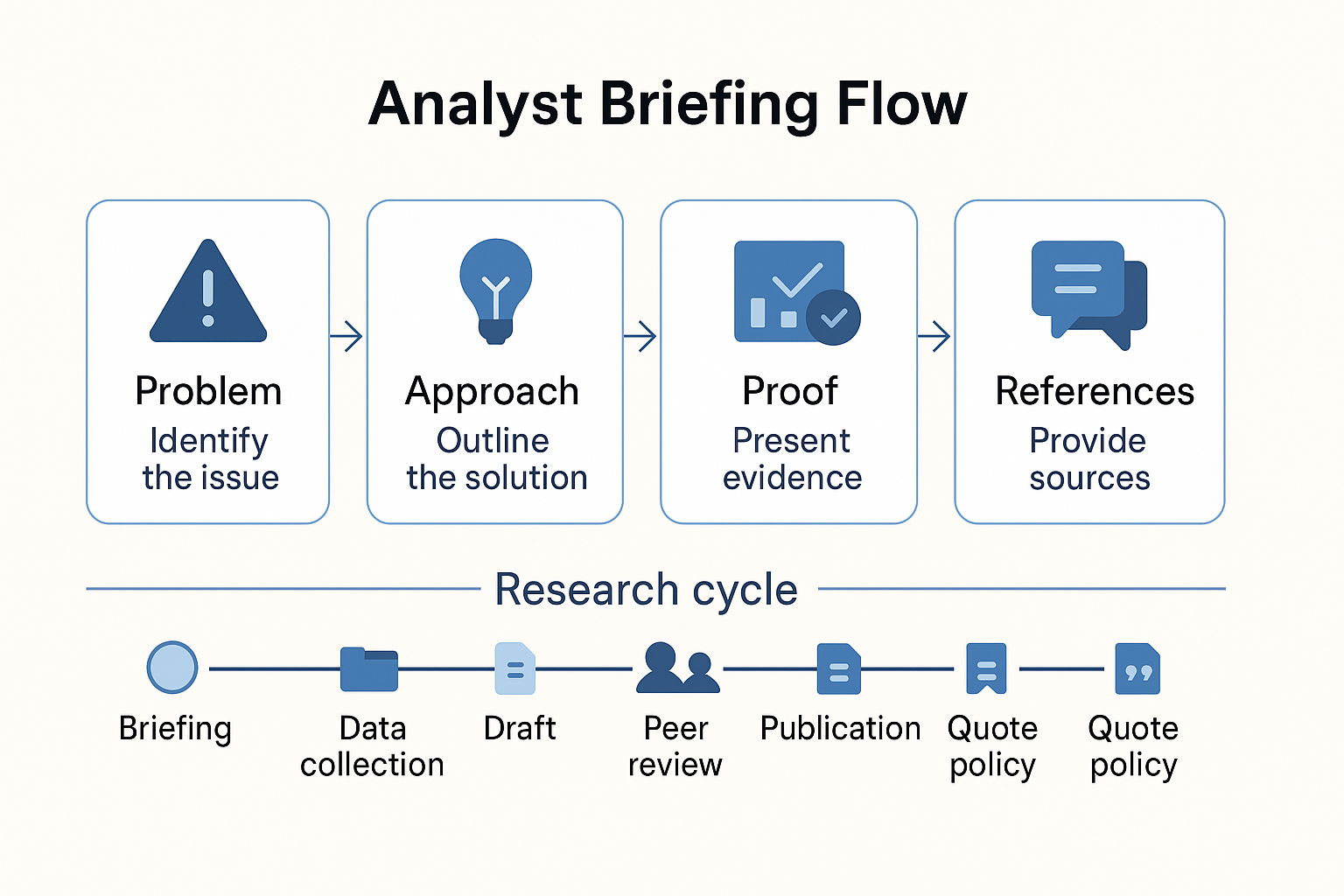
- Briefing deck: problem → approach → proof → roadmap → customer references → demo (5–7 slides, minimal adjectives, one chart).
- References: cultivate 3–5 customers who will speak to analysts under NDA.
- Integrity: never pressure for ratings; ask for criteria and feedback you can action. Get permission before quoting.
Leveraging Reviews (Ethically)
- Invite verified customers to post detailed reviews (no gating, disclose incentives if permitted).
- Highlight specific outcomes (“cut intake time 22%”) and use cases rather than star counts alone.
- Respond to critiques with fixes and dates; analysts read replies.
90‑Day Implementation Plan
Week 1–2: Prioritize & Plan
- Map buyer questions → validation targets. Pick 1–2 certifications (by ARR and region), 2 awards, and 2 analyst briefings.
- Create a single proof backlog: controls to implement, data cuts to produce, references to secure.
Week 3–6: Build & Collect Proof
- Run a mini gap assessment; assign owners and due dates.
- Draft award entries using the reusable structure; get customer quotes.
- Prepare briefing deck; rehearse 20‑sec soundbites and a limitations line for each stat.
Week 7–10: Execute
- Begin audit evidence collection (tickets, access reviews, policies).
- Submit awards; schedule analyst briefings aligned to research calendars.
- Publish/refresh the Trust Center; add a newsroom note explaining your scope.
Week 11–12: Measure & Iterate
- Dashboard: deal velocity with required certs, referral/read‑depth on trust pages, analyst feedback themes, review volume & specificity.
- Decide next rung: deeper audit scope, second award in another region, or a customer‑panel webinar with an analyst as moderator.
Metrics That Matter (Reputation + Revenue)
- Security/compliance: audit status on time, % of deals unblocked by cert, risk exceptions trend.
- Awards: acceptance rate, referral traffic from award site, mentions in sales calls, recruiting applies traced to the badge page.
- Analyst relations: inclusion in reports/landscapes, quote approvals, inbound RFPs citing analyst coverage, review depth (word count + use‑case tags).
Governance & Ethics
- No “implied certification.” Don’t claim compliance you don’t hold; state scope and dates.
- Separate church and state: clearly label sponsorships vs. editorial analyst research.
- Customer dignity: get written consent for names, logos, and quotes; respect confidentiality.
- Accessibility: alt text on badges and charts; transcripts for analyst webinars.
Templates (Copy‑Ready)
Trust Center blurbs
- SOC 2 Type II: “Independent audit of our controls for security, availability, and confidentiality over a [period]. Scope: [systems]. Last audit: [month/year].”
- ISO 27001: “Certified ISMS covering [locations/systems]. Certificate #: [id], valid through [date].”
- ISO 9001: “Quality management system certified for [manufacturing/service scope]. Last surveillance audit: [date].”
Award entry opening (100 words)
“In [year], [company] tackled [problem] for [audience]. We shipped [solution] and measured outcomes across [period]. The result: [metric 1], [metric 2], and [named customer quote]. Our approach—[distinctive method]—is repeatable and documented; we include a method note and limitations below.”
Analyst briefing email (short)
“Hi [Analyst], we have new data on [topic] across [N] customers ([time‑window]). Three findings: [#1], [#2], [#3]. Happy to brief for 30 minutes and share two references under NDA. If useful, we can follow with a short demo and a method note.”
Conclusion
External validation isn’t decoration—it’s risk removal and meaningful signal when tied to buyer questions and real outcomes. Choose the few validations that matter, execute with evidence, and package them in a Trust Center, a tight press note, and a repeatable AR cadence. When done right, third‑party proof shortens sales, strengthens recruiting, and clarifies your place in the market.
Add comment