
Introduction
Media interviews aren’t exams you “pass.” They’re collaborations: the reporter needs a clear, verifiable story; you need your core messages to survive the edit. Message discipline and ethical bridging help you answer the question and advance what matters to your audience—without spin. This guide gives founders a concrete system you can rehearse this week: a message map, a bridging loop, language you can actually say out loud, and drills that build camera‑safe reflexes.
Start with the 3×3 Message Map
Distill your story into a headline and three pillars—each with one proof.
- Headline (15 words): What you do for whom, and why it matters now.
- Pillar A: Product value → Proof: specific number, named customer, or demo result.
- Pillar B: Market/mission context → Proof: external source, regulation, or trend data.
- Pillar C: Credibility/traction → Proof: adoption, revenue range, security/compliance, team.
Print it. Keep it visible during prep and taped near the lens for remote interviews.
The BRIDGE Loop (Answer → Bridge → Proof → Land)
Most “media training” encourages dodges. Don’t. Use BRIDGE to satisfy the question and steer to value.
B — Brief answer: 3–8 seconds. If it’s a yes/no, start with yes/no.
R — Reframe: Connect to a pillar.
I — Introduce proof: One stat, named example, or independent source.
D — Detail the takeaway: What it means for the audience.
G — Give next step: What happens next / where to see it.
E — End clean: Stop talking.
Example (pricing pressure)
Q: “Are you raising prices?”
A: “No—core plans stay the same this year. What customers asked for was predictable costs as usage grew. So we introduced caps; in pilots, mid‑market teams cut 18% from variance. That predictability is the real story here.”
Flagging, Bridging, Blocking—Ethically
- Flagging (telegraph importance): “The key point is…”, “What matters for your viewers…” Use sparingly—once per answer.
- Bridging (move to a pillar): “What that means is…”, “The bigger picture…”, “Here’s how we handle that…”
- Blocking (decline and redirect) is for legal/rumor/speculation. Acknowledge, give reason, pivot to what you can say.
Example (rumor)
“I can’t comment on market rumors, and here’s why: we disclose material changes publicly. What I can share is today’s release and how it affects small retailers…”
Never say “no comment.” It reads as guilt. Say what you can’t discuss and why, then bridge.
The 20‑Second Soundbite Formula
Producers cut for time. Build answers that survive the crop:
HOOK (3s) → CLAIM (4s) → PROOF (6–8s) → PAYOFF (3–5s).
Example
“Returns fraud jumped. Audit at purchase, not month‑end, caught 94% of duplicates in pilots. That’s why reimbursements now clear in 36 hours.”
Record on your phone: if it runs 20–25 seconds and a layperson understands it, you’re close.
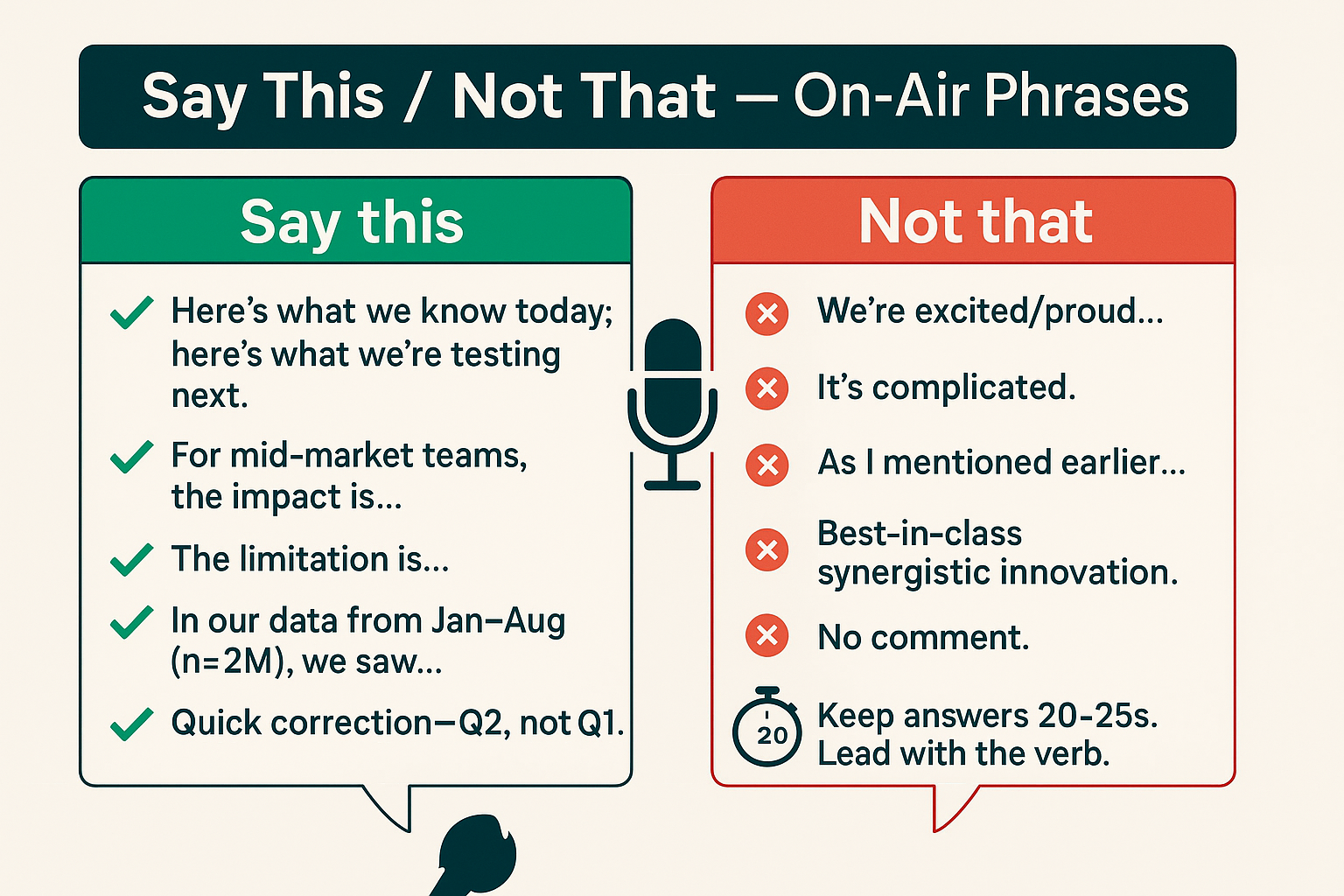
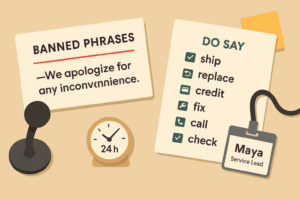
Language Bank (Say This, Not That)
Say
- “Here’s what we know today; here’s what we’re testing next.”
- “For mid‑market teams, the impact is…”
- “The limitation is…”
- “In our data from Jan–Aug (n=2M), we saw…”
Avoid
- “We’re excited/proud” (empty).
- “It’s complicated” (explain or say what’s uncertain).
- “As I mentioned earlier” (restate crisply).
- Jargon soup (pick verbs: ship, reduce, automate, secure, verify).
Handling Tough Question Types
1) The false choice
“Is it growth or profitability?” → “Both, but sequence matters. We target breakeven on core while funding R&D from partnerships—here’s the timeline.”
2) The speculative trap
“Will regulators shut this down?” → “We work within the proposed rules; the draft focuses on XYZ. Our third‑party audit met those thresholds in Q3.”
3) The old news re‑litigation
Acknowledge → action → outcome → today. “We missed a SLA in March. We added 24/7 paging and error budgets; uptime is 99.96% since June. Today’s launch builds on that reliability.”
4) The hostile premise
Disarm, then reframe with evidence. “I hear the concern. The premise assumes every model hallucinates equally; our use‑case is retrieval‑only and human‑in‑the‑loop. That’s why errors fell below 1 in 1,000 docs last quarter.”
5) The personal poke
Keep composure, return to audience. “Founders are always learning. What customers asked for is…”
Prep in 60 Minutes (Before Any Interview)
T‑60 to T‑45: Clarify peg, audience, hostile topics list. Update 3×3 map.
T‑45 to T‑30: Draft three 20‑second bites (one per pillar). Write two bridges per tough topic.
T‑30 to T‑20: Camera/mic check, background, do not disturb. Print factsheet and numbers doc (with dates).
T‑20 to T‑10: Rehearse two hostile questions with a comms partner; record and self‑critique.
T‑10 to T‑0: Breathing, posture, first answer ready.
Remote setup: eye‑level camera, wired mic if possible, soft light 45° to face, notes at lens height, Ethernet over Wi‑Fi.
On‑Air Habits that Build Trust
- Lead with the verb. “We shipped caps,” not “We’re excited to announce…”
- Numbers with context. “12M receipts Jan–Aug, mid‑market only; SMB varies.”
- Name the limit. Credibility up, risk down.
- Stop at the period. Silence is a tool; don’t fill it with waffle.
- Correct gently. “Quick correction—Q2, not Q1.”
- Human first. If people are affected, open with empathy, not policy.
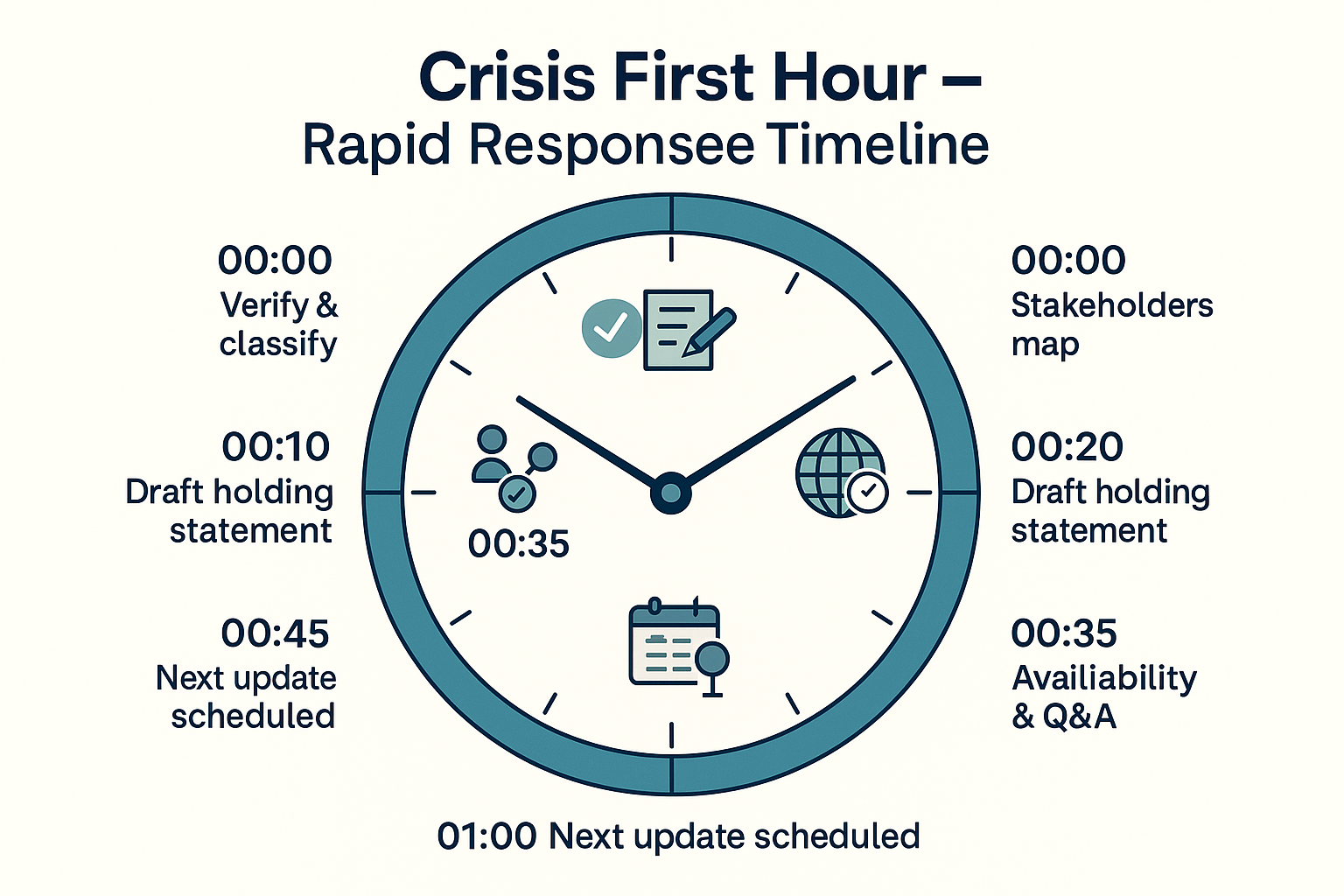
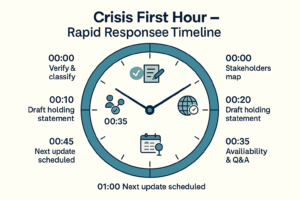
Crisis‑Mode Tweaks (Same Tools, Tighter Rules)
- One spokesperson; one source of truth page with timestamps.
- Answers in 10–15 seconds; more frequent bridges to facts + actions + timeline.
- No hypotheticals; avoid blaming.
- Close every answer with what happens next and where updates live.
Drills That Make It Stick
Red Team 10×10: Ten rapid‑fire questions, ten seconds each. Score: answered + bridged?
The Mirror: Record three answers/day for a week. Review for: first verb, proof clarity, stop‑at‑period.
Hot‑Mic Drill: Keep discipline during small talk. Nothing off‑hand you wouldn’t want aired.
Numbers Only: Explain a chart with one message and one limitation line.
Flag Once: Practice flagging once per answer—never twice.
Founder Q&A: Sample Bridges
Q: “Are you laying off staff after this automation?”
A: “No layoffs. The gain is fewer weekend pages. Our SREs spent 22% fewer off‑hours on incidents last quarter, and we re‑assigned that time to reliability work. That’s why uptime moved.”
Q: “Why trust you over incumbents?”
A: “Two reasons: data and delivery. Our 2M‑item dataset spotted cold‑start issues incumbents miss; and we ship weekly with transparent changelogs customers can see.”
Q: “What keeps you up at night?”
A: “Customer trust. Security audits every quarter and SOC 2 are table stakes; what’s next is confidential computing in our 2026 roadmap.”
Measurement: Did We Actually Land the Message?
- Quote rate: Did one of the three pillars appear verbatim in coverage?
- Accuracy: Any corrections requested by you? By editors?
- Cut‑through: % of pieces that used your stat or chart.
- Reach to ICP: How many target accounts read/engaged within 7 days?
- Rep performance: Self‑review rubric (1–5) on answer brevity, bridge clarity, proof specificity, and stop‑at‑period.
Debrief within 24 hours; update the map and language bank.
Conclusion
Message discipline isn’t about robotic lines—it’s about useful clarity under pressure. With a 3×3 map, the BRIDGE loop, and a few honest phrases, founders can satisfy tough questions and still deliver the line that helps readers make sense of the moment. Practice short, prove with specifics, and land where your audience needs you.
Add comment