
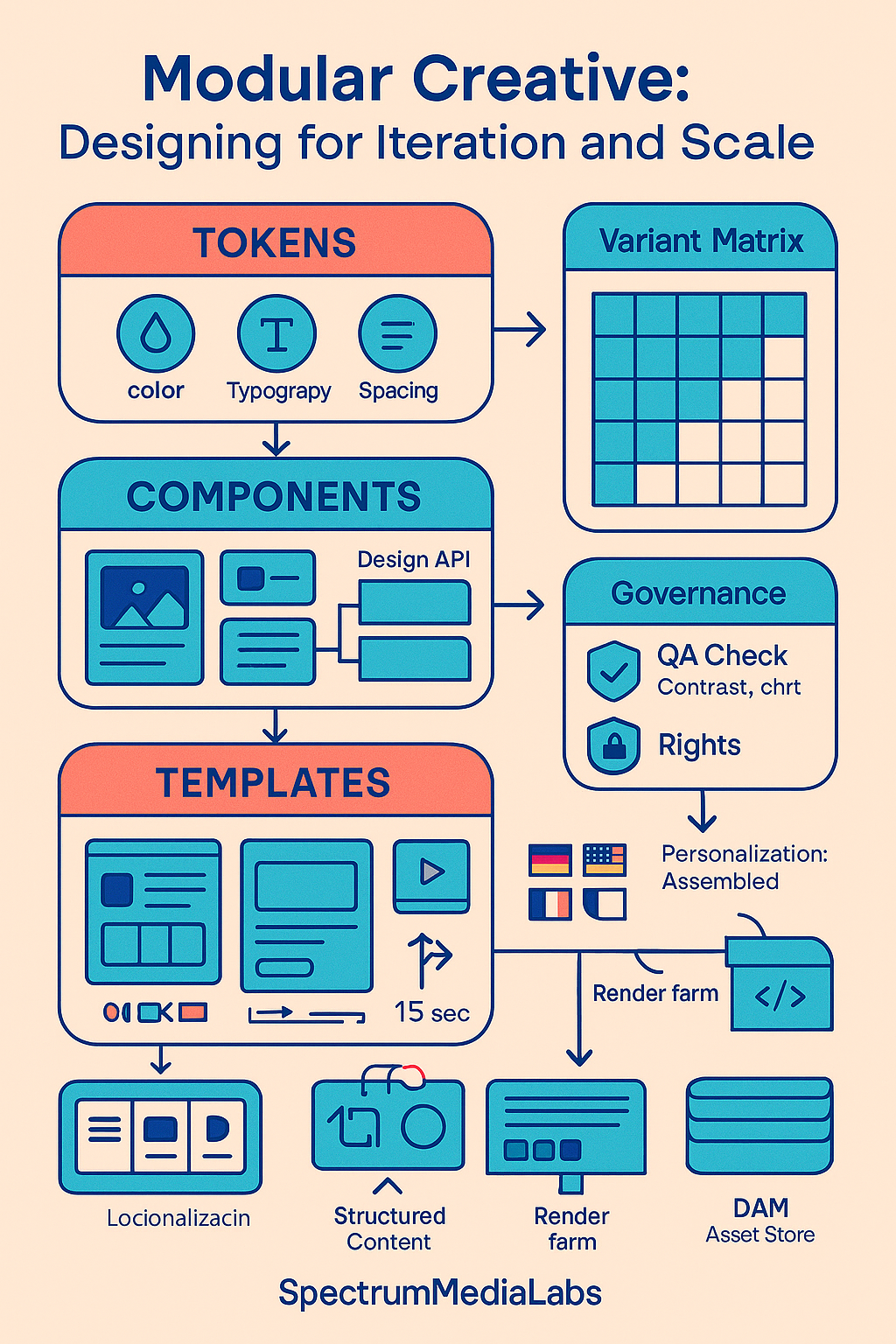
Most teams try to scale by hiring more people or buying more tools. The sustainable path is different: design the work so it scales. Modular creative turns fuzzy briefs into re-combinable parts—small, well-defined units that can be assembled into dozens of on-brand executions without reinventing the wheel each time. For SpectrumMediaLabs, a modular system shrinks cycle time, unlocks rapid iteration, and makes localization and personalization practical.
This playbook lays out the architecture, specs, governance, and metrics you need to make modular creative real—not just a slide in a deck.
What “modular” actually means (and doesn’t)
Modular creative is an ecosystem of tokens → components → templates → experiences governed by explicit contracts. It is not “a folder of templates.” It’s a design and content system with rules for assembly, quality, and measurement.
- Tokens: brand primitives (color, type, spacing, motion durations, voice tone scales).
- Components: reusable UI/creative building blocks that accept parameters (e.g., Proof Tile, Feature Card, Offer Banner).
- Templates: channel-specific compositions of components with locked layout logic.
- Experiences: assembled executions (a LinkedIn carousel, a landing page hero, a 15s cutdown) generated from template + data.
If a part cannot be described by a contract—inputs, constraints, outputs—it’s not modular yet.
Why modular wins
- Speed: Swap content, not layouts. First drafts in hours, not days.
- Consistency: Fewer off-brand “creative snowflakes.”
- Iteration: Test messages and proofs independently from layout.
- Localization: Translate fields, not files; reuse images with regional guardrails.
- Personalization: Assemble variants at the edge from approved parts.
The reference architecture
1) Tokens (visual + verbal)
Create a single source of truth in your design system and CMS.
- Visual tokens:
color.primary.600,radius.2xl,space.4,motion.fast=150ms,grid.column=12. - Typographic tokens:
font.headline=Inter Bold,lineHeight.tight=1.1,tracking.tight=-1%. - Voice tokens: scale of tone (e.g.,
authoritative,friendly,playful), reading level ranges, forbidden words list. - Legal tokens: required disclaimers by claim type, region, and channel.
Rule: Tokens cannot reference a specific execution. They must be usable anywhere.
2) Components (with contracts)
Each component exposes props, constraints, and rendering rules. Think “design APIs.”
Example: Proof Tile
- Props:
headline (≤48 chars),subline (≤90 chars),logo_id,stat_value,stat_label,cta_text,cta_url. - Constraints:
logo_idmust be from rights-cleared list;stat_valuemust link to a citation; cta is optional on organic social. - Variants:
compact,standard,no-image. - Motion:
enter=fadeUp 180ms,hover=scale 1.03.
Contract: If inputs meet constraints, the component must render on-brand without manual design.
3) Templates (layout logic)
Templates are compositions of components with locked hierarchy and spacing.
LP Hero v3
- Slots:
badge,headline,subhead,primary_cta,secondary_cta,proof_row[3],hero_image. - Breakpoints:
sm,md,lg. - Forbidden combos:
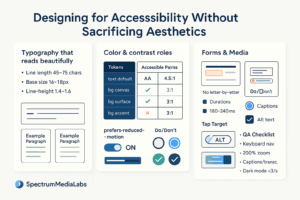
badge + secondary_ctaon mobile. - Accessibility: contrast ≥ 4.5:1; H1 ≤ 7 words.
- Analytics: auto-inject
data-slotattributes for heatmaps.
Social Carousel v2
- 6 cards:
opener,proof,feature,case,objection,closer. - Card-level caps: headlines ≤ 6 words; body ≤ 20.
- Export: static PNG + motion Lottie variant.
4) Experiences (assembled)
An experience is a template + dataset + locale snapshot with an ID you can track across channels.
Content modeling: write once, use everywhere
Move from copy docs to structured content. In your CMS (or a spreadsheet to start), define content types that map to components.
Content type: Reason-to-Believe (RTB)
{
  "id": "rtb_023",
  "title": "Proven ROI in 30 days",
  "stat_value": "27%",
  "stat_label": "lift in qualified demos",
  "citation_url": "https://…",
  "logo_id": "acme_logo",
  "regions_allowed": ["US","EU"],
  "localizations": {
    "de-DE": {"title": "Nachweisbare ROI in 30 Tagen", "stat_label": "Steigerung der qualifizierten Demos"}
  },
  "last_verified": "2025-08-10"
}
Components pull from these objects; localization becomes field-level, not file-level.
Variation without chaos: the variant matrix
The enemy of modularity is combinatorial explosion. Solve with a variant matrix and gates.
- Axes: Audience (New/Returning/Buyer), Funnel (Awareness/Consideration/Conversion), Topic (Performance/Trust/Ease), Channel (LP/Carousel/15s).
- Base set: 1 concept spine × 3 topics × 2 audiences × 2 channels = 12 variants.
- Gates: Only promote to Tier B after a performance threshold (e.g., CTR +15% vs control). Don’t auto-spawn Tier C.
Naming convention: SML-2025Q4-CONCEPT7-AWR-TRUST-RET-LP-HERO-v3
This maps to analytics and asset management.
Tooling: where the system lives
- Design: Figma components + libraries; use variants and Auto Layout; lock templates with protected layers.
- Motion: After Effects + MOGRTs (data-driven fields); Lottie for lightweight playback.
- Web: Component library (React/Vue) with tokens wired to CSS variables; design tokens exported via Style Dictionary.
- Content: Headless CMS (or Airtable to start) hosting structured content and rights metadata.
- Renderers: Scriptable exporters for social sizes, video lower-thirds, and HTML snippets (“render farm”).
- DAM: Stores outputs with metadata:
concept_id,template_id,component_set,locale,rights,expiry.
Governance: versioning, QA, and rights
- Semantic versioning: tokens
1.3.0, components2.1.4, templates3.0.0. Only minor versions auto-roll; major requires migration plan. - Deprecation policy: announce EOL date; provide replacement mapping.
- QA checkers (programmatic): character counts, color contrast, safe-area, logo clear-space, legal line presence.
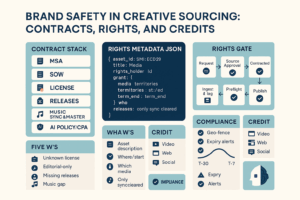
- Rights management: tie every image/logo to consent/license; block rendering outside allowed regions/channels.
- Approvals: approve content objects and templates, not every exported asset.
Process: from idea to scaled outputs
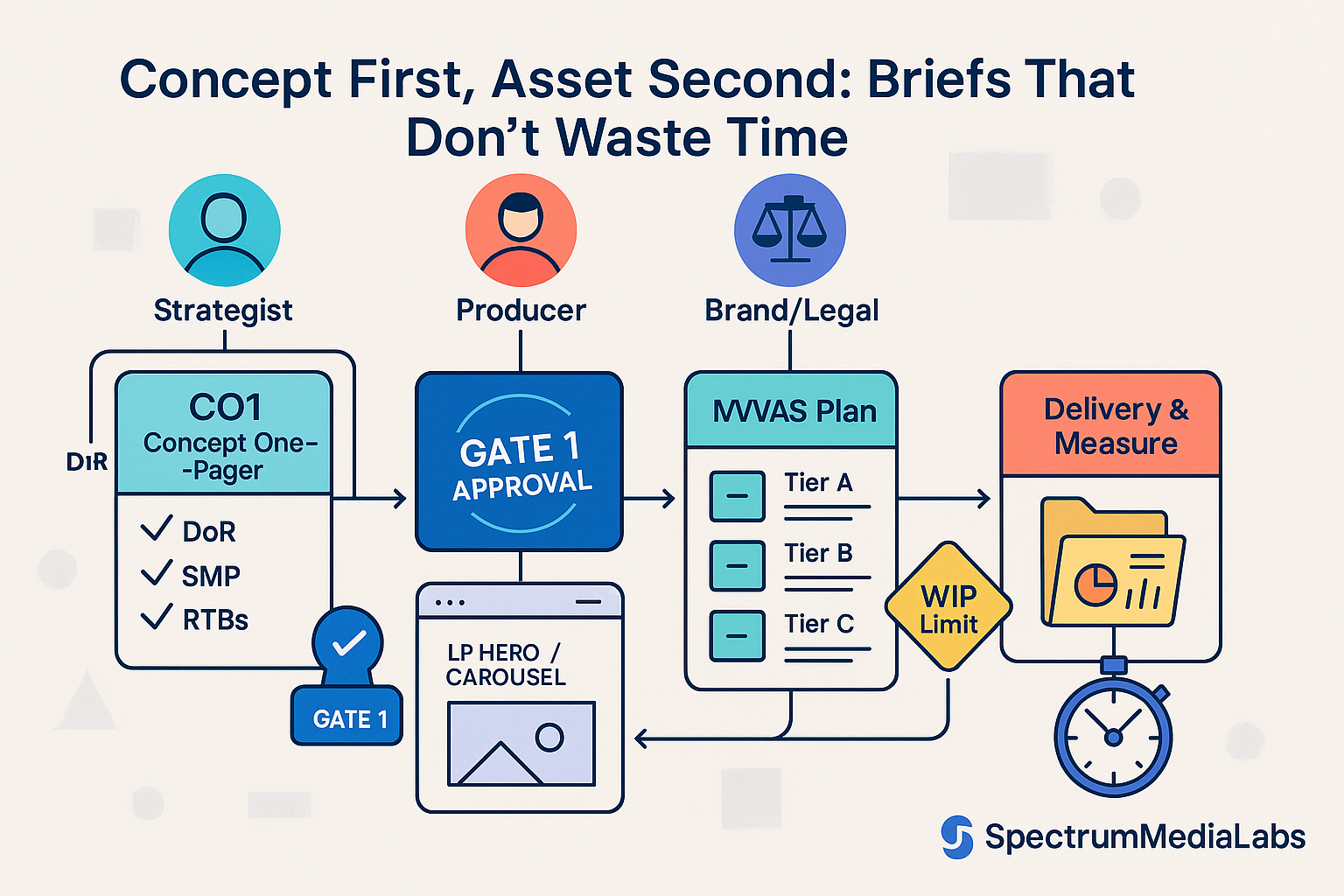
- Concept approved (see “Concept First” article).
- Component selection: choose minimum set to tell the story.
- Data assembly: fill content objects (headline, RTBs, objections, offers).
- Template binding: map objects to slots; render preview.
- Automated QA: pass/fail with a reasons list.
- Human sweep: Lead signs off (10–15 minutes).
- Batch render: generate variants across prioritized channels/locales.
- Publish & tag: UTM includes
concept_idandtemplate_id. - Measure & learn: update the playbook; promote winners to base set.
Metrics that matter
- Reuse rate: % of shipped assets built from components/templates (target ≥85%).
- Time-to-variant: concept-approved → first 10 variants (target ≤2 days).
- QA pass rate (auto): initial render pass without manual fixes (≥90%).
- Localization velocity: time to add a new locale for an existing concept (≤1 day).
- Library health: coverage (components used in last 60 days), orphaned items, version drift.
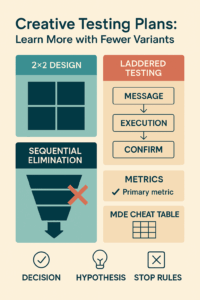
- Impact distribution: share of lift attributable to message vs. layout vs. offer (using factorial tests).
- Cost per usable asset: should decline as reuse climbs—track by channel.
AI’s role (with guardrails)
- Copy generation: Fill structured fields (headline, objections, proof intros) with tone constraints from voice tokens.
- Image/video variants: Swap backgrounds, crops, or lower-third text via MOGRT/Lottie while locking brand layers.
- QA helpers: enforce character caps, detect brand term misuse, flag geographic references for localization.
- RAG for claims: pull citations from a vetted knowledge base; auto-link RTBs.
- Recommendation engine: propose component mixes based on past performance for the same audience/funnel.
Non-negotiable: AI never bypasses rights checks or legal tokens.
Templates you can ship today
1) Proof-led LinkedIn Carousel (6 cards)
- Card 1: Problem framing (SMP).
- Card 2: RTB #1 (stat + logo).
- Card 3: Feature that enables the proof.
- Card 4: Case artifact (“receipt”).
- Card 5: Objection handling (one line).
- Card 6: CTA + social proof footer.
Inputs: 1 headline (≤6 words), 1 stat, 1 artifact image, 1 objection, 1 CTA.
2) Landing Hero + Exhibits
- Hero: Badge, H1, subhead, CTA primary/secondary.
- Exhibits: Three Proof Tiles (logos auto-balanced).
- Footer slug: compliance/claims line auto-injected.
3) 15-second Cutdown (caption-led)
- Beats: Hook (0–3s), Proof (3–8s), Feature (8–12s), CTA (12–15s).
- Captions: auto from component copy; color/position from tokens.
Example contracts (copy-paste)
Design token (YAML)
color:
  primary:
    600: "#2C46FF"
  accent:
    500: "#FF7A59"
space:
  4: 16
  6: 24
radius:
  2xl: 20
motion:
  fast: 150ms
  base: 240ms
Component schema (JSON)
{
  "component": "ProofTile",
  "version": "2.1.0",
  "props": {
    "headline": {"type":"string","maxChars":48,"required":true},
    "subline": {"type":"string","maxChars":90,"required":false},
    "logo_id": {"type":"assetRef","rights":"cleared","required":true},
    "stat_value": {"type":"string","pattern":"^\\d+%$","required":true},
    "stat_label": {"type":"string","maxChars":30,"required":true},
    "cta_text": {"type":"string","maxChars":20,"required":false},
    "cta_url": {"type":"url","required":false}
  },
  "constraints": {
    "regions_forbidden": [],
    "channels_forbidden": ["print"]
  }
}
Template binding (CSV)
experience_id,template_id,locale,slot,content_ref
SML-Q4-EX-101,LP-HERO-v3,en-US,headline,copy_201
SML-Q4-EX-101,LP-HERO-v3,en-US,subhead,copy_202
SML-Q4-EX-101,LP-HERO-v3,en-US,proof_row_1,rtb_023
SML-Q4-EX-101,LP-HERO-v3,en-US,proof_row_2,rtb_019
SML-Q4-EX-101,LP-HERO-v3,en-US,proof_row_3,rtb_031
Operating model (who owns what)
- System Owner (A): Creative Operations Lead—governance, roadmap, metrics.
- Design System Lead (R): tokens, components in Figma/motion; accessibility.
- Template Owner(s) (R): per channel; maintain versioning and QA rules.
- Content Ops (R): structured content in CMS, rights, localization workflows.
- Automation Engineer (R): renderers, bindings, and DAM integration.
- Brand/Legal (C/A on claims): approve templates and content objects, not each asset.
- Analytics (C): test design, dashboards, promotion/demotion of variants.
30/60/90 rollout
Days 1–30: Foundations
- Inventory top 20 assets and extract 3–5 universal components (Proof Tile, Feature Card, Offer Banner).
- Define tokens and export them to design + code.
- Build two locked templates (LP Hero v3, Carousel v2).
- Stand up a lightweight CMS (or Airtable) with content types and rights fields.
Days 31–60: Automation & QA
- Wire a batch renderer (Figma API, AE MOGRT, or code) to produce 10–20 variants.
- Implement automated QA (char caps, contrast, legal lines).
- Tag experiences with
concept_id/template_id; ship a small live test in two locales.
Days 61–90: Scale & Governance
- Add a 15s cutdown template; enable localization flow.
- Launch dashboards for reuse rate, time-to-variant, and QA pass rate.
- Formalize versioning and deprecation; publish a “promotion” policy for winners.
- Document a playbook of three proven spines (Proof-led, Myth-bust, ROI-receipt).
Pitfalls (and how to dodge them)
- Template theater: pretty files no one uses. Fix: lock layers, enforce contracts, tie to CMS.
- Variant explosion: every stakeholder wants “just one more size.” Fix: gate by performance and define Tier caps.
- Rights drift: great case logos with expired consent. Fix: auto-expire content objects; block rendering.
- Version soup: multiple template versions in the wild. Fix: semantic versioning + EOL policies.
- Manual overrides: designers detach instances “just this once.” Fix: require change orders; raise the component quality so detaching isn’t tempting.
What “good” looks like in 3 months
- ≥85% of shipped assets produced from templates/components
- ≤2 days to generate first 10 localized/social variants after concept approval
- ≥90% automated QA pass on first render
- A living library with usage heatmaps and a quarterly cull of low-value parts
- Measurable lift from message and proof iteration—not pixel tinkering
Modular creative is not about making everything look the same. It’s about building with parts that love to recombine—so SpectrumMediaLabs can test faster, localize without tears, and scale ideas across channels without losing the plot. Ship the tokens, lock the templates, structure the content, and let the system do the heavy lifting.

Add comment