
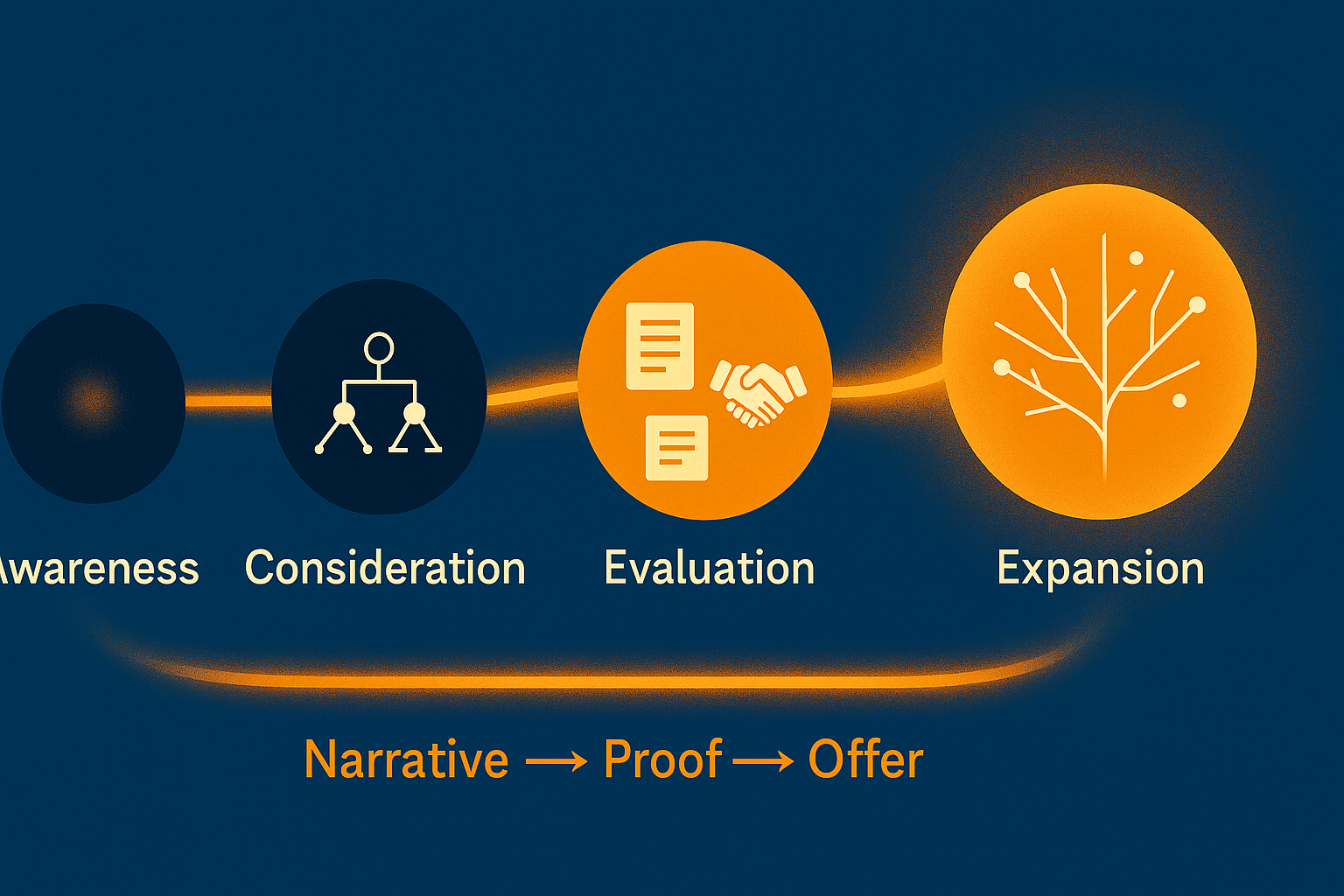
Most B2B nurture programs fail for one simple reason: they treat every lead like a buyer and every email like a pitch. Real buyers move through stages—from problem awareness to solution framing to vendor selection and, eventually, expansion. To sell through nurture, you must align three levers to each stage: a narrative that reframes the problem, proof that de-risks the decision, and offers that advance momentum without forcing a premature close.
This is not a “send more emails” play. It’s a communication system that compounds learning and intent.
The Four Buying Stages (and What They Need)
- Awareness → “Do I care?”
The prospect recognizes symptoms but hasn’t named the problem.- Narrative: Name the stakes; crystallize the cost of inaction.
- Proof: Independent data points, market trends, expert POV.
- Offer: Lightweight content (checklists, calculators, field notes). Zero friction.
- Consideration → “What’s my approach?”
The buyer is collecting mental models and potential paths.- Narrative: Teach the category and trade-offs; position your “why now.”
- Proof: Frameworks, decision guides, teardown webinars.
- Offer: Toolkits, templates, benchmark reports, live Q&A.
- Evaluation → “Can you do this for me?”
The project is real. Stakes and risk are explicit.- Narrative: Map your product to their use cases and constraints.
- Proof: Case studies with numbers, ROI models, pilot results, references.
- Offer: Assessment, pilot design, proof-of-concept with defined success criteria.
- Expansion → “How do we get more?”
Post-win, you earn permission to widen scope.- Narrative: From point solution to platform; from project to program.
- Proof: Before/after deltas, adoption dashboards, success plans.
- Offer: Bundles, success workshops, roadmap previews, co-marketing.
Architecting the Nurture: Narrative → Proof → Offer (N→P→O)
Use a simple three-beat pattern for each touch:
- Narrative (why this matters now): One big idea, one tension, one consequence.
- Proof (why it’s credible): A number, a quote, a screen, or a story.
- Offer (what to do next): A low-friction step that advances stage fit.
Repeat per stage. Your cadence becomes a sequence of tiny truths, not a stream of slogans.
Content System by Stage
1) Awareness Library (problem shaping)
- Assets: Problem primers, cost-of-inaction calculators, 90-sec explainer videos, executive briefs.
- Signals to watch: First-party engagement (time on page, calculator completions), topic affinity.
- Exit criteria: The lead engages with two or more problem assets or submits a self-diagnosis.
2) Consideration Library (approach selection)
- Assets: Comparison matrices (approach A vs B), solution architecture diagrams, “how to buy” guides, live teardown webinars.
- Signals: Repeat visits to the same theme, framework downloads, webinar questions.
- Exit criteria: Request for examples, ICP fit confirmed, buying committee identified.
3) Evaluation Library (risk removal)
- Assets: Use-case case studies, ROI one-pagers, security/compliance kits, pilot playbooks, mutual success plans.
- Signals: Pricing page dwell, security doc requests, multi-contact engagement within one domain.
- Exit criteria: Pilot acceptance or commercial discussion scheduled.
4) Expansion Library (value amplification)
- Assets: Quarterly business reviews, adoption dashboards, new-module intros, co-marketing briefs.
- Signals: License utilization, NPS, usage across teams, cross-department referrals.
- Exit criteria: Multi-threaded usage or signed expansion plan.
Offers That Advance (Without Premature Selling)
- Awareness: “5-minute self-assessment,” “ROI range calculator,” “field note digest.”
- Consideration: “Architecture workshop,” “benchmark report personalized by your inputs,” “recorded teardown + worksheet.”
- Evaluation: “Risk register + mitigation plan,” “pilot design canvas,” “reference call with matching industry.”
- Expansion: “Roadmap preview,” “adoption sprint,” “executive outcomes review.”
Think micro-commitments: each offer trades value for information that improves fit and forecast.
Proof That Persuades (and Passes Finance)
Not all proof is equal. Prioritize artifacts that survive scrutiny:
- Before/after metrics tied to CFO-language (time saved → cost avoided; cycle time → cash flow).
- Counterfactuals (“What happened when we paused this lever?”).
- Comparable logos + contexts (same industry, scale, stack).
- Transparent assumptions in ROI models (editable cells, sensitivity tabs).
If a proof asset can’t withstand a screen-share with Finance, it’s not proof—it’s promotion.
Cadence, Channels, and Routing
- Cadence: Think weeks, not days for B2B. Two high-quality touches per stage beat daily drips.
- Channels: Email + LinkedIn + retargeting + website personalization. Keep the message consistent; vary format.
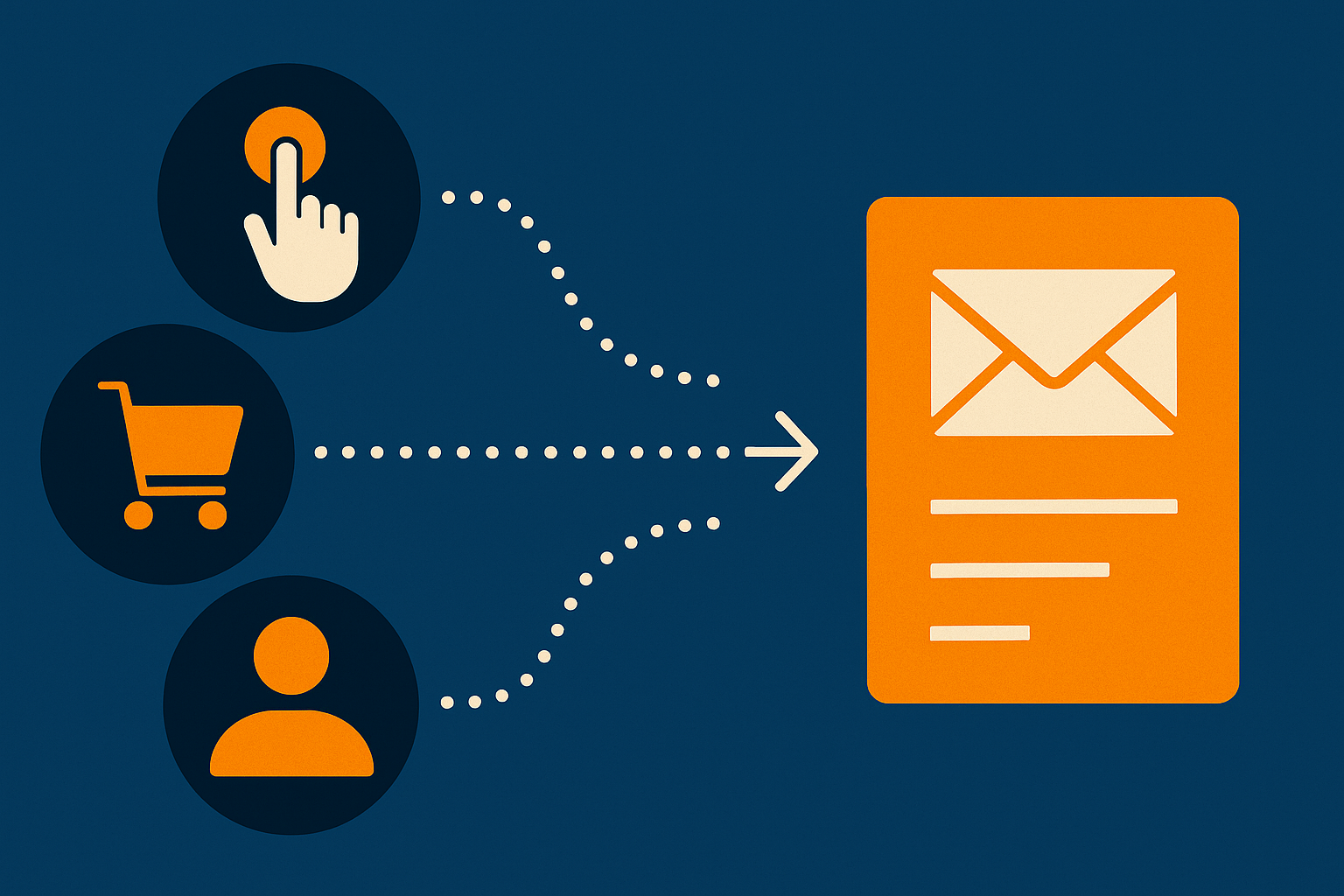
- Routing: When stage signals spike (pricing visit + security kit download), trigger sales assist, not a hard MQL throw. Provide the rep with a stage brief: last narrative engaged, proofs viewed, and next-best offer.
Measurement That Matters
Track progress within and between stages:
- Stage conversion rates (Awareness→Consideration→Evaluation→Opportunity).
- Offer uptake per touch (not just email CTR).
- Proof consumption before meetings (case views, ROI model opens).
- Sales cycle compression and pilot win rate for nurtured vs. non-nurtured cohorts.
- Expansion revenue attributable to post-sale nurture.
Ignore vanity opens; optimize for stage movement.
Common Failure Modes (and Fixes)
- One-size nurture: All leads get the same content. → Fix: Stage-based segments driven by first-party behavior.
- Proof last: Case studies only at the close. → Fix: Introduce light proof early; deepen later.
- Offerless emails: Value but no next step. → Fix: Every touch ships an offer aligned to the stage.
- Marketing–Sales gap: Leads stall at evaluation. → Fix: Mutual success plans and pilot templates shared across teams.
A 30-Day Build Sprint
- Week 1: Map buyer stages, signals, and exit criteria.
- Week 2: Draft N→P→O sequences; fill gaps with highest-leverage assets (one per stage).
- Week 3: Instrument triggers (site, email, ads), build stage briefs for Sales.
- Week 4: Launch to a single ICP segment; review stage movement and offer uptake; iterate.
Ship small, learn fast, expand deliberately.
Final Thought
B2B nurture that sells isn’t louder—it’s truer to how buyers actually decide. Align narrative, proof, and offers to the stage they’re in, and you replace noise with momentum. When every touch advances the story and reduces risk, sales becomes the natural conclusion, not the hard ask.




Add comment