
For years, marketers have been told that “what can’t be measured doesn’t matter.” Yet some of the most powerful drivers of growth today—private shares, closed communities, and peer-to-peer recommendations—happen in places traditional analytics can’t track. Welcome to the world of dark social.
Dark social includes the WhatsApp link you send to a colleague, the Slack thread where a team discusses your product, or the screenshot a customer pastes into a Discord group. None of these interactions show up cleanly in Google Analytics or your ad dashboards, but together they can account for more than half of all social sharing activity.
So how can brands measure the unmeasurable? Not with false precision, but with sensible dashboards that surface signals, not illusions.
Why Dark Social Matters More Than Ever
- Trust has shifted — Users rely less on brand content and more on private recommendations.
- Channels are fragmenting — From Telegram to Reddit DMs, conversations move where analytics tags don’t follow.
- Attribution models break down — Last-click misses the influence of countless invisible touchpoints.
If you only optimize based on trackable clicks, you ignore the very channels where trust (and conversions) are seeded.
Principle 1: Use Proxies, Not Myths
You won’t see exact WhatsApp shares. But you can design proxies:
- Direct traffic spikes on specific URLs after campaigns.
- “Copy link” events instrumented on-site to capture intent to share.
- UTM fragments in influencer or community campaigns to estimate hidden spread.
A sensible dashboard admits uncertainty but shows directional trends.
Principle 2: Blend Quant + Qual
Numbers alone won’t explain dark social. You need signals from:
- Customer surveys — “Where did you first hear about us?” often reveals dark social.
- Sales team notes — Repeated mentions of “a colleague sent me” are data.
- Community listening — Tracking mentions in Slack, Discord, or niche forums paints the hidden map.
Principle 3: Attribution by Influence, Not Clicks
Instead of forcing dark social into broken models, adjust expectations:
- Treat dark social as an influence layer, not a conversion channel.
- Build attribution models that weight its impact on awareness and consideration, not only last-click revenue.
- Educate stakeholders that absence of data ≠ absence of impact.
Designing the Dashboard
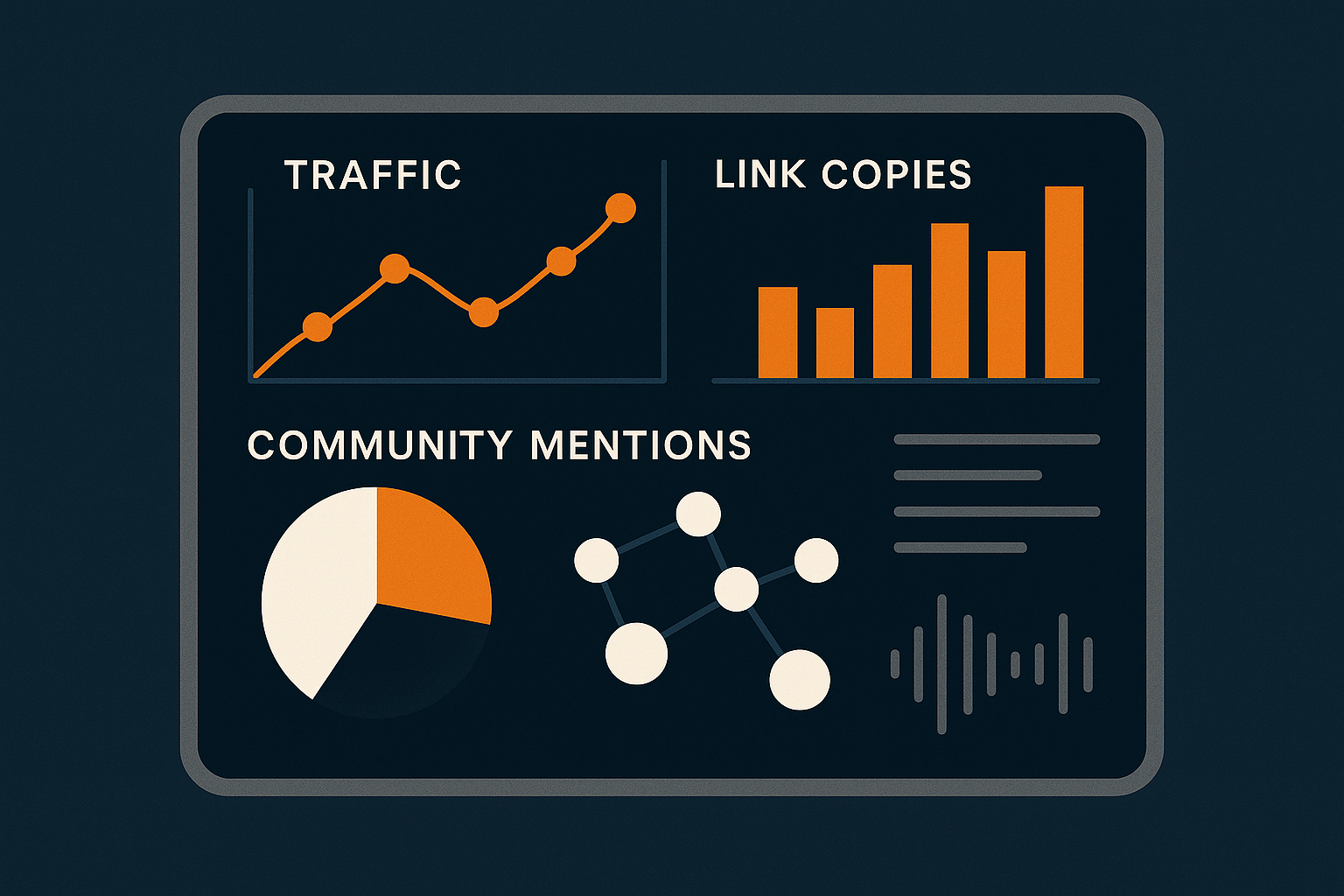
A practical dark social dashboard should include:
- Traffic anomalies (direct spikes vs. baseline).
- Link copy/share intent events.
- Survey-derived attribution (“colleague,” “friend,” “Slack group”).
- Community mentions (qualitative inputs).
- Overlay with paid + organic performance for triangulation.
The goal is not perfect measurement—it’s visibility where there was once a blind spot.
The Sensible Path Forward
Dark social won’t ever be fully transparent. That’s the point—it thrives in trust-based, semi-private spaces. But with the right proxies, qualitative inputs, and sensible dashboards, marketers can align their strategies with reality instead of clinging to myths of precision.
In a world where the most valuable referrals happen in invisible channels, brands that embrace the messiness of dark social will outcompete those chasing false certainty.
👉 At Spectrum Media Labs, we help brands design measurement systems that respect complexity without drowning in noise. Because in the end, it’s not about measuring everything—it’s about measuring what matters.



Add comment