
Every marketer has seen it: the campaign that once fueled growth suddenly stops moving the needle. Spend remains steady, impressions flow in, and yet conversions plateau. The first instinct is often to push harder — more budget, more creatives, more channels. But that reaction can be costly if you haven’t diagnosed why performance has flatlined.
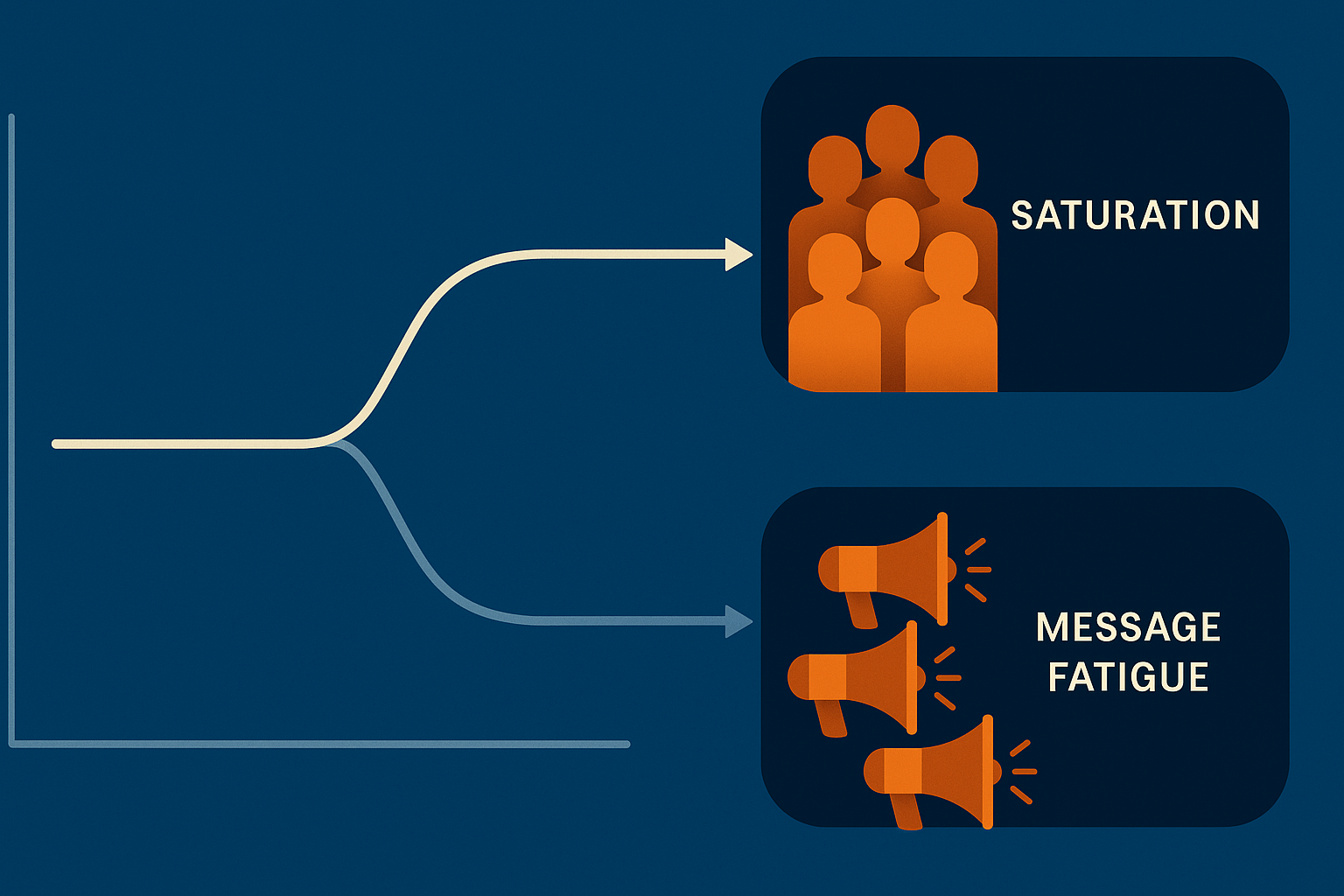
The truth is that not all plateaus are created equal. Some are the result of market saturation, where your audience has reached its natural ceiling. Others are caused by message fatigue, where your creative or positioning has worn out its welcome long before the market itself is exhausted. Knowing which one you’re facing determines whether to pivot, optimize, or expand.
What Is a Performance Plateau?
A performance plateau occurs when growth metrics — leads, conversions, revenue — stop increasing despite consistent investment. Unlike temporary dips or seasonality, a plateau is persistent. It suggests that your current mix of channels, audience targeting, and messaging has reached a limit.
Plateaus are not inherently bad. In fact, they often signal that you’ve squeezed maximum efficiency out of a current tactic. The problem arises when companies misdiagnose the plateau, treating saturation like fatigue (or vice versa), leading to wasted budget and missed opportunities.
Market Saturation: When the Audience Is Tapped Out
Saturation happens when you’ve reached most of the viable buyers in your chosen segment. Indicators include:
- Diminishing new-user reach: Ad platforms repeatedly serve to the same audience segments.
- Stable impressions, declining engagement: CTR drops while impressions remain constant.
- Incremental cost increases: Each new lead costs more despite no change in creative.
- Competitor crowding: More brands fight for the same eyeballs, driving up bids.
If you’re facing saturation, new creative won’t solve the problem. The path forward requires either broadening the addressable market or deepening your product value to capture demand you’ve previously missed.
Message Fatigue: When the Story Wears Thin
Message fatigue sets in when audiences tune out because they’ve seen your creative too often — or because the message no longer resonates. Symptoms include:
- Frequency spikes: Ads are shown 6, 8, 10+ times to the same users.
- Sharp decline in CTR: Engagement plummets even though reach is still available.
- Audience feedback: Comments, replies, or survey data point to boredom or annoyance.
- Performance rebounds with fresh assets: When a new creative set outperforms immediately.
Unlike saturation, fatigue is usually reversible. Updating creative concepts, rotating offers, or reframing narratives often restores performance.
A Framework for Diagnosis
When diagnosing a plateau, ask three questions:
- Who’s still in the funnel?
If reach is flat and frequency is high, you’re likely dealing with fatigue. If reach is still growing but leads aren’t, you may be saturated in quality buyers. - What happens when creative changes?
A quick A/B swap of messaging often reveals the culprit. If new creative sparks life, it was fatigue. If nothing changes, you may be saturated. - Where are competitors pushing?
If rivals are heavily bidding in the same space, your costs rise regardless of fatigue. Market dynamics matter as much as your assets.
Breaking Through Plateaus
- For saturation:
- Expand targeting into adjacent personas or geographies.
- Build new offers that unlock overlooked segments.
- Invest in brand equity to defend share in crowded markets.
- For fatigue:
- Refresh creative formats and storytelling angles.
- Sequence messaging to evolve the narrative over time.
- Use frequency caps and rotation rules to protect audience goodwill.
Long-Term Prevention
Performance plateaus are inevitable, but stagnation doesn’t have to be permanent. By building systems that track frequency, reach, cost curves, and audience overlap, you can anticipate plateaus before they damage ROI. The best marketing organizations don’t fear plateaus — they use them as signals to evolve strategy.
At its core, diagnosing the difference between saturation and fatigue is about respecting your audience. One problem says, we’ve reached everyone worth reaching here. The other says, we’ve overstayed our welcome with the way we’re speaking. Both demand different solutions, but both are solvable with the right mix of data and creativity.





Add comment