
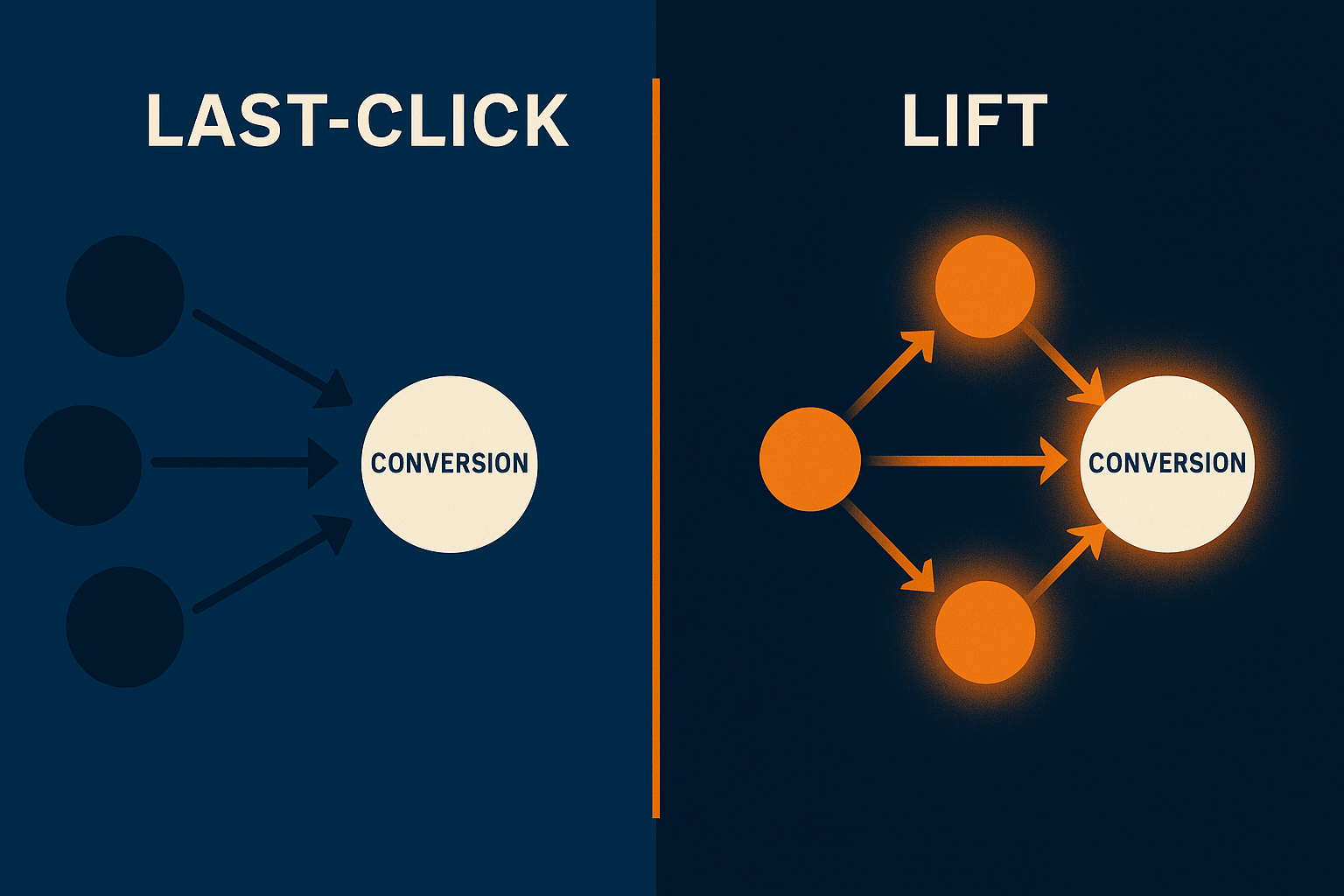
Attribution is one of the most contentious topics in marketing. Platforms present glossy dashboards with perfect ROAS, agencies defend their channel, and finance teams demand “hard numbers.” Too often, this devolves into last-click thinking: whoever touched the customer last takes all the credit.
But last-click doesn’t reflect reality. It ignores the long chain of influences that shape decisions, undervalues upper-funnel work, and distorts budget allocations. Educating stakeholders to move from last-click to lift-based attribution is one of the most important shifts a modern marketing leader can drive.
Why Last-Click Persists
- It’s Simple. One click, one conversion. Easy to explain to executives.
- It’s Default. Most analytics and ad platforms report in last-click by default.
- It Feels Safe. Finance likes the clarity, even if it’s misleading.
But simplicity comes at the cost of accuracy. By rewarding only the closer, last-click encourages teams to overspend on branded search or remarketing while underinvesting in demand creation.
What “Lift” Really Means
Lift-based attribution asks a different question: what incremental value did a channel add compared to what would have happened anyway?
Instead of assigning 100% of credit to the last touch, lift measures whether exposure to a channel, campaign, or creative actually increased conversions relative to a holdout. Lift=ConversionsExposed−ConversionsControlLift = Conversions_{Exposed} — Conversions_{Control}Lift=ConversionsExposed−ConversionsControl
This isn’t theory — it’s the foundation of incrementality testing, geo holdouts, and platform lift studies.
Educating Stakeholders: A Three-Step Playbook
1. Reframe the Question
Don’t debate attribution models in abstract. Reframe the discussion:
- Last-click asks: Who closed the deal?
- Lift asks: Who made the deal happen that otherwise wouldn’t?
That’s a business question, not just a marketing one.
2. Use Simple Visuals
Executives don’t need regression equations. Show a funnel or timeline:
- Top-funnel ad → consideration ad → brand search → conversion.
- Without the top-funnel ad, the brand search never happens.
Visuals make the logic tangible.
3. Provide Evidence with Small Tests
Run a simple geo holdout or platform lift study. Show that branded search captures conversions that would have happened anyway, while prospecting ads actually grow the pie. Small experiments provide proof far more compelling than theory.
Common Stakeholder Objections
- “Lift tests are too complex.”
→ Start small, even with platform-provided tests. Complexity grows with confidence. - “We just need numbers for reporting.”
→ Explain that misleading numbers drive bad budget decisions. Bad inputs → bad outputs. - “Finance won’t understand.”
→ Translate lift into incremental revenue and ROI. That’s the language finance cares about.
Case Example
A SaaS company was spending 40% of paid budget on branded search because last-click ROAS looked unbeatable. A geo holdout test revealed that 70% of those conversions were organic demand captured by ads. After reallocating budget into prospecting campaigns, pipeline grew by 28% within a quarter.
Building Attribution Maturity
Moving from last-click to lift is not a single switch — it’s a maturity curve:
- Awareness: Teach stakeholders the flaws of last-click.
- Experiments: Run holdouts and lift tests on priority channels.
- Integration: Blend lift insights into budget planning.
- Culture: Make “incrementality” the default language of performance.
Final Thought
Attribution will never be perfect, but it can be more honest. Last-click flatters closers. Lift rewards true growth drivers.
Educating stakeholders to value incrementality over simplicity transforms attribution from politics to strategy — and ensures budgets flow to channels that actually grow the business.





Add comment