
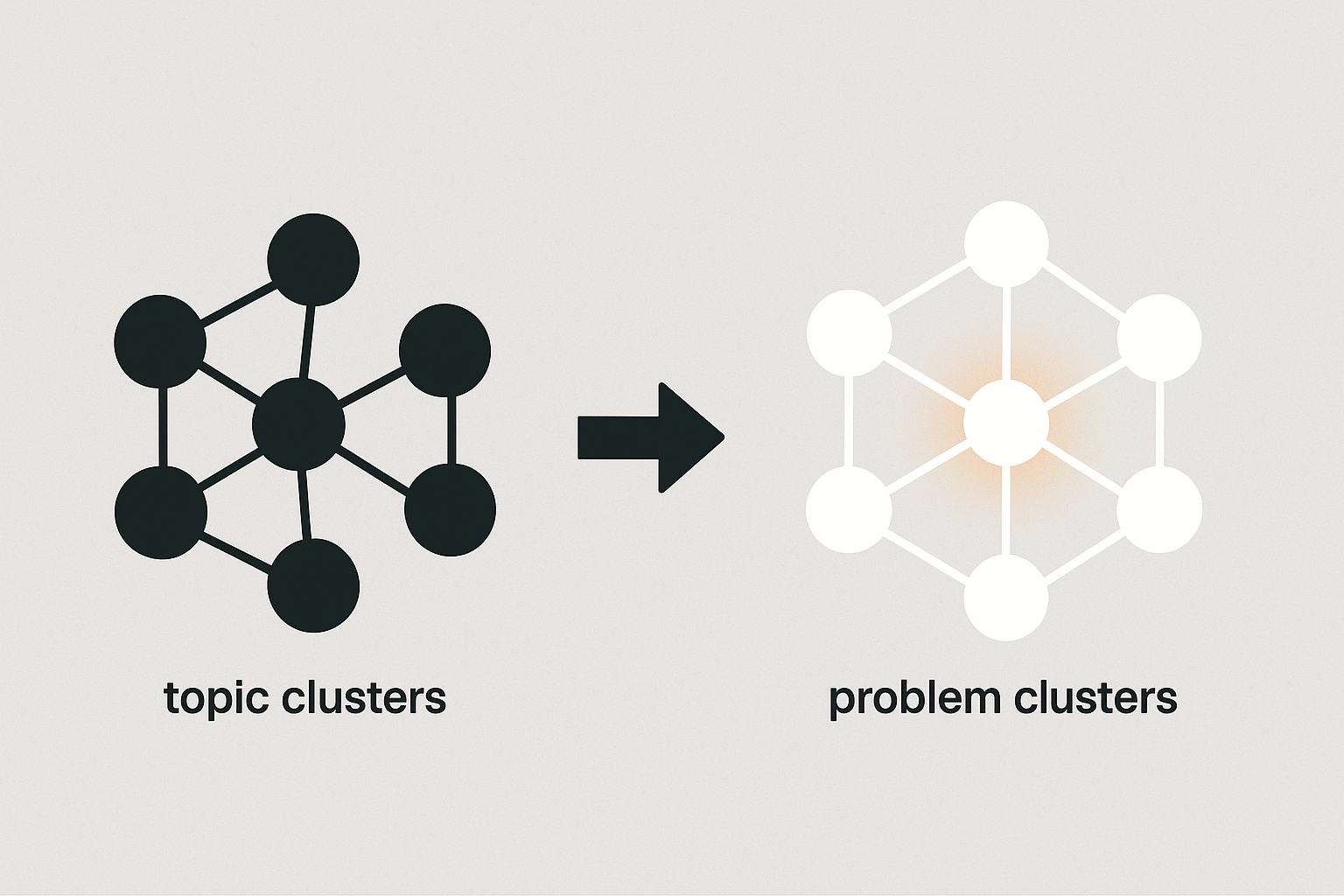
For years, content marketing teams have organized their calendars around topic clusters: a central pillar page surrounded by interlinked articles on related subtopics. It’s a neat SEO model, and it works — but only up to a point.
The issue? Topic clusters often serve search engines more than people. They create a library of “content about content,” but they don’t always map to the way buyers actually think when making decisions. Buyers don’t wake up thinking in topics; they think in problems.
Editorial planning that truly converts requires a shift: from organizing around topics to organizing around problems.
Why Topic Clusters Plateau
Topic clusters made sense in the era of keyword-first SEO. They:
- Improved site structure.
- Built domain authority around themes.
- Helped rank for a family of related keywords.
But they often failed to close the loop from ranking to revenue. Why? Because they optimize for queries, not for buyer friction. A blog that explains “what is content marketing” may bring in traffic — but it rarely converts a director of marketing with a budget to spend.
Enter Problem Clusters
Problem clusters reframe editorial planning around the actual barriers buyers face at different stages of their journey. Instead of building content silos around abstract themes (“SEO strategy,” “brand storytelling”), you build them around the pain points and anxieties buyers articulate.
Examples:
- Topic cluster: “Remote work best practices.”
- Problem cluster: “How to keep distributed teams aligned without Zoom fatigue.”
- Topic cluster: “Customer retention strategies.”
- Problem cluster: “How to reduce churn when competitors undercut on price.”
Problem clusters force you to anchor content in urgency, relevance, and conversion potential.
How to Build Problem Clusters
1. Mine Buyer Conversations
Listen to sales calls, support tickets, and community forums. Problems surface in the exact words your buyers use.
2. Map Problems to Buyer Journey Stages
- Awareness: “Why is this happening?”
- Consideration: “What are my options?”
- Decision: “How do I avoid risk?”
Each stage has its own problem set.
3. Create Multi-Format Solutions
Don’t stop at blog posts. Problem clusters may require case studies, ROI calculators, webinars, or comparison guides.
4. Build Internal Linking by Solution Path
Instead of linking purely by keyword relevance, link content pieces by problem-solving sequence: introduction → deeper dive → proof → conversion asset.
Benefits of Problem Clusters
- Higher Relevance: Buyers see themselves in your content.
- Faster Conversion: Solving urgent problems builds trust more quickly than explaining abstract topics.
- Sales Alignment: Editorial maps directly to objections sales teams hear.
- SEO Resilience: Search algorithms increasingly reward user intent over keyword density; problem clusters align with intent.
Case Example
A SaaS company selling workflow automation tools shifted from writing about “automation trends” (topic cluster) to “how to get IT buy-in for automation” (problem cluster). Engagement dropped slightly in traffic volume but doubled in demo requests, because the content spoke to decision-critical barriers.
Final Thought
Topic clusters built traffic. Problem clusters build trust and revenue.
Editorial planning in 2025 must go beyond keywords and embrace the messy, emotional, high-stakes problems buyers face. When you shift from content that organizes information to content that resolves tension, you don’t just attract readers — you convert them.






Add comment