
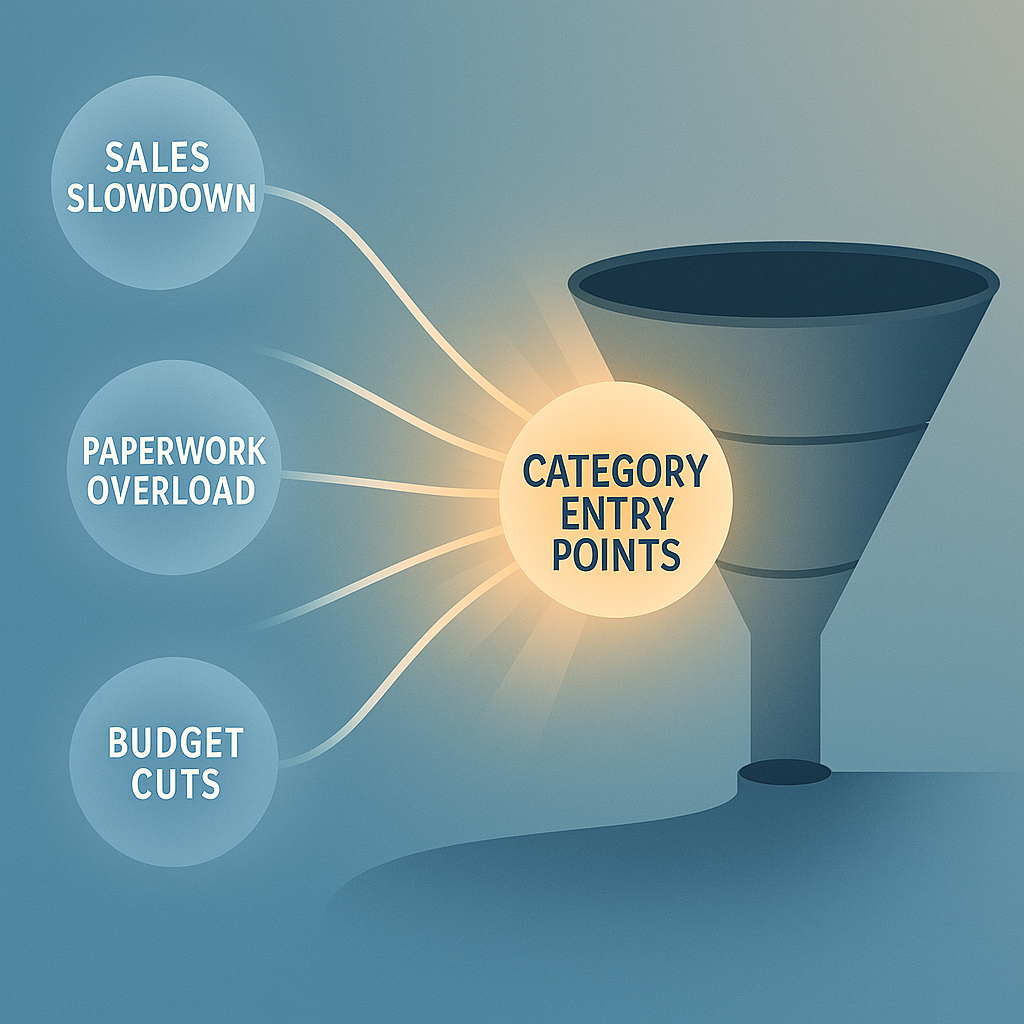
In B2B strategy, most conversations start with funnels. Companies design awareness stages, lead magnets, nurturing flows, and conversion triggers. But there’s a deeper, more fundamental layer that often gets overlooked: mental availability. Before customers can enter your funnel, they need a reason to remember you. And that reason comes from category entry points (CEPs).
What Are Category Entry Points?
A category entry point is a mental trigger that links a customer’s situation or need to your brand. Instead of waiting for a buyer to Google “solutions,” CEPs ensure that when the situation arises, your company is one of the first that comes to mind.
For example:
- “When my sales team can’t close deals fast enough…” → a CRM vendor.
- “When my compliance team drowns in paperwork…” → a credentialing platform.
- “When finance needs to cut costs without cutting growth…” → a business automation tool.
CEPs are not features. They are memory structures that attach your brand to the struggles and triggers your buyers experience.
Funnels Without Mental Availability Are Empty
Funnels assume that customers are actively shopping. But in B2B, buying cycles are long and sporadic. Most of the time, your buyers are not in-market. That means your funnel can’t capture them until they already decide to act.
CEPs solve this by building pre-funnel recognition. They seed your brand in the buyer’s memory, so when a triggering event happens, your brand is one of the “mental shortcuts” they reach for. Without this, you risk spending heavily on funnels that capture attention too late.
Designing Category Entry Points
Building CEPs requires three steps:
- Map Buyer Contexts
Identify the situations your ICP faces before they search for solutions. These are emotional, practical, or political triggers inside their organizations. - Translate Into Accessible Language
CEPs must be phrased in customer-centric terms. Not “advanced compliance automation,” but “when your team drowns in paperwork.” The job-to-be-done language makes the entry point sticky. - Embed CEPs Across Channels
Use CEPs as anchors in campaigns, sales scripts, and content. Instead of talking about your product, talk about the situation where your product becomes essential.
Why Most Companies Ignore CEPs
Many organizations skip CEPs because they chase immediate performance metrics. Funnels show tangible conversion rates; CEPs build intangible memory structures. But ignoring CEPs means relying on luck: hoping buyers stumble into your funnel when the need arises, instead of deliberately shaping how they think of you in advance.
Category Leaders Master CEPs
The strongest brands dominate categories because they dominate entry points. Salesforce isn’t just a CRM; it’s the company you think of when sales teams need to close deals faster. HubSpot isn’t just marketing automation; it’s what comes to mind when small teams want inbound growth without big budgets.
Category leaders build mental monopolies before they build funnels.
Takeaway
Funnels convert intent. CEPs create it. To scale in B2B, you need both. But the sequence matters. Building a funnel without mental availability is like building a store in the desert — there’s no foot traffic.
By mapping and embedding category entry points, you ensure that when the buying moment comes, your brand is already present in the customer’s mind. Funnels are tactical. CEPs are strategic. And strategy always comes first.




Add comment