
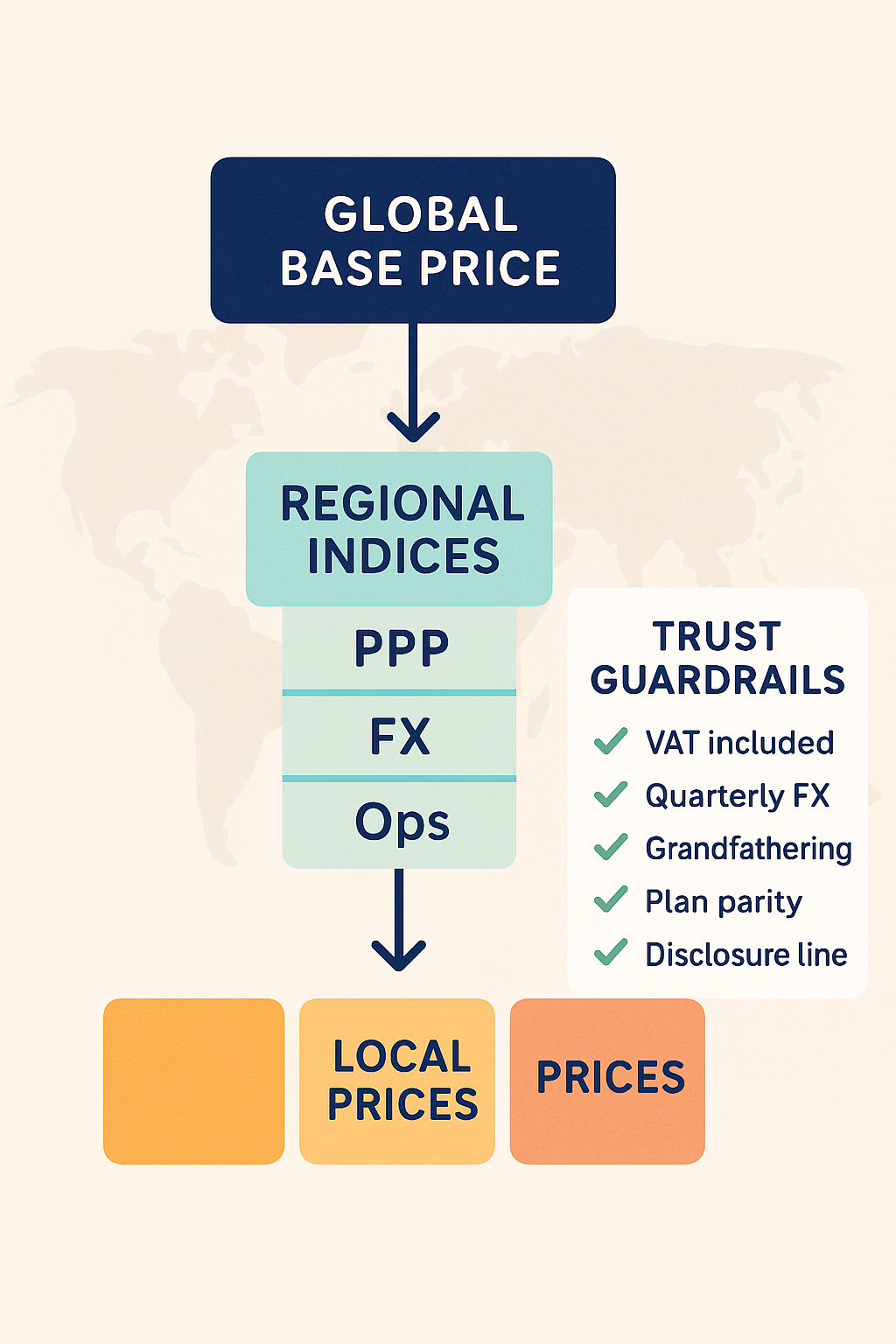
Regional pricing can increase conversion 10–40% with no new features. It can also trigger a backlash (“Why do I pay more?”) and erode brand equity overnight. The difference isn’t the number on the page; it’s the principles, transparency, and operational discipline behind those numbers.
Below is a field-tested playbook to set country/region prices that respect willingness to pay, comply with local norms, and keep your brand trusted.
1) First principles: trust before tactics
Consistency beats cleverness. Customers accept differences if they look systematic, explainable, and stable—not opportunistic.
- Value-first: Price differentials must map to value (local support hours, language, payment rails, tax handling) or to economic context (income, VAT, FX costs)—not to who can be squeezed.
- Transparency rules: If taxes are included, state it. If you absorb FX fees, state it. If a promo is region-limited, say why.
- Rights parity: Don’t sell less for the same plan name across regions unless you explicitly rename the plan. “Pro” in one country must equal “Pro” elsewhere or be “Pro (Local)” with clear deltas.
2) Choose a regional pricing architecture (and stick to it)
Think in systems, not one-off prices. Pick one of these models, or a hybrid:
A) Global Base + Index Multiplier (most common)
- Define a Global Base Price in a home currency (e.g., USD).
- For each region, multiply by an Index that blends:
- PPP (purchasing power parity) index weight (e.g., 50–70%).
- FX rate weight (e.g., 20–30%), using a 30–90 day moving average.
- Operating-cost factor (e.g., payment rails, VAT absorption) weight (10–20%).
- Round to psychological thresholds customary for the market (e.g., €49, ₹2,999).
Formula:
Local Price = BaseUSD × (α·PPP + β·FX + γ·Ops) × RoundingRule
B) Tiered Regional Bands
- Group countries into 4–6 bands (e.g., North America, DACH/Nordics, UK, EU-rest, LATAM, India/SEA, MENA, ANZ).
- Each band has a set price per plan. Easier to maintain; less granular sensitivity.
C) Localized “Fair-Use” Discounts (PLG)
- Keep list price global. Offer country-aware coupons or in-product means-testing (e.g., student/NGO) auto-applied via IP/geo + self-attestation.
- Good for self-serve SaaS where resistance is high to visible list-price differences.
D) Enterprise Contracting
- Public site shows banded price. Large deals negotiate country-specific terms inside MSAs. Keep public logic simple; keep enterprise flexible.
Pick one primary model to avoid internal contradictions.
3) Guardrails that protect brand trust
Implement these hard rules before launching any regional changes:
- VAT/Tax clarity: In EU/UK and others, show tax-inclusive prices by default; keep the pre-tax figure available on hover/tooltip.
- FX buffer & cadence: Recalculate quarterly—not daily. Add a small FX buffer (e.g., +1–2%) to cover fees, but freeze price for 90 days to reduce noise.
- Legacy protection: Grandfather existing customers for 12 months (or until renewal) when a local price moves up; allow one-time “price lock” extensions for key accounts.
- Plan naming parity: If features differ, change the label (“Pro Local”) and publish a feature matrix so expectations remain aligned.
- Price floors: Set floors to prevent race-to-bottom screenshots. Example: no localized list price <60% of base unless justified by PPP + tax policy.
4) Communication strategy (because silence looks sneaky)
How you explain matters as much as what you set:
- Narrative: “We’re aligning prices with local taxes, payment costs, and income levels to keep access fair.”
- Receipts: Where appropriate, cite components you absorb (e.g., currency conversion, platform fees, GST/VAT handling).
- Change emails: Segment by region; give 30-day notice; show before → after with context; link to an FAQ.
- On-page disclosure: Short line under the price: “Includes VAT where applicable. Local currency based on quarterly FX/PPP index.”
- Support scripts: Provide macros for “Why is Country X cheaper?” → steer to PPP and tax rationale.
5) Psychological pricing by market
- Decimals: Many EU markets accept .90 or .99; parts of Asia favor round integers; India often prefers 99 endings but in rupee-friendly steps (₹1,999, ₹2,999).
- Currency symbol placement: Respect local convention (symbol vs. code, spacing).
- Bundle anchors: Create good-better-best anchors locally; ensure the perceived value gap (feature/limit) matches the price gap.
6) Payments & invoicing: invisible price drivers
Conversion collapses when payment rails don’t match local expectation:
- Rails: iDEAL (NL), Bancontact (BE), Sofort/Giropay (DE), Pix/Boleto (BR), Konbini (JP), UPI (IN). Add PayPal/Apple/Google Pay where trust is low.
- Billing cadence: Monthly often dominates PLG; annual upfront discounts vary (10–25%). In LATAM, installments can outweigh discounts.
- Currency exposure: Charge in local currency and settle locally when possible; if not, disclose possible bank FX.
- Invoicing norms: Include fiscal IDs (e.g., GSTIN, RFC), legal addresses, and local tax text to avoid procurement delays that feel like “pricing friction.”
7) Packaging for region-specific value
Sometimes pricing pushback is a packaging problem:
- Support hours: Add local time-zone support access to higher tiers in markets where that is decisive.
- Data residency & compliance: Offer residency add-ons (EU/DE, AU) and list the surcharge openly.
- Language services: Include translation or implementation credits where English proficiency is a barrier.
- Education & NGO plans: Make them discoverable and self-serve, not hidden coupons.
If value differs, say so explicitly and price the add-on—not the core plan—whenever possible.
8) Rollout plan (30–60–90)
Day 0–30: Modeling & Governance
- Lock architecture (Index vs. Bands).
- Finalize PPP/FX sources, weights, and rounding rules.
- Simulate revenue impact (new, expansion, churn risk).
- Draft comms, FAQs, and success metrics.
Day 31–60: Limited Launch
- Soft-launch in 2–3 representative markets (one high-PPP, one mid, one low).
- Monitor: conversion rate, ARPPU, refund rate, support volume, social sentiment.
- A/B localized price vs. global price on 10–20% traffic if risk allows.
Day 61–90: Globalize & Stabilize
- Roll to remaining bands.
- Publish a pricing principles page once stable (1–2 paragraphs; human tone).
- Set a quarterly review cadence with finance + growth + support.
9) Metrics & alerting
- Topline: Conversion rate by country, ARPPU, Average Discount Rate (should not spike post-localization).
- Unit economics: Gross margin by region after payment + FX + tax costs.
- Trust signals: Support tickets tagged “pricing unfair,” refund reasons, social sentiment index.
- Equity checks: Cross-border abuse (VPN arbitrage) rate. Cap coupon stacking; require billing-country = IP-country within tolerance.
- Cohort health: Renewal uplift/decline for localized cohorts vs. control.
Set alert thresholds (e.g., >15% increase in “pricing unfair” tickets for 3 days) to trigger a comms response or a hotfix.
10) Pitfalls to avoid (and quick fixes)
- Daily FX oscillation on price pages → Fix: quarterly index with buffer + lock headline numbers between reviews.
- Feature drift under same plan name → Fix: rename or publish a clear matrix; avoid silent downgrades.
- Hidden tax treatment → Fix: add “tax included/excluded” labels; unify invoice language.
- Copy-paste from competitors → Fix: anchor on your cost/value model; competitors may be subsidizing or chasing vanity share.
- VPN arbitrage & reseller leakage → Fix: bind prices to billing address + payment instrument country; rate-limit coupon issuance.
Implementation checklist (copy–paste)
- Pick architecture (Index vs. Bands vs. Fair-Use) and publish internal policy.
- Define Base Price, indices, rounding, review cadence.
- Align plan names & feature parity across regions.
- Configure tax display, payment rails, and invoicing fields per country.
- Write comms pack: site disclosures, email templates, support macros, FAQ.
- Pilot in 2–3 markets; monitor conversion, ARPPU, sentiment, tickets.
- Roll out globally; set quarterly review and alert thresholds.
- Create a public “Pricing Principles” note to reinforce trust.







Add comment