
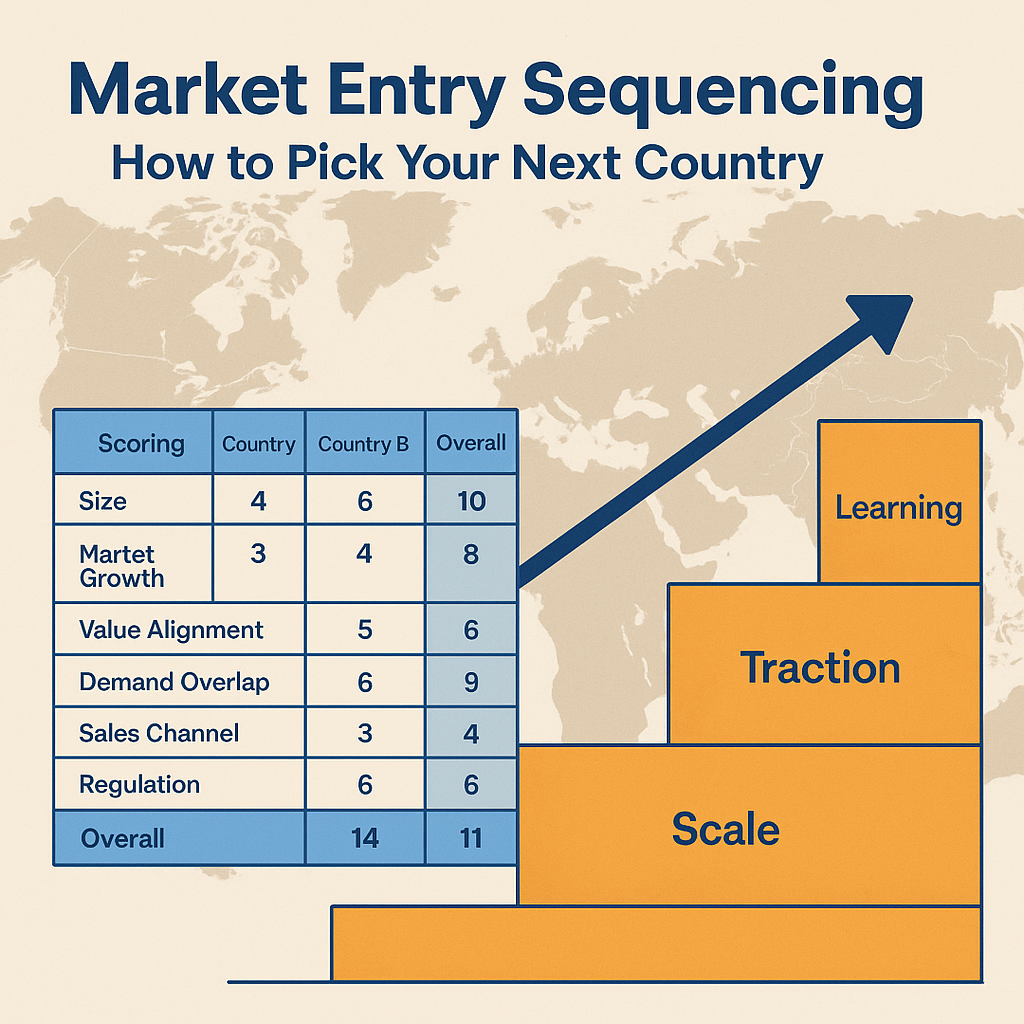
Winning globally is less about bravery and more about order of operations.
Most expansion failures happen not because the product is bad, but because teams pick the next country based on anecdotes (“our CEO met a partner in Dubai”) or surface metrics (GDP, English penetration). The right approach combines opportunity size, probability of traction, and time-to-learning—then sequences markets so each one compounds the next.
Below is a pragmatic decision model you can run with product, finance, and go-to-market in one room.
1) Define success before you pick the country
Expansion isn’t a goal; it’s a strategy to reach measurable business outcomes.
Decide up front:
- Primary objective: revenue growth, margin mix, strategic logos, or learning (R&D-by-market).
- Horizon: Are you optimizing for 12-month payback or a multi-year land-and-expand?
- Entry mode: direct sales, self-serve, partner-led, or hybrid.
- Guardrails: cash burn limit, headcount cap, regulatory risk you won’t cross.
Without this, a “big” market can quietly be the wrong market.
2) Build a three-layer scoring model
Create a market list (longlist of 10–20) and score on Size, Fit, Feasibility. Weight them for your business (e.g., 40/35/25).
A) Size (External Demand)
- TAM/SAM for your exact ICP (not country GDP).
- Category maturity & growth (search volume trends, ecosystem density).
- Deal value potential (pricing power, willingness to pay, procurement norms).
B) Fit (Product & Buyer-Logic Alignment)
- Problem intensity (how acute is the pain your product solves).
- Regulatory compatibility (data residency, certifications).
- Cultural/operational alignment (self-serve vs. relationship-led buyers; English vs. local language expectations).
- Competitive white space (incumbent strength, local clones).
C) Feasibility (Speed-to-First-Dollar)
- Route-to-market (existing partners, channel readiness).
- Talent availability (country managers, SEs, support).
- Local cost-to-operate (entity setup, payroll load, marketing CPMs).
- Cycle friction (payment rails, VAT/GST, contract norms).
Normalize each to 0–5, multiply by weights, and you have defensible comparables.
3) Sequence by “learning velocity,” not only size
The best second market isn’t always the biggest—it’s the one that teaches you the most quickly with the least irreversible spend.
Prioritize markets that:
- Share adjacent infrastructure (time zone, language, compliance) with your home market, so existing playbooks port with minimal mutation.
- Expose a new constraint you need to solve anyway (e.g., SSO standards, procurement complexity).
- Offer partner leverage (one distributor unlocks multiple countries).
- Provide referenceability for the next market (“wins in DACH help open Nordics”).
You’re building a staircase; each step should shorten the next.
4) Choose the entry motion deliberately
Self-serve / PLG-first:
Works when activation is light, ACV is low-to-mid, and local support needs are small. Focus on localization (copy, payments, support hours) and performance marketing.
Partner-led:
Best when local trust matters. Recruit 2–3 partners, not 20; make enablement and joint pipeline targets explicit. Align incentives (margin + MQL passbacks).
Hybrid “beachhead” team:
One senior country lead + SE/CS support + marketing contractor + 1–2 anchor partners. Keeps burn low, preserves learning speed.
5) Don’t ship translation—ship an entry bundle
Launch each new country with a complete offer:
- Positioning & proof: case studies (local if possible), sector examples relevant to that market.
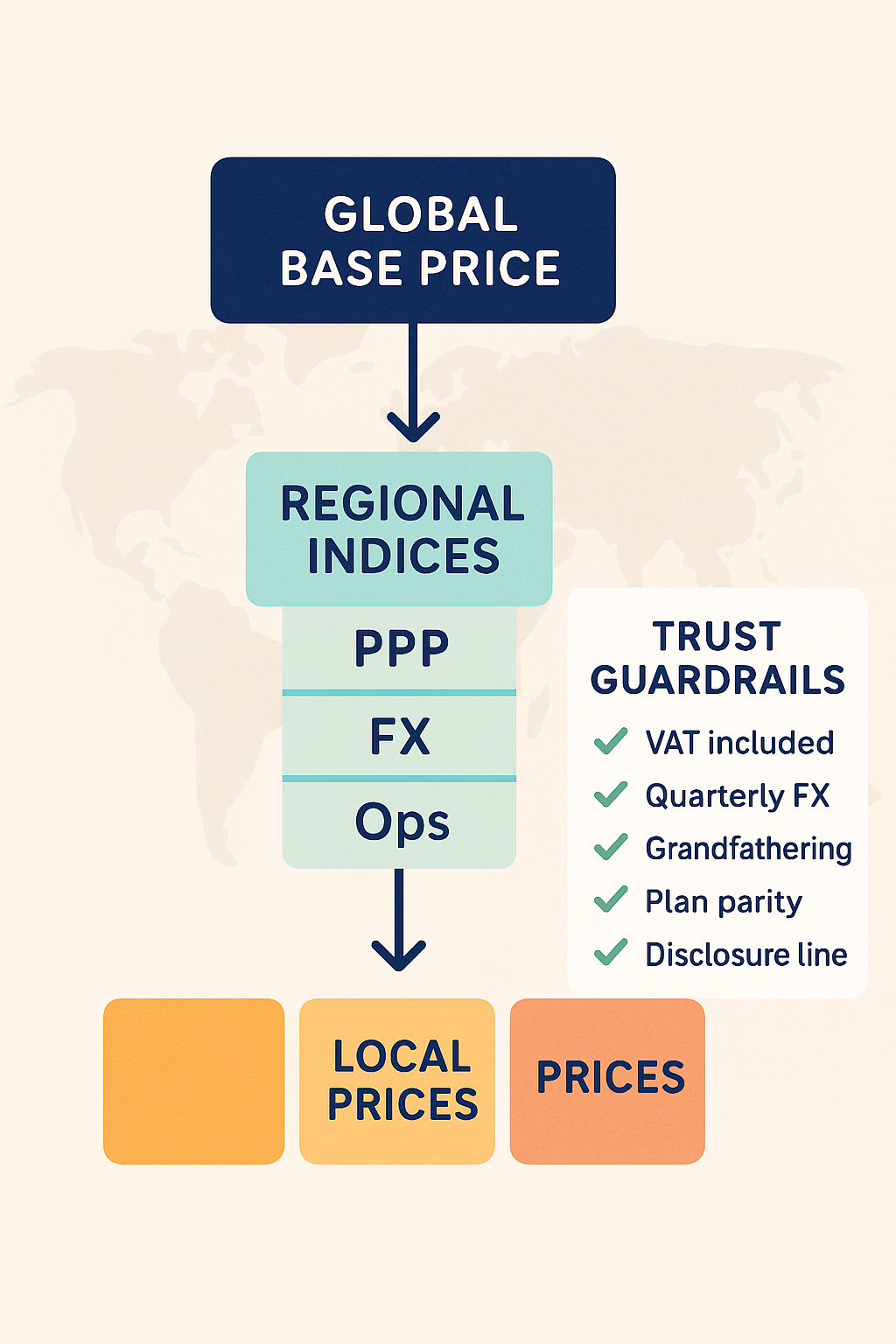
- Pricing & packaging: currencies, taxes, contract norms (auto-renewal legality, data clauses).
- Payments: local rails (Pix/Boleto in BR, iDEAL in NL, Konbini in JP if B2C), invoicing cadence.
- Sales assets: localized pitch, security pack, legal appendix.
- Support: local time-zone coverage, SLA language, escalation path.
A translated website without this bundle is a leaky bucket.
6) Regulatory and compliance gates (decide early)
Create a red/yellow/green matrix per market:
- Data residency & transfer (cloud region options, SCCs).
- Industry certifications (SOC 2, ISO 27001, HIPAA-equivalents).
- Advertising & claims rules.
- Employment & entity setup: EOR viable vs. legal entity required.
Blockers that require 6–12 months of work change sequencing—even if the market is attractive.
7) Unit economics & payback math
For each candidate, model a simple P&L for Year 1–2:
- Topline: pipeline capacity × win rate × ACV (localized).
- Cost lines: country lead, sales/SE/CS, marketing spend, enablement, legal/accounting, travel, partner margin.
- CAC payback target: e.g., ≤18 months for mid-market SaaS.
- Sensitivity: optimistic/most-likely/pessimistic scenarios.
Use this to sort markets by risk-adjusted NPV and by cash trough depth (how much you’re underwater before breakeven).
8) Design the 2-quarter experiment
Before you “go big,” run a Q1–Q2 beachhead plan with explicit success criteria:
- Inputs: hires done, partners signed, assets localized, campaigns shipped.
- Leading indicators (first 60–90 days):
- % of ICP traffic from target country
- MQLs and first meetings
- POCs/trials started
- Lagging indicators (by Day 180):
- Opportunities created, time-to-first-dollar
- ACV lift vs. home market, win rates
- NPS/retention early signals
Green-light to scale requires hitting thresholds, not vibes.
9) Operating model across multiple countries
When you have 3–5 countries live, chaos creeps in. Keep global-local balance:
- Centralize learning, decentralize execution. Global product/brand sets standards; countries adapt plays and report insight.
- Quarterly “market council.” Country leads present playbooks, share blockers, propose roadmap tweaks.
- Shared services: creative, web, ops, data science.
- Portfolio perspective: don’t starve early, promising markets because one big region is noisy; allocate by marginal ROI, not politics.
10) Signs you’re ready (or not) to open the next flag
Ready:
- Two consecutive quarters hitting beachhead KPIs.
- Repeatable pipeline sources identified (≥2 channels).
- Support and billing scaled without heroics.
- At least one exportable case study.
Not ready:
- You’re adding markets to hit top-line, while CAC payback worsens.
- Sales is the bottleneck for localization feedback.
- Regulatory escrow still open or core feature gap unaddressed.
Expansion is a multiplier for what you’re already good at. If your core motion is shaky, global won’t fix it—it magnifies it.
Implementation checklist (copy-paste)
- Agree on objective, horizon, guardrails.
- Score longlist with Size/Fit/Feasibility model.
- Pick top 3 and run learning-velocity screen.
- Select entry motion (self-serve, partner, hybrid).
- Build the entry bundle (positioning, pricing, payments, proof, support).
- Model unit economics; set payback thresholds.
- Ship a 2-quarter beachhead plan with green-light criteria.
- Stand up a market council for ongoing sequencing.





Add comment