
Sponsorships can be the most overpaid line in the marketing budget — or the most underestimated growth lever.
The difference lies in intent, integration, and instrumentation.
Too many brands buy logos, not leverage.
They sponsor for visibility instead of outcomes, measuring “mentions” instead of meetings.
Here’s how high-performing teams pick sponsorships that actually pay back — and build measurement frameworks that hold up under CFO scrutiny.
1. Redefine the goal: buy outcomes, not impressions
The old sponsorship logic — “we’ll get exposure to X people” — doesn’t translate in a pipeline-driven world.
Modern marketing leaders use sponsorships to accelerate specific funnel stages:
| Stage | Sponsorship goal | Example |
|---|---|---|
| Awareness | Reach net-new audiences in key segments | Branded stage, podcast, report co-sponsorship |
| Consideration | Deepen trust & credibility | Workshop, roundtable, research collaboration |
| Conversion | Trigger direct leads or trials | Demo booth, co-hosted webinar, customer session |
| Retention | Reinforce existing relationships | Client hospitality, community events |
If you can’t assign your sponsorship to a stage, it’s probably vanity spend.
2. The sponsorship fit matrix
Before you sign, score potential opportunities across four dimensions:
| Dimension | Question | Ideal state |
|---|---|---|
| Audience | Does it align with our ICP, not just broad category? | 70%+ audience match |
| Format | Can we activate, not just appear? | Panel, demo, content slot |
| Data access | Will we get attendee or engagement data? | Named leads or firmographic insights |
| Longevity | Can assets live beyond the event? | Replay, co-promo rights, evergreen content |
If two or more are “no,” skip it — or negotiate until they are.
3. Choose activations that create contact
Visibility ≠ value.
What converts is contact — conversations, downloads, sign-ups, shared insights.
High-yield activations:
- Workshops or micro-sessions instead of standard booths.
- Joint research or reports that give both brands data and backlinks.
- Co-branded webinars within 30 days post-event.
- Interactive demos or challenges tied to your product.
- Customer storytelling (your users as speakers).
Make sure your presence is experiential, not decorative.
That’s what drives memory — and measurable outcomes.
4. Measure like a performance channel
A sponsorship isn’t an expense — it’s an attribution problem.
You’re buying influence upstream in the funnel, so measurement needs to blend direct and assisted impact.
Track at three levels:
A. Engagement metrics
- Booth visits, session attendance, chat Q&A, demo scans.
- Content downloads or scans from unique QR codes.
- Mentions and UTM-tagged clicks.
B. Pipeline metrics
- Leads sourced or influenced (match event list → CRM).
- Meetings booked within 30 days.
- Opportunities created or accelerated post-sponsorship.
C. Brand metrics
- Category search volume lift.
- Branded traffic spikes (via GA or Search Console).
- Sentiment analysis (social / NPS delta among attendees).
The best sponsorship dashboards blend qualitative insight (positioning gain) with quantitative data (pipeline ROI).
5. Attribution setup before activation
Instrumentation must precede the event:
- UTMs everywhere. For links in pre-event promos, partner emails, and booth QR codes.
- Unique forms and landing pages. “/partner-event2025” beats generic “/contact.”
- CRM tagging. Custom campaign IDs for tracking influenced deals.
- Integrations. Sync registrant lists, leads, and survey results directly into your MAP or CRM.
- Feedback loop. Post-event: did sales feel the quality? Did partners deliver?
Without pre-tagging, your post-event reports are storytelling, not analytics.
6. Cost frameworks: how to judge “worth it”
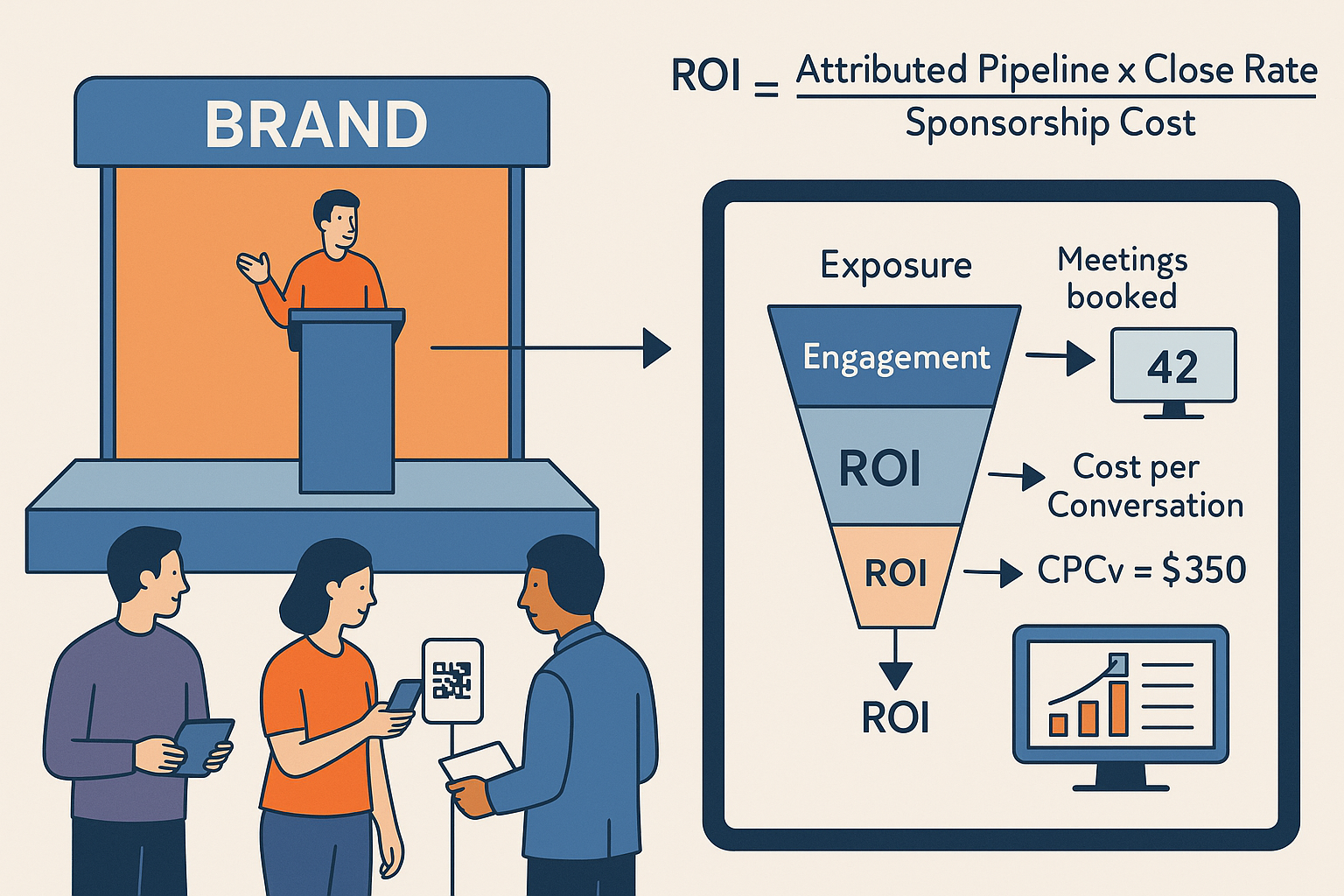
Sponsorship ROI formula
ROI=(AttributedPipeline×CloseRate×GrossMargin)SponsorshipCostROI = \frac{(Attributed Pipeline \times Close Rate \times Gross Margin)}{Sponsorship Cost}ROI=SponsorshipCost(AttributedPipeline×CloseRate×GrossMargin)
That’s the CFO’s lens. But marketers should also calculate “Cost per Conversation” (CPCv) — the number of meaningful, qualified interactions per dollar.
Healthy benchmarks:
- Booth or conference sponsorships: 1 qualified conversation per $400–$700 spent.
- Co-marketing campaigns (webinars, reports): 1 per $150–$300.
- VIP dinners or activations: 1 per $600–$900, but higher close rate.
7. Leverage post-event assets
The sponsorship ROI window doesn’t end when the lights go off.
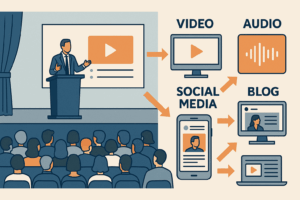
Always negotiate content rights — the ability to reuse, clip, or co-brand assets.
Use them to:
- Publish recaps and highlight videos.
- Feed short-form content into your organic and paid campaigns.
- Create internal enablement decks for sales.
- Build retargeting audiences from event traffic pixels.
Each sponsorship should yield a repurposing library, not a single weekend of exposure.
8. Partner alignment & communication
Successful sponsorships run on mutual enablement, not logo swaps.
Treat your partner as a co-strategist, not a vendor.
- Kickoff early. Align on ICP, key messages, CTAs, and data flow.
- Build a shared dashboard. Visibility into performance builds trust.
- Run debriefs. Identify what worked and what didn’t before the next deal cycle.
You’re building long-term brand compounding — and your partners are part of that portfolio.
9. Qualitative success indicators
Not all wins show up in CRM right away. Watch for:
- Speaker invitations → thought-leadership credibility.
- Press mentions → category authority.
- Pipeline influence → deals closing faster after exposure.
- Talent inbound → employer brand halo.
Track these over 6–12 months for the true compounding effect.
10. Sponsorships as media
Once your tracking, content, and activation design mature, you can treat sponsorships as media channels — with predictable yield and frequency.
That’s when CFOs stop asking “Why this spend?” and start asking “Can we scale it?”
The playbook is simple:
Choose for alignment.
Activate for engagement.
Measure for pipeline.
Repurpose for longevity.
That’s how sponsorships start paying back — again and again.
Implementation checklist
- Map sponsorship to funnel stage.
- Run the 4D Fit Matrix.
- Design activation for contact (not visibility).
- Instrument UTMs, CRM tagging, and custom pages.
- Define ROI and Cost per Conversation targets.
- Negotiate rights for repurposing.
- Post-event debrief and content rollout.
Add comment