
Introduction
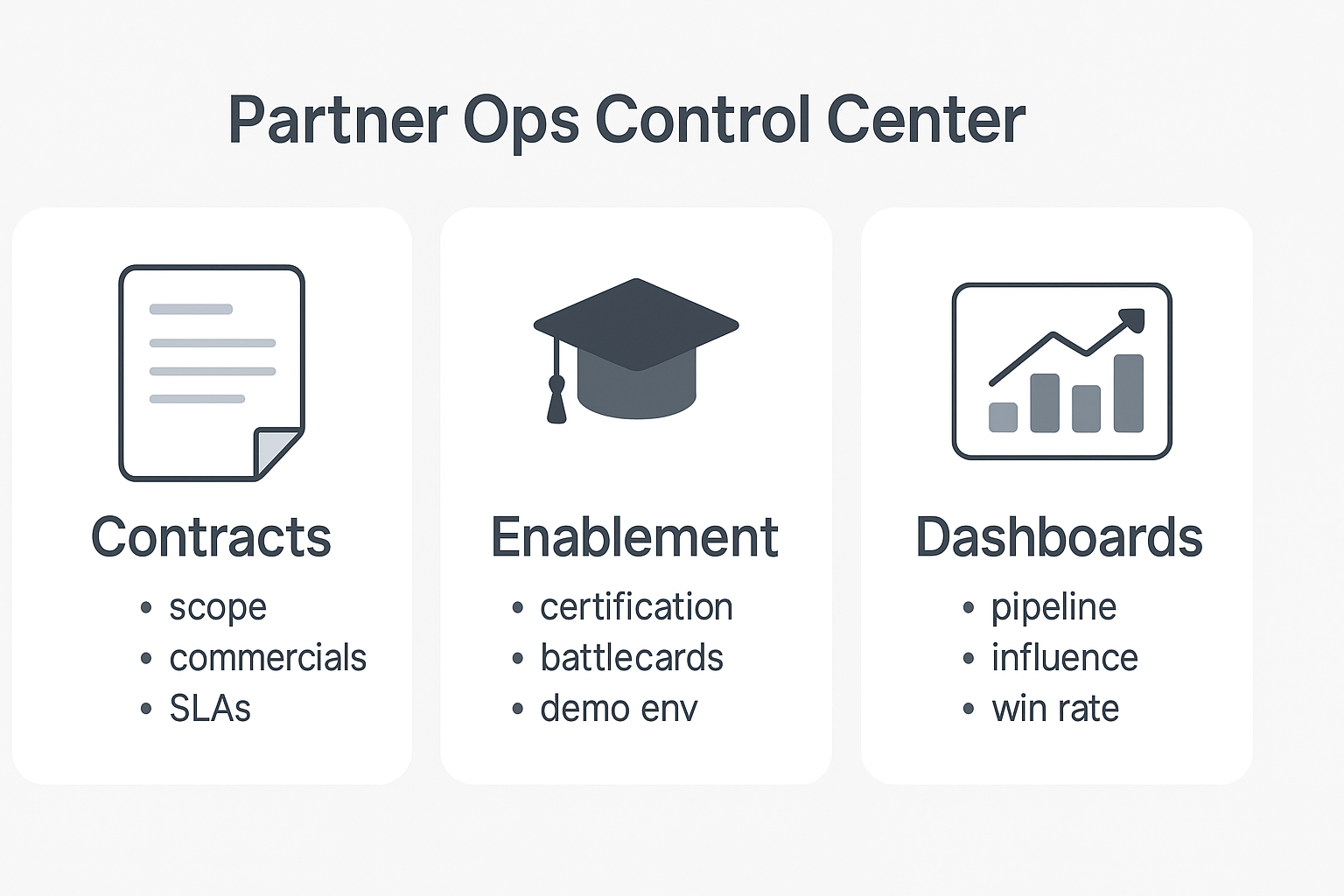
Great partnerships don’t collapse because the strategy is wrong—they stall because Partner Ops is missing. No clean contracts, no shared definitions, no way to see the same pipeline. This guide shows how to wire partner operations so co‑selling and co‑marketing move faster: what to put in your contracts, how to run enablement that changes behavior, and which shared dashboards prove impact without spreadsheet wars.
Operating Model: From “Relationship” to Revenue
Partner Ops connects four loops:
- Source: recruit, vet, and onboard partners who serve your ICP.
- Activate: certify people, publish playbooks, and launch the first joint offer.
- Co‑sell/Co‑market: agree on routes to market, deal‑reg rules, and shared SLAs.
- Measure & improve: one data model, one set of definitions, and QBRs that lead to decisions—not theater.
Rule #1: document in public, not in DMs. If it’s not in the PRM/CRM, it doesn’t exist.
Contracts: Reduce Risk and Decision Friction
Your master partner agreement (MPA) and SOWs should be boring, short, and decision‑oriented. Include:
A. Scope & Territory
- Partner type: reseller, referral, services, ISV, MSP, marketplace.
- Territory/segment: geo, industry caps, customer size. Avoid overlap wars by being explicit.
B. Commercials
- Comp model: referral % or bounty; reseller discount; services rev‑share; co‑sell rules (who invoices).
- Deal registration: bonus points or higher margin for partner‑sourced deals; validity window (e.g., 90 days) and refresh conditions.
- MDF (marketing development funds): eligibility, matching rules, pre‑approval process, and proof‑of‑performance artifacts.
C. Trademarks & IP
- Brand kit usage, co‑branding rules, and approval timelines.
- Joint IP created in projects (who owns what; license back).
D. Data & Privacy
- Data sharing fields (company, contact, stage, value, intent signals).
- DPAs, sub‑processor notices, incident response and security contacts.
- No scraping / resale of leads; explicit use limits.
E. Compliance & Ethics
- Anti‑bribery, conflicts, export controls, accessibility commitments; whistleblower channel.
- Audit rights limited to specific fields and time windows.
F. Operational SLAs (Put in an Appendix)
- Lead response: e.g., partner‑sourced leads get first touch in 2 business hours.
- Co‑sell handoff: discovery summary in 48 hours; join first call within 5 business days.
- Support: priority routing for joint customers; response times by severity.
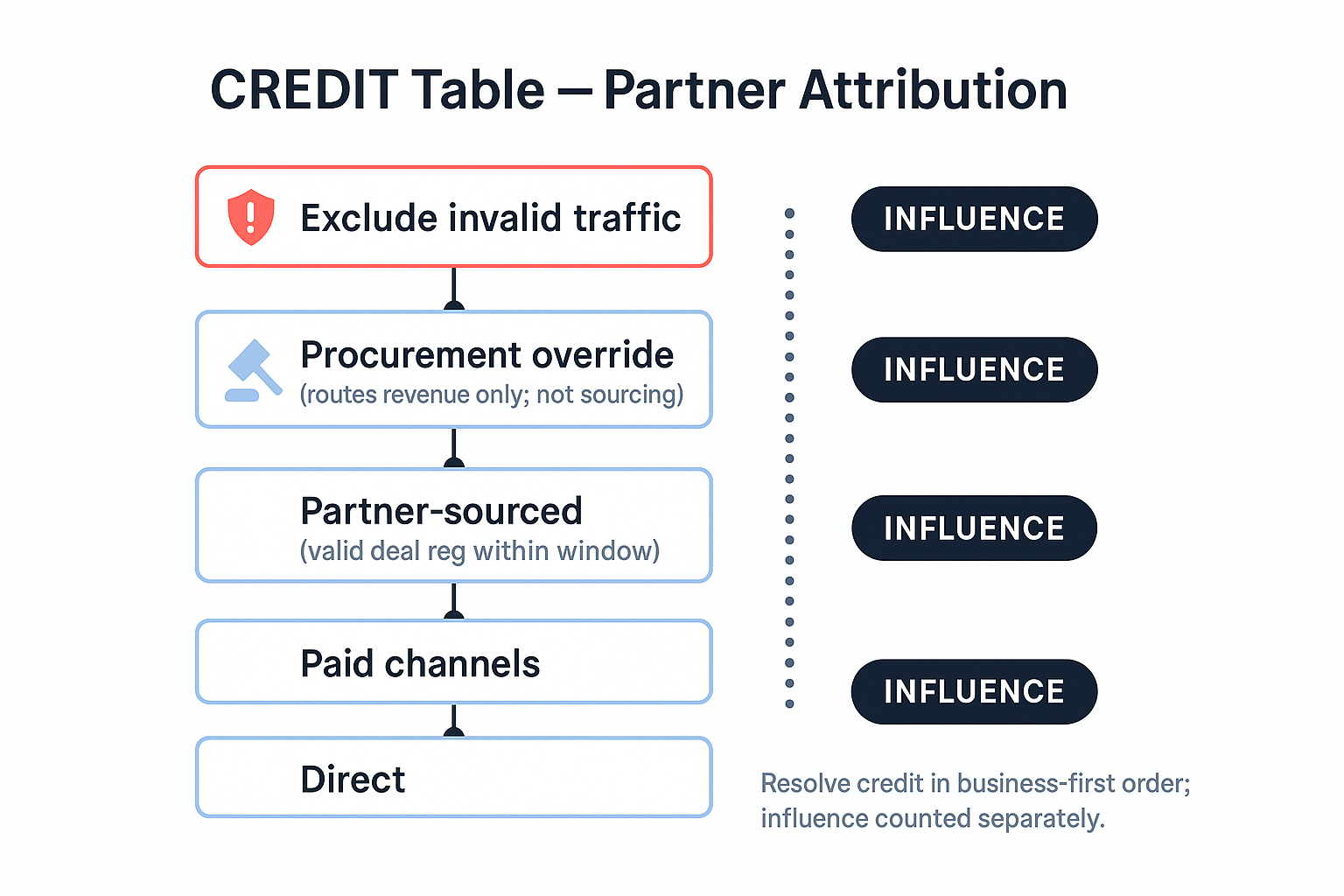
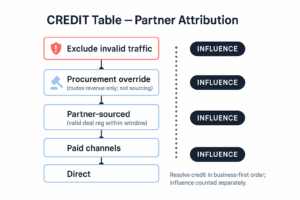
- Attribution & de‑dup: reference the credit table used by both teams.
Keep the MPA < 12 pages. Push details (rate cards, co‑branding examples, reporting fields) into appendices you can update without legal renegotiation.
Enablement: Make Partners Capable, Not Just Aware
Enablement changes behavior when it is role‑specific, asset‑light, and measured.
Who to Train
- AEs & SDRs: qualification, first call deck, ROI story, objection handling, demo script.
- SEs & Consultants: integration map, sample data, success criteria, troubleshooting tree.
- CSMs: handoffs, renewal playbooks, escalation lanes.
- Marketers: joint offer templates, UTM rules, proof pack.
What “Good” Enablement Looks Like
- Certification paths with an exam and a live demo.
- Two‑page battlecards (problem → approach → proof → next step).
- Talk tracks with 20‑second soundbites for three core personas.
- Demo environments with seeded data; 3‑minute walkthroughs with captions.
- Solution page template both teams can clone (headline, who it’s for, what’s included, time‑to‑value, CTA).
Measure Capability
- Pass rates and time‑to‑first‑opportunity.
- Win‑rate delta on partner‑involved deals vs solo.
- Stage velocity (days in stage) when partners join calls early.
- Attach rate of integration/features in joint wins.
Tie MDF eligibility to certification + outcomes, not registrations.
Shared Data Model (Stop Arguing, Start Selling)
Define a minimal, shared schema across PRM and CRM:
Account fields
partner_id,partner_type,overlap_reason,integration_present (Y/N),region,segment.
Opportunity fields
source(direct/partner/paid/marketplace),influence(Y/N + partner_id),deal_reg_id,co_sell (Y/N),private_offer (Y/N),marketplace (Y/N),offer_id,expected_close_date,product_mix,discount,take_rate.
Activity fields
joint_meeting (Y/N),meeting_count,next_step_date,owner_functions (AE/SE/CSM/PartnerAE).
Attribution table (business priority order)
- Fraud/forbidden traffic excluded
- Contracted marketplace procurement override
- Partner‑sourced (valid deal reg)
- Paid (by channel rules)
- Direct
Publish this as a one‑pager; store IDs for offers/listings and use SubID fields for campaigns.
Dashboards You Both Trust
Build three role‑based shared dashboards and review them live monthly.
1) Partner Executive Scorecard (Quarterly)
- Sourced pipeline & revenue (by partner, by segment)
- Influenced pipeline & revenue
- Win‑rate & cycle time delta vs solo deals
- Net revenue after fees/take rate
- Joint customer NPS/CSAT
- Top 5 wins with proof and next steps
- Top 5 risks and owners
2) Co‑Sell Pipeline (Weekly Ops)
- New deal regs (valid/invalid)
- Aging by stage, days since last touch
- Meetings booked (joint)
- Next steps due this week
- Private offers in flight
- Blockers (security, legal, procurement)
3) Co‑Marketing & MDF (Monthly)
- Solution page traffic → demo requests
- Campaign UTM performance (both sides)
- Review velocity & themes (if marketplace/app store)
- MDF spent vs plan; cost per qualified opportunity
- New referring domains from joint posts
Share Looker/Datastudio links or embed in PRM; avoid screenshot PDFs where possible.
Processes That Keep Deals Moving
Deal Registration (golden rules)
- Required fields: account URL, buyer role, problem statement, next meeting date.
- Validity: 90 days from approval; auto‑expire if no meeting in 21 days.
- Conflicts: first‑touch wins if the partner can evidence discovery; otherwise split influence credit.
Co‑Sell Rhythm
- Weekly 20‑min pods (your AE/SE + partner AE/CS): 5 target accounts, 2 intros, 1 next step each.
- Notes logged in the same place; summaries emailed after each call.
- Escalation path for security or legal stalls (named contacts, <=48h response).
Support & Success for Joint Customers
- Shared RACI for incidents and escalations.
- Quarterly success reviews with joint roadmap items.
- Renewal forecast shared 90 days out; identify expansion plays.
Tooling: Keep It Simple, Integrate Well
- PRM for partner onboarding, deal reg, content library, certifications (e.g., Allbound/Impartner/PartnerStack).
- CRM (Salesforce/HubSpot) as the source of truth for pipeline and revenue.
- BI layer (Looker/PowerBI/Data Studio) to publish dashboards.
- G‑suite/Office for shared docs; wiki for playbooks; calendar for pods.
- Status page/Trust center to shorten security reviews.
Avoid duplicating objects; sync IDs and keep a one‑page data flow diagram handy.
90‑Day Implementation Plan
Weeks 1–2 — Baseline
- Draft the shared data model + credit table.
- Update MPA appendices (SLAs, MDF, attribution).
- Pick 5 partners for a pilot; define exec sponsors.
Weeks 3–6 — Train & Launch
- Publish battlecards, demo env, and certification quiz.
- Stand up dashboards; import existing regs; clean duplicates.
- Kick off weekly pods; open the first joint solution page.
Weeks 7–9 — Prove It
- Track win‑rate and cycle delta for partner‑involved deals.
- Run one joint campaign with UTM/SubID discipline.
- Hold first QBR with decisions: add, pause, or invest.
Weeks 10–12 — Scale
- Expand to 10–15 partners; enforce SLAs; release a co‑marketing calendar.
- Tune dashboards; add net revenue after fees and attach rate panels.
Metrics That Matter (and How to Lift Them)
- Partner‑sourced pipeline → raise via tighter ICP match and fast‑lane routing.
- Influence rate → invite partners to first calls; equip with customer stories.
- Win‑rate delta → use joint ROI stories and executive alignment.
- Cycle time delta → pre‑approved legal/security packs; private offers (if cloud).
- Net revenue after fees → keep discounts disciplined; model take‑rates.
- Review velocity (marketplaces) → ask at first value; reply with specifics.
Templates (Copy/Paste)
Deal‑Reg Acceptance
“Approved through [date] for [account] on [problem]. Next step: [meeting on date]. Please attach summary within 24h of the call to keep validity.”
Joint Intro Email
“Hi [Buyer], looping in [Partner AE] who solved [similar problem] at [customer]. We propose a 30‑min working session to map your workflow and leave with a 2‑step plan. How does [two slots] look?”
QBR Agenda
- What we said we’d do
- What happened (wins/learns)
- Metrics vs targets
- 90‑day plan (3 bets)
- Risks & asks
Conclusion
Partner Ops is a product: it has users (AEs, SEs, marketers), interfaces (contracts, dashboards), and outcomes (pipeline, win rate, net revenue). When you standardize contracts, certify people to do the job, and look at the same numbers in the same way, partnerships move from “nice” to necessary.
Add comment