
Paying creators is simple until money moves. Flat fees feel predictable but risk over‑ or under‑paying. Pure performance aligns incentives but can be unfair when you also demand brand lifts, creative rounds, and usage rights. Hybrids try to split the difference—yet collapse if contracts and measurement are weak. This guide lays out three core models (Flat, Performance, Hybrid), how to choose among them, and how to design contracts, tests, and dashboards so your program is both fair to creators and accountable to finance.
Model 1 — Flat Fees (Fixed Pay for Defined Deliverables)
When it shines
- Brand/upper‑funnel goals where outcomes are hard to attribute.
- High‑craft content (storytelling, set design) or talent whose likeness value is the product.
- Tight timelines where creative control and approvals matter more than iteration.
What to define
- Deliverables: formats, lengths, ratios (9:16/1:1/16:9), cut‑downs, thumbnails, raw files.
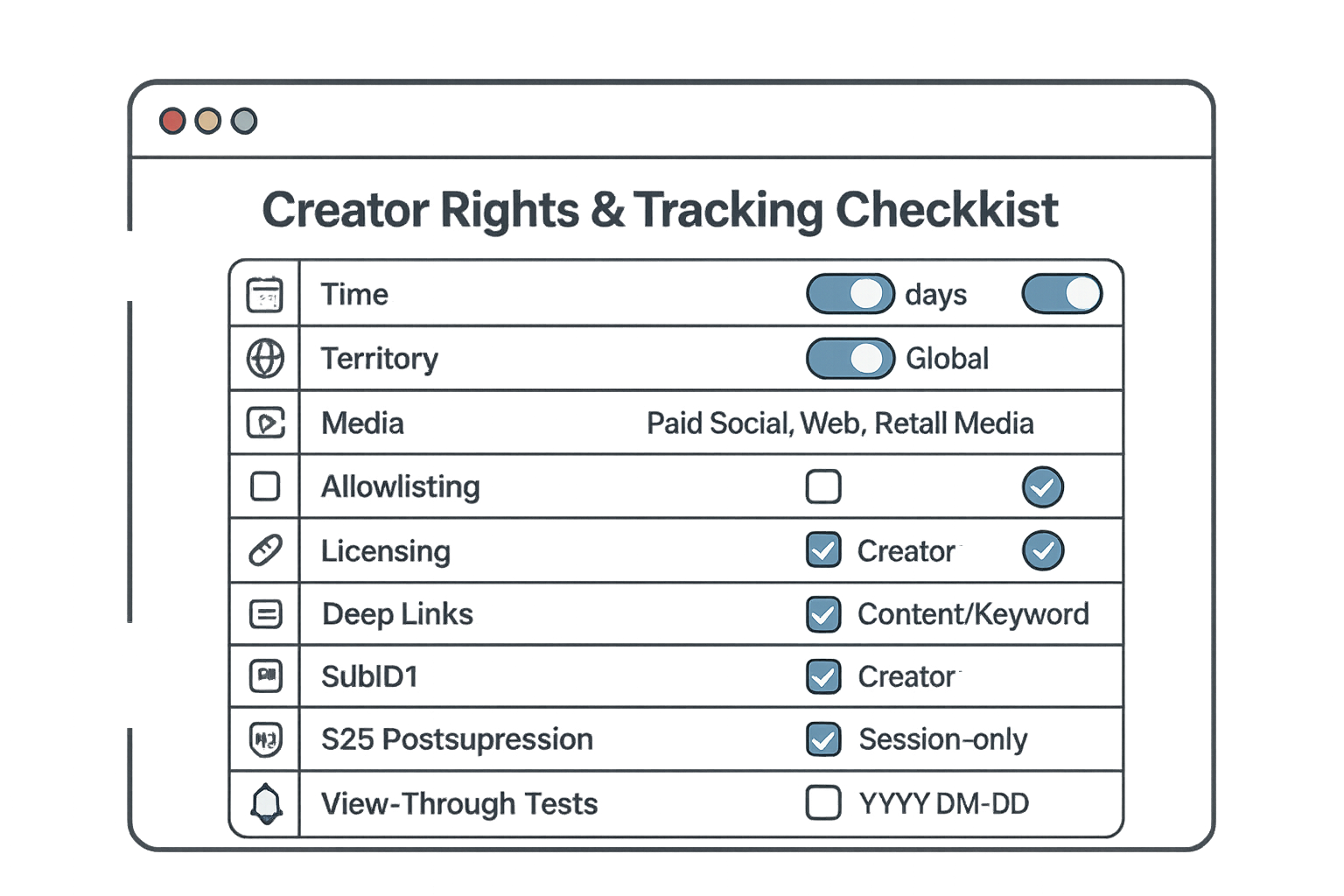
- Usage rights: time, territory, media (paid social, web, retail, OOH/CTV), editing rights, translations.
- Posting: which handles, dates, and pin windows.
- Approval rounds and a 48‑hour cure window for small edits.
- Exclusivity: categories and blackout periods.
Risks & fixes
- Risk: Overpaying for underperformance.
Fix: Add a performance kicker (bonus) tied to measurable KPIs, not a clawback. - Risk: Underpaying craft.
Fix: Separate creation fee from usage and whitelisting so talent isn’t subsidizing media.
Mini example
- Creation fee: $X for 1×60s + 2×15s + RAW.
- Usage: +50% for 90‑day paid social; +100% if adding web/display.
- Whitelisting access: $Y/month with spend cap and brand‑safety guardrails.
- Performance bonus: +$Z if CPA ≤ target over 14 days.
Model 2 — Performance (Pay Per Result)
Common units
- CPA/CPS: cost per acquisition/sale (e‑com/SaaS trials).
- CPL/CPE: lead or qualified event (signup with MQL rules).
- CPC/CPV: clicks/views when the goal is attention at scale.
- Revenue share: % of tracked net revenue for a period.
When it shines
- Clear, short journeys (low AOV e‑com, freemium apps).
- Creators with proven audience–offer fit and a history in your niche.
- You can track cleanly: deep links, UTMs/SubIDs, unique codes, server‑to‑server postbacks.
Risks & fixes
- Risk: Creators bear platform risk (auction shocks, outages).
Fix: Minimum guarantee (MG) or floor to cover production time. - Risk: Cannibalization via coupon/extension hijacks.
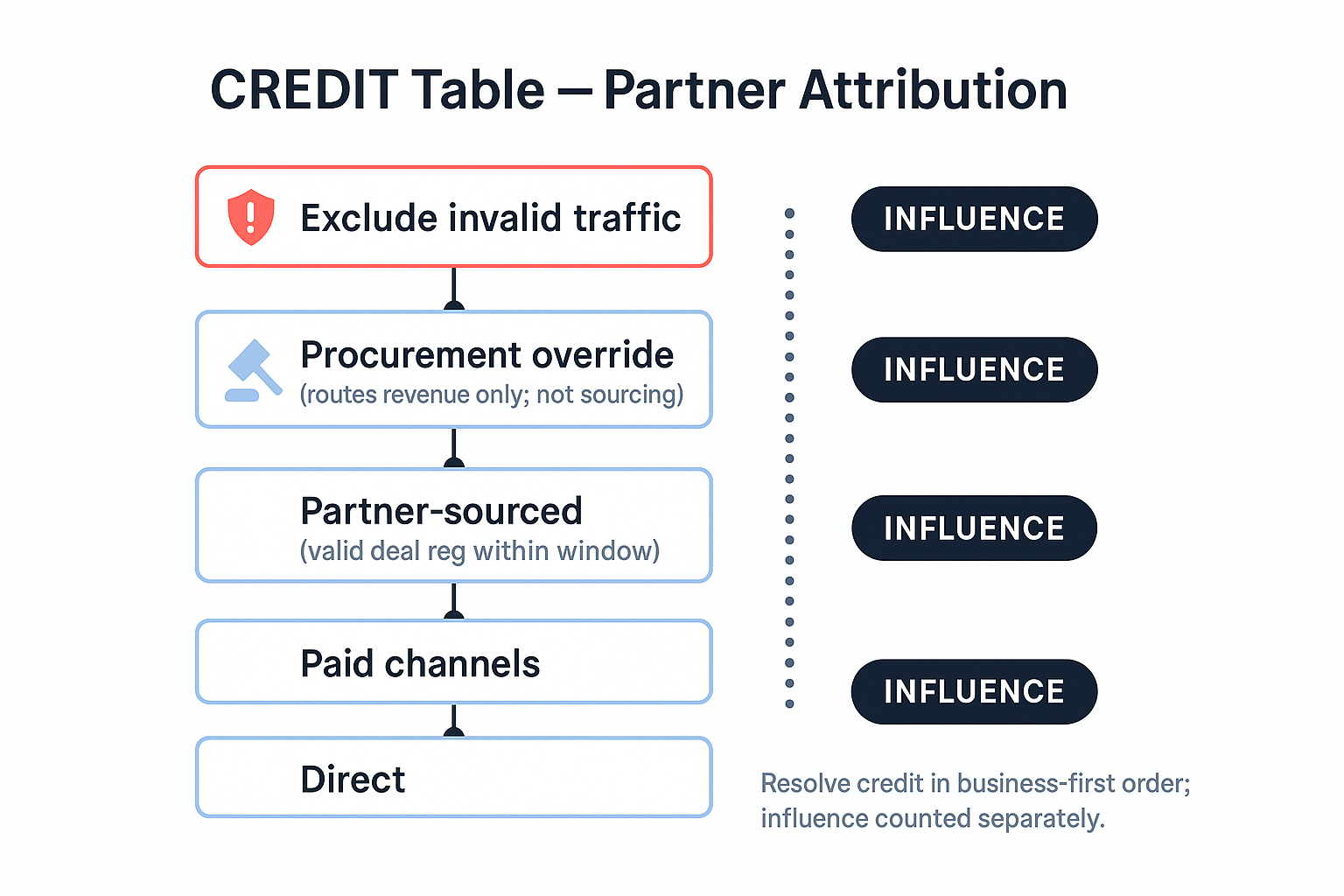
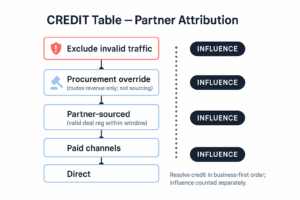
Fix: Last‑click with exclusions (suppress coupon/toolbar if qualifying content click exists). - Risk: Misaligned incentives (clickbait, low‑quality traffic).
Fix: Pay on qualified actions and monitor refund/chargeback rates by creator.
Mini example
- $0 MG + $20 CPA for new‑to‑file users; code + click‑ID required.
- Clawbacks on refunds within 30 days.
- Bonus ladder: +10% CPA if 200+ qualified actions in 14 days; +15% if 500+.
Model 3 — Hybrid (Minimum + Upside)
The why
Hybrid models recognize two truths: creators create assets with option value, and marketers must protect CAC/ROAS. The answer is a Minimum Guarantee (MG) for creation and posting, plus performance upside if the asset wins.
Common hybrids
- MG + CPA: flat MG to cover time; CPA for net‑new customers within window.
- MG + ROAS bonus: MG + a tiered bonus based on ad spend returns when you whitelist or license content.
- MG + revenue share: MG + % of net revenue for a limited term when LTV is strong.
- MG + milestone: bonus on activation (trial→qualified event), not just signups.
Design rules
- Keep MG modest (covers production/time) and upside meaningful.
- Declare tracking, windows, and eligibility in the SOW.
- Pay separately for licensing and whitelisting if you run paid media.
Mini example
- MG = $2,500 for 1×60s, 2×15s, 1 still; 90‑day paid‑social license (+$1,250).
- Whitelisting access = $500/month (handle + approvals).
- CPA = $22 new‑to‑file with last‑click exclusions; 14‑day window; unique code + click‑ID.
- ROAS bonus: +$1,000 if creative sustains 2.5× ROAS on $10k spend.
Choosing the Model: A Decision Matrix
Ask three questions:
- What outcome are we buying? (reach/consideration vs direct sales)
- How clean is tracking? (S2S postbacks, deep links, de‑dup table)
- How much creative craft is required? (script, set, special access)
Quick guidance
- High craft + brand lift → Flat + bonus.
- Direct response + clean tracking → Performance or MG + CPA.
- Mixed goals + paid usage → Hybrid with separate usage/whitelist fees.
Contracts: Clauses That Prevent Drama
- Rights: time/territory/media; editing; translations; captions; alt text.
- Identity: name/handle/likeness permission; ban AI voice clones unless agreed.
- Deliverables & approvals: formats, rounds, deadlines, cure window.
- Exclusivity: scope and windows (e.g., no direct competitors 60 days pre/post).
- Disclosures: FTC/ASA; platform branded content tools.
- Payment terms: MG on signing/first cut, performance paid monthly with reporting.
- Metrics definitions: what counts as a qualified action; fraud/refund clawback rules.
- Data & access: advertiser permissions for allowlisting; revoke at term‑end.
- Termination & morals: pause within 24 hours; pro‑rata payments.
SOW naming conventionCREATOR_Handle|Concept|Deliverables|RightsEnd_YYYY‑MM‑DD|Model(MG+CPA)
The Math (Make Finance Smile)
Net Media Efficiency (NME)(Incremental revenue − media − creator fees − network fees) ÷ media
Incremental revenue requires a test or at least a correction factor. If you can’t run holdouts, use new‑to‑file % and refund deltas by creator to estimate quality.
Worked example (hybrid)
- Spend = $10,000; Orders = 600; AOV = $60 → Gross rev = $36,000.
- Estimated incremental share = 60% → $21,600.
- Creator fees: MG $2,500 + license $1,250 + whitelist $500 + CPA $22×200 = $4,400 → $8,650 total.
- Network fees: $600.
- NME = (21,600 − 10,000 − 8,650 − 600) ÷ 10,000 = 0.235 (23.5%).
If target NME is ≥20%, extend rights. If not, end term and test a new concept.
Tracking & Fraud Hygiene
- First‑party click IDs on your domain; S2S postbacks for purchases/events.
- Deep links to product/cart; pass SubID1 (creator) and SubID2 (content/keyword).
- Code + click match: only pay code‑use if a qualifying click exists in window.
- Coupon/toolbars: session‑only eligibility; suppress if other qualifying click exists within 14 days.
- Refund/chargeback audits by creator; clawbacks per SOW.
- View‑through: allowed only with pre‑registered tests (geo split or PSA swap).
Equity & Ethics (Pay Fairly)
- Rate transparency: separate creation from licensing and allowlisting; publish your ranges.
- Access costs: fund closed captions, travel, childcare when relevant; do not shift accessibility costs to creators.
- No perpetuity: buy time‑bound rights with options.
- Consent & privacy: no scraping DMs; keep personal data out of contracts.
Dashboards You’ll Actually Use
- Creative leaderboard: thumb‑stop rate, 3‑sec views, VTR, CTR, CPA/ROAS by concept and handle (brand vs creator).
- Quality board: new‑to‑file %, refund rate, repeated buyers, support tickets by cohort.
- Rights tracker: asset ID → rights window end date; auto‑pause before expiry.
- Payout ledger: MGs, performance payouts, bonuses, and licensing renewals.
30‑Day Starter Plan
Week 1 — Design: pick 3 creators; choose model per decision matrix; draft SOW with rights and disclosures.
Week 2 — Produce: shoot 2 concepts per creator (demo + myth‑bust); clear music; capture RAW.
Week 3 — Launch: A/B brand vs creator handle; wire S2S postbacks; set CPA ladders or ROAS bonus terms.
Week 4 — Read & Act: extend rights on winners; pay bonuses; cut losers; write a 1‑page post‑mortem.
FAQ (Quick Answers)
Can we do rev share only? Works for subscription/LTV plays with clean attribution. Add a small MG to cover creative labor.
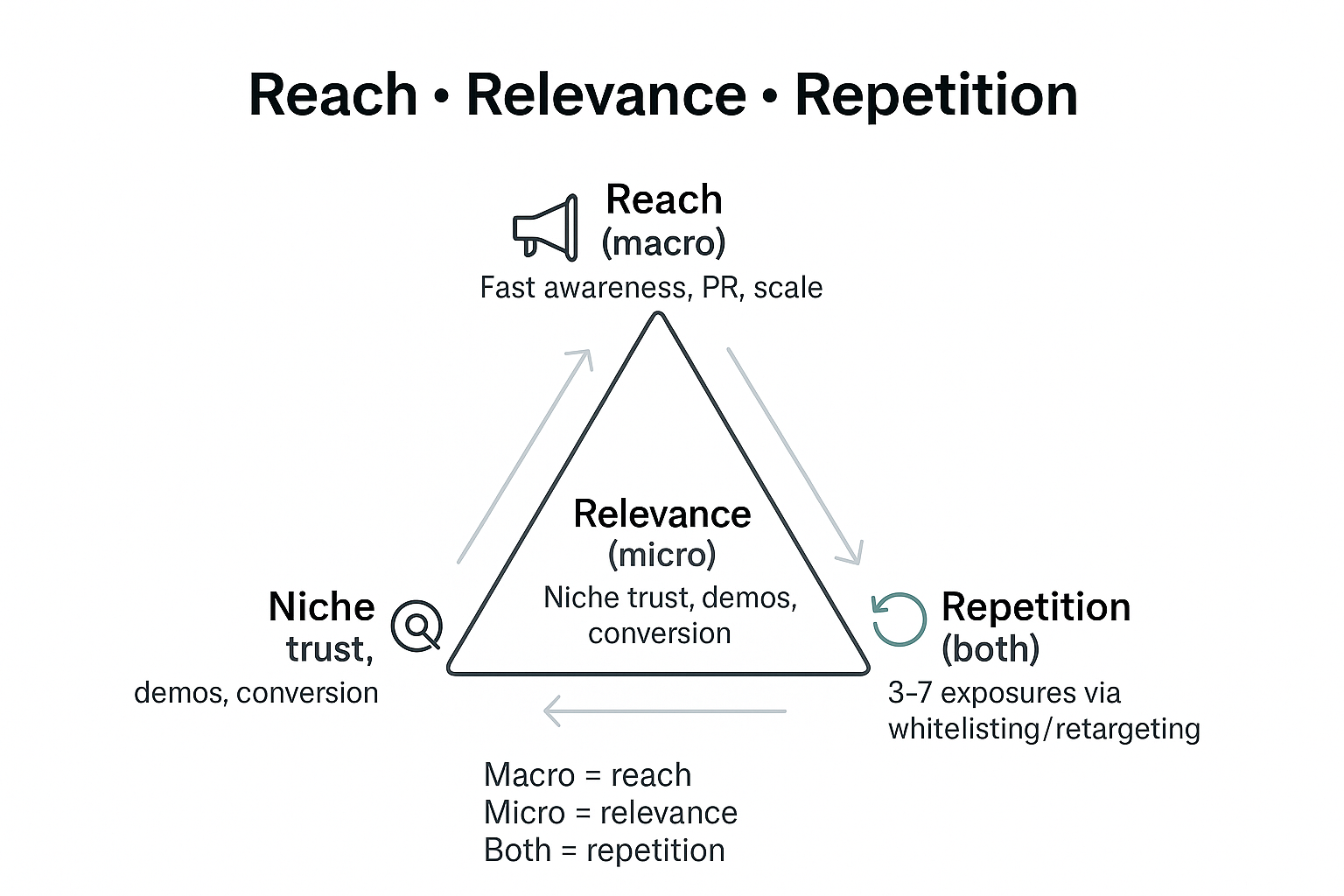
What about micro‑creators? Often outperform on CPA; pay fair MGs and scale breadth, not just spend.
How long should usage be? Buy 90 days with options; keep TV/CTV separate.
Do we need whitelisting if we’re not running ads from their handle? No—then you need licensing only.
Conclusion
There is no one “right” way to pay creators—only fit for purpose. Flat fees buy craft and certainty. Performance buys accountability. Hybrids blend the two when you also need paid usage or whitelisting. If you separate creation from usage and identity, define KPIs in plain English, and run simple incrementality tests, you’ll pay fairly—and scale what works.
Add comment