
Introduction
National reputation often starts on neighborhood streets. Editors everywhere are hunting for specific, human stories with proof—exactly what community work produces. But most brands treat local PR as charity posts and ribbon‑cuttings. That’s performative, forgettable, and hard to scale.
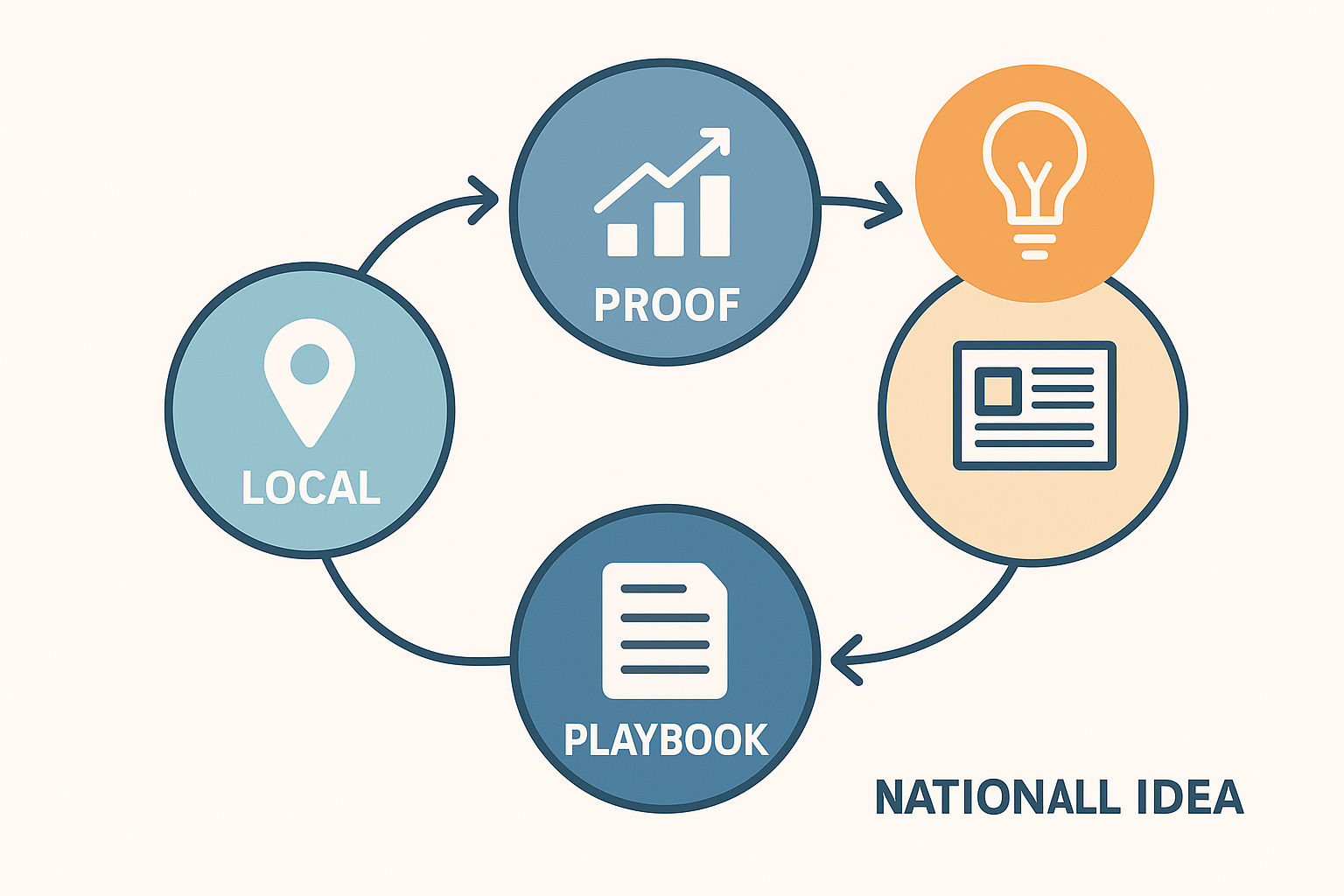
This guide shows how to build a local‑to‑national flywheel: pick authentic community problems you’re qualified to help solve; measure outcomes; publish with transparency; pitch local newsrooms first; then translate the lesson into a national angle. Do the work, capture the proof, and let place give your story texture and trust.
The Local→Regional→National Flywheel
- Do real work that aligns with your product/mission (not random acts of philanthropy).
- Instrument outcomes with simple, auditable metrics.
- Publish locally with faces, numbers, and partners.
- Package the pattern so others can reuse it.
- Pitch regionals/nationals with the big idea + local evidence + ready access.
When a local story scales, it’s usually because it has three layers: human scene → community result → generalizable insight.
Choose the Right Community Problems (Fit Test)
Use this 4‑point filter before you launch any initiative:
- Relevance: Does this problem intersect with what we sell or know? (e.g., logistics startup → food bank cold chain; edtech → adult digital literacy.)
- Continuity: Can we commit for 6–12 months, not just a weekend?
- Measurability: Can we track baselines and outcomes without invasive data?
- Partners: Are there credible local organizations who want this?
If you can’t check all four, pick a smaller effort or a different issue. Authentic beats grand.
Story Forms That Travel
1) Pilot → Playbook
Run a 90‑day pilot with a community partner, publish a 2‑page playbook anyone can reuse (steps, pitfalls, budget, timeline).
2) Local Data → National Trend
Aggregate anonymized local usage/survey data and show how it mirrors or contradicts national narratives. Include a method note and limitations.
3) One Street → One Policy
Show how a micro‑change (e.g., changing pickup windows for seniors) reduced waste or wait times, and connect to a policy discussion other cities face.
4) Skills Transfer
Employees volunteer core skills (design, compliance, devops). Document the before/after and publish templates ( checklists, dashboards) others can steal.
Asset Kit: What to Capture From Day One
People
- Named spokespeople (community partner + your operator) with bios and photos.
- 2–3 residents/customers willing to be quoted (with consent forms).
Numbers
- A baseline and a small set of outcomes (e.g., “appointments kept ↑ 21% in 10 weeks”).
- Method note (period, sample size, caveats).
Visuals
- Photos in context (faces, places, action) + alt text.
- One simple chart (SVG) that shows the change.
Docs
- A 1‑pager factsheet, partner MOUs, and a repeatable checklist.
- A public “How we did it” post on your owned channels.
Access
- Interview windows, location access (if appropriate), and a media contact who replies quickly.
Packaging: Make the Local Story Easy to File
- Lead with names and place. “In Rustavi’s 2nd microdistrict, a volunteer dispatcher named Nino cut average wait times by 18 minutes in June.”
- Add one chart and two photos (with permissions).
- Include the partner voice first—your brand second.
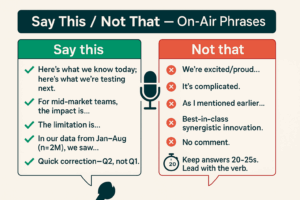
- Plain language: avoid CSR jargon; describe what changed for whom and how you measured it.
Mini template (owned post)
Headline: [Place] did X; here’s the playbook we used.
Nut graf: what changed, for whom, how measured, what it cost.
Body: steps, partners, numbers + limitations, quotes, reusable checklist.
Close: “If you want to try this in your town, here’s the contact + template pack.”
Outreach Ladder (Emails You Can Copy)
Local newsroom (first):
Subject: [Neighborhood] pilot cut [problem] by [number] in [weeks]—want a look?
Hi [Name]—We’ve been working with [partner] in [neighborhood] since [month] to fix [problem]. Two numbers: [metric 1, time window], [metric 2, time window]. [Partner spokesperson] and [resident name] are available for 10 minutes on [days]. Photos and a one‑page method are ready. Would this fit your [beat]?
Regional/national (after local runs):
Subject: A local pilot that scaled: what [city] taught us about [bigger issue].
Hi [Name]—You covered [issue] nationally last month. In [city], a small pilot changed [result] and offers a replicable approach: [one‑line lesson]. We can share data, a chart with method notes, and connect you with the community lead. Interested in a quick look?
Partner First: How to Share the Stage
- Co‑author posts with the community org; let them lead the quote.
- Share assets (photos, charts) under commons‑style terms so partners can publish too.
- Revenue‑free zones: keep product plugs out of community write‑ups unless they are strictly factual and essential.
Measurement: Reputation and Real‑World Outcomes
Community KPIs
- People affected (with definitions), completion/adoption rates, time or cost saved, satisfaction.
- Partner capacity built (tools left behind, staff trained).
Reputation KPIs
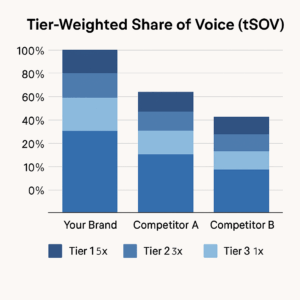
- Quality of local coverage (QCI), Tier‑weighted SOV when the story scales, message pull‑through of the lesson learned.
- Brand search lift in the city/region; referral + read‑depth to the playbook post.
- Inbound from policymakers/journalists from outside the region.
Guardrails
- Report limits honestly. If the pilot only ran 6 weeks with n=120, say so—and say what you’re testing next.
Calendar: Pegs You Can Plan Around
- Civic moments: city budgets, school calendars, transit or health campaigns, local elections (non‑partisan information access), seasonal weather impacts.
- Industry tie‑ins: your product’s release cycles, new standards/regulations, conferences coming to town.
- Cultural anchors: holidays, festivals, sports, community anniversaries.
Map a 12‑month calendar and pencil “ownable” weeks with partners.
Ethics: Community First, Always
- Informed consent for quotes/photos; avoid exploiting hardship.
- Do no harm: never publish details that could endanger people (locations, identities, vulnerabilities).
- No parachuting: hire local photographers, translators, and fixers; pay partners for their time.
- Sustainability: commit to maintenance (e.g., report back after six months; fund replacement parts).
- Transparency: publish budgets and in‑kind contributions when possible.
Case Sketches (Hypothetical but Realistic)
1) Transit Reminder Pilot (Mobility app × City transit)
Problem: missed early‑morning buses for shift workers.
Action: opt‑in SMS alerts tied to route reliability and depot delays.
Result: on‑time arrival ↑ 14% across two depots in 8 weeks; drivers reported fewer crowding spikes.
Scale: union and city published a joint playbook; two neighboring cities copied it; national outlet covered the labor impact angle.
2) Heat Map Teams (HVAC startup × Seniors center)
Problem: summer heat deaths among elderly residents.
Action: sensors + weekly volunteer checks + portable units where readings spiked.
Result: emergency calls ↓ 23% during heat alerts; 3‑hour response window standard set.
Scale: state public‑health blog featured the data cut; national press used it during a heatwave story.
3) Skills Hub (Edtech × Local library)
Problem: adults struggling with gov services online.
Action: 6‑week micro‑course taught by employees on Saturdays; childcare provided.
Result: completion 78%; median form‑completion time cut by 40 minutes; library staff trained to continue.
Scale: regional radio ran a feature; national outlet tied it to the digital divide.
Playbook: 30‑Day Sprint to Your First Local Story
Week 1: pick a problem with a partner; define a single outcome metric; assign a project owner.
Week 2: launch a small pilot; set up collection for quotes/photos/consents; draft the one‑pager.
Week 3: check the data; adjust; capture a before/after photo and a short resident interview.
Week 4: publish the owned post + chart; pitch two local reporters; schedule a partner‑led community debrief; plan the “scale” angle.
Checklist (Print This)
Conclusion
Community PR isn’t a shortcut to national headlines—it’s the source material for credible stories. If you choose problems you can actually help solve, measure honestly, and let partners lead, your local work will earn local trust. Package that proof with care and it becomes the backbone of national narratives that feel human, specific, and true.
Add comment