
Introduction
Columns and op‑eds still shape agendas—when they are timely, argued with evidence, and written in a human voice. The problem: most brand “thought leadership” reads like sanitized marketing, and most pitches miss the editorial bar by confusing opinion with promotion. This guide shows how to place bylines that editors actually want, how to build a recurring column, and how to ghostwrite with integrity—so readers get value and your brand earns authority without pay‑to‑play.
Columns vs. Op‑Eds (and Where You Fit)
Op‑ed: a one‑off argument tied to a now moment. It takes a stance, offers evidence, addresses counterpoints, and ends with a clear implication or call to action.
Column: a recurring voice on a defined beat (e.g., fintech risk, creative operations, supply‑chain AI). Columns compound value through consistency: readers return for the approach as much as the topic.
Guest post / contributed article: somewhere in between—less hot‑take than an op‑ed, more explainer than a column.
Fit test
- If you have a strong thesis about a timely issue and fresh numbers → Op‑ed.
- If you can publish on a beat every 2–4 weeks with original frameworks and examples → Column.
- If you want to unpack how something works or what to do next → Contributed article.
Editor’s Bar: What Gets Accepted
Before you think about a pitch, audit your idea against the four gates editors use:
- Timeliness: Why this, this week? Tie to a decision window, release, ruling, earnings, or behavior shift.
- Originality: New angle, data, or lived experience. If ten founders could write it, it’s not yours yet.
- Evidence: Numbers, examples, method notes, and cited sources.
- Service: What readers should think/do differently by the end. Plain takeaways beat lofty rhetoric.
Pro tip: De‑risk acceptance by proposing a format that fits the outlet (Q&A with a customer, annotated chart essay, short case breakdown).
The Op‑Ed Structure That Files Fast
Use this seven‑part spine. Keep sentences short; lead with verbs.
- Hook (2–3 sentences): Start at the moment of tension—an unexpected stat, a seen‑from‑inside anecdote, or a sharp question.
- Thesis (1 sentence): State your stance in a way a critic would recognize.
- Context (1 paragraph): What changed? Who’s affected? Why now?
- Evidence (2–3 paragraphs): Your data, named examples, expert references. Include a method note or limitations line.
- Counterpoint (1 paragraph): Steel‑man the opposing view and explain the trade‑offs.
- Implications (1 paragraph): What this means for the audience (policy, operators, consumers).
- Close (2 sentences): Memorable line + clear next step or question to watch.
Mini‑example
Hook: “Nearly 1 in 5 retail returns last quarter were fraudulent—our 12M‑receipt dataset shows where the leak is.”
Thesis: “Audit belongs at the moment of purchase, not the month‑end reconciliation.”
Evidence: “Inline models caught duplicates and screen‑edited totals with 94% precision; three mid‑market pilots cut reimbursements delays from 7 days to 36 hours.”
Counterpoint: “False positives frustrate employees; here’s how we thresholded to avoid that.”
How to Build (and Keep) a Column
Define your lens. A good column isn’t “everything AI.” It’s AI where it meets ops budgets in mid‑market companies—or another crisp intersection.
Promise a cadence you can keep. Editors prefer reliability over bursts of brilliance. Start monthly; move to bi‑weekly when your process is tight.
Create a column kit:
- Angle bank: 12–15 one‑line ideas with pegs, so you’re never starting cold.
- Evidence shelf: lightweight datasets, 2–3 recurring charts you update, a list of go‑to sources.
- Story forms: rotating formats (framework breakdown, case study, counter‑intuition, mailbag).
- Voice rules: phrases to use/avoid, sentence rhythm, how much first‑person, how to handle product mentions (usually: minimal, factual, and relevant or not at all).
Compound value with series. Pitch a 3‑part arc (e.g., The New Pre‑Sale, The Proof Pack, The Post‑Launch Reality). Outlets like a roadmap.
Pitching: Email Templates That Don’t Sound Like PR
Subject (op‑ed): Your readers are missing X in the [current story]—we can show it with data from [N] cases.
Body:
Hi [Name]—Two fast points your readers don’t have yet: 1) [metric, number, time‑window, source]; 2) [specific implication]. I can file 800–900 words by [date] with a method note and named examples. I’ve attached two headlines and a two‑sentence nut graf below. Does this fit your coverage today?
Subject (column proposal): Monthly column on [beat]: practical frameworks + fresh data (3 sample headlines).
Body:
Hi [Name]—I’d like to propose a monthly column covering [beat] for [audience]. Every piece includes a usable framework, one chart (SVG), and a named case. Here are three sample headlines and a 3‑month outline. Can we discuss fit?
Attachments / inline:
- 2–3 headlines + 2‑sentence nut graf for each.
- 1 sample chart (with alt text) and a source line.
- 1 paragraph bio that proves domain expertise.
Ghostwriting With Integrity (Voice, Process, Ethics)
Ghostwriting works when readers hear a real voice and editors trust the process.
Voice capture
- Run a 25‑minute recorded interview. Ask for stories, not claims: “Tell me about the day X failed.”
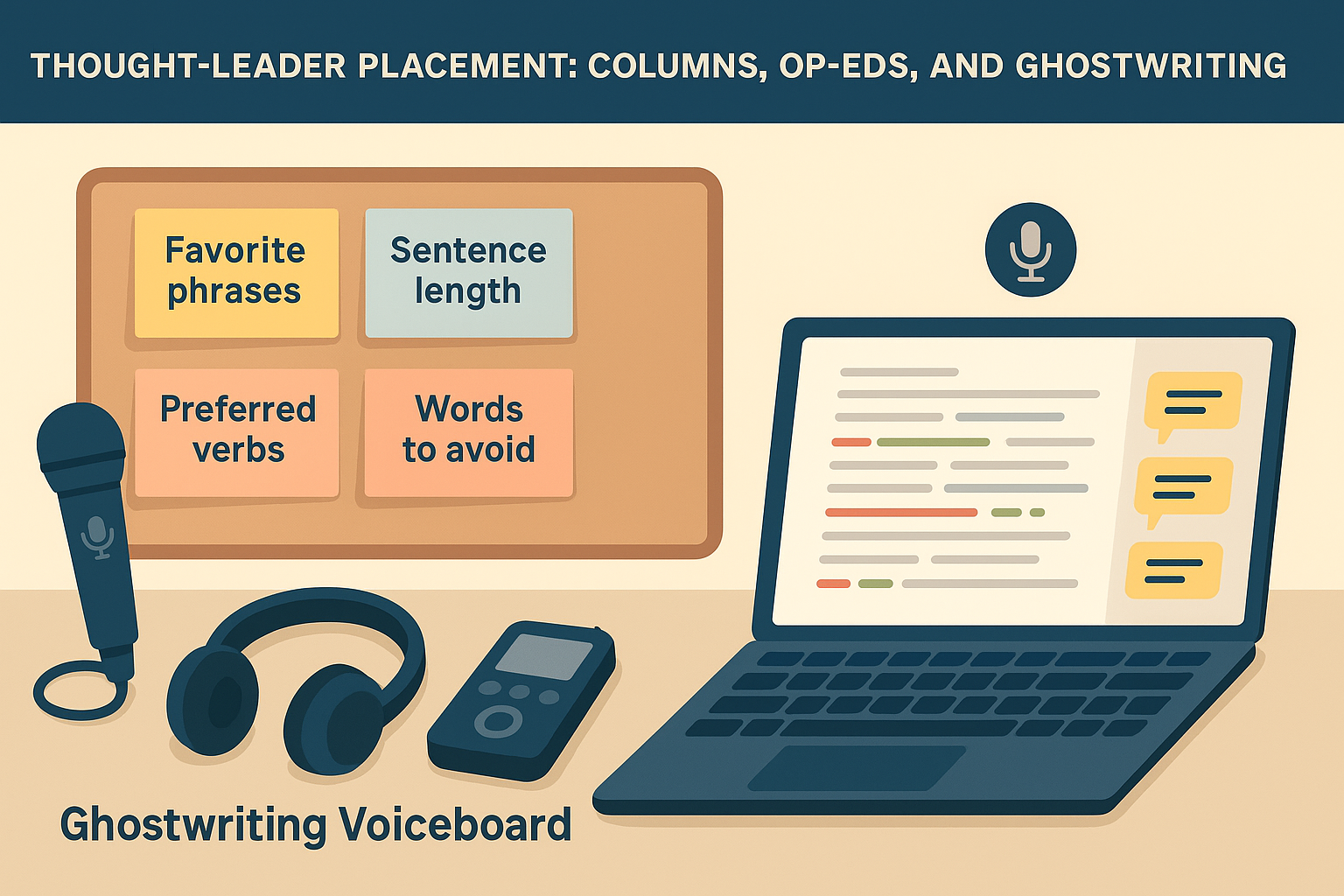
- Build a voiceboard: 10 phrases they naturally use, 5 to avoid, sentence length, preferred verbs, tolerance for jargon, stance on humor.
- Collect artifacts: past talks, internal memos, unsent drafts. Mark what sounds like them.
Proof discipline
- Separate claims from facts in the draft. Footnote stats with sources and dates.
- Add a “limitations” line to every dataset (“Mid‑market only; SMB variance likely”).
- Pass a basic fact‑check: names, titles, dates, and numbers verified against primary sources.
Ethics & disclosure
- Follow the outlet’s policy on ghostwriting and bylines. Some require co‑bylines or acknowledgments; most accept PR‑assisted drafts if the named author reviews and approves.
- Avoid astroturfing: do not place pieces under false affiliation or hide conflicts of interest.
- Keep a signed final‑approval record from the named author before filing.
Workflow
- 30–45 min interview → 2–3 day draft
- Margin questions for specifics and anecdotes
- Second pass to tighten verbs, cut adjectives
- Legal/comms review (narrowly scoped)
- Proof + alt text for visuals
- Author read‑aloud before send
Do’s, Don’ts, and Red Flags
Do
- Lead with a point of view, not a product.
- Keep paragraphs short (3–5 sentences), verbs active, and examples named.
- Provide charts as SVG with short alt text and a one‑line method note.
- Offer access: a contact for follow‑up, a dataset appendix, or a named customer willing to speak.
- Track outcomes like product metrics (see below).
Don’t
- Write listicles without a thesis.
- Pitch generic “Five tips for innovation.”
- Over‑optimize for SEO in the byline; optimize your site version instead.
- Submit simultaneously to multiple outlets unless their guidelines allow it.
- Bury conflicts of interest.
Red flags
- Pay‑to‑publish packages disguised as editorial.
- Outlets that demand followed links for money.
- Editors who remove data without context or introduce factual errors—push back politely, with sources.
Measuring Impact (Beyond Vanity)
Treat placements as part of a research and distribution loop, not a trophy case.
- Acceptance rate: accepted ÷ pitched (by outlet and angle).
- Time to publish: from pitch to live (days).
- Quote/idea spread: mentions in secondary coverage, social references of your thesis line.
- High‑intent actions: demos, inbound from ICP accounts within 7 days of publication.
- Link equity: dofollow ratio, anchor text relevance, landing page conversion.
- Reader feedback: corrections, letters, expert replies—feed into next pieces.
Post‑publication, ship an Owned Explainer that expands the method, hosts the charts, and links to the byline. This turns earned attention into long‑tail discoverability.
Two Sample Outlines
Op‑ed (800–900 words):
- Hook (anecdote or stat)
- Thesis
- Context + stakes
- Evidence 1–2 (named examples)
- Counterpoint + trade‑offs
- Implications for [audience]
- Close with a line and a next step
Column (monthly, 1,100–1,400 words):
- Cold open scene or question
- Framework with labeled steps
- Chart or table (SVG + alt text)
- Case study (before/after, numbers)
- Playbook (what to do Monday)
- Reader mailbag or prediction for next month
Frequently Asked (Quick Answers)
Can I mention my product? Sparingly and factually (e.g., “in our pilot with 200 SMB stores…”). If the piece only exists to mention the product, it’s an ad, not an op‑ed.
Should I pitch exclusives? For op‑eds tied to breaking news, yes—one outlet at a time. For evergreen columns, proposals can go to a short list sequentially.
How long should I wait to follow up? 3 business days or when the news peg evolves—whichever comes first. Bring a new angle when you follow up.
Conclusion
Thought‑leader placement is a craft. Respect the editorial job: bring a new idea at the right moment, prove it with specifics, and write in a voice a human could say out loud. When you combine a clear thesis with evidence and a repeatable workflow—whether you write or ghostwrite—you’ll earn bylines that move minds and markets.
Add comment