
Introduction
Speed helps, substance wins. In fast news cycles, many brands scramble to “say something” and end up newsjacking—pushing irrelevant or opportunistic takes into sensitive conversations. Editors notice, and audiences remember. Rapid response PR (RRP) is different: you move quickly only when you can add verified facts, clear explanations, or practical next steps that help a reporter file a better story. This guide shows how to build a repeatable RRP program that wins by being useful—not loud.
Rapid Response vs. Newsjacking (Know the Line)
Rapid response: timely, on‑topic commentary grounded in your expertise and data, offered to the right reporters with ready‑to‑publish assets.
Newsjacking: opportunistic tie‑ins with weak relevance, self‑promotion during crises, or takes that add heat but no light.
Three litmus tests
- Relevance: Do we have unique expertise, data, or access? If not, pass.
- Contribution: Will our input help audiences understand, decide, or act?
- Respect: Would this feel exploitative to those affected? If yes, stop.
The R.A.P.I.D. Framework
Use this five‑step loop to decide and deliver in under two hours.
R — Relevance Map
Maintain a pre‑approved “right‑to‑speak” map: topics where you’re an authority (green), adjacent areas (amber), and off‑limits (red). Include examples.
A — Angle Bank
Keep reusable angles that serve journalism, not slogans:
- Explainer: plain‑English breakdown of how X works.
- Impact: who is affected, how much, and when.
- Data check: what the numbers do/don’t show; method notes.
- Next steps: what to watch in 24–72 hours.
- Counter‑intuition: common myth and the evidence against it.
P — Proof Pack
A small folder you can send instantly: one‑page factsheet, three paste‑ready stats with time windows and sources, two named quotes (short/long), one illustrative chart (SVG + PNG@2x), and spokesperson availability windows.
I — Integrity Guardrails
Rules that protect brand and audience: no commentary on ongoing tragedies without a concrete way to help; no legal speculation; label opinion as opinion; add limitations to every stat; respect embargoes; offer off‑the‑record context only with clear terms.
D — Delivery Pipeline
A routable workflow (Slack/Teams + CRM) to move from trigger → draft → legal review (tight) → outreach in <120 minutes.
Build Your Readiness Stack
1) Monitoring
Set up layered alerts:
- Beat reporters & outlets (newsletters, RSS, X/Twitter lists, journalist databases).
- Keywords & entities (product category, competitors, regulators).
- Calendar triggers (earnings, rulings, standards, major conferences).
Route alerts to a #rapid‑response channel with clear on‑call owners.
2) Spokesperson Bench
Have 2–3 trained voices with bio, headshot, areas of expertise, and calendar windows. Capture plain‑language quotes in their voice during calm weather, not storms.
3) Data Shelf
Maintain small, defensible datasets you can query within minutes—recent usage cohorts, anonymized customer results, benchmark tests. Each metric gets a method note and last‑updated date.
4) Legal/Compliance Sprint
Pre‑agree on what can ship without extra approvals (e.g., non‑PII aggregated stats, previously published benchmarks). For risky topics, define a 15‑minute legal check path with named contacts.
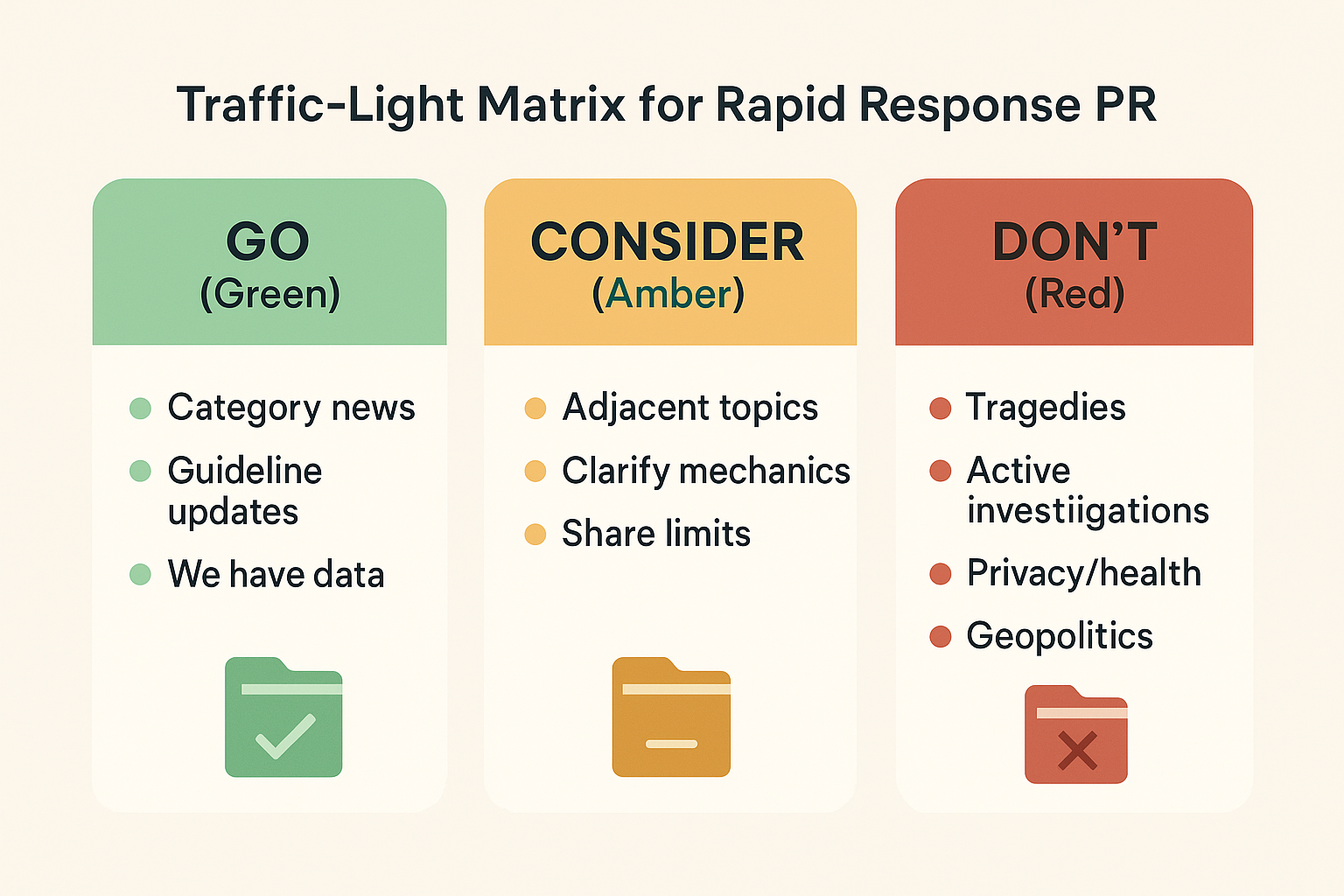
The Trigger Triage (Traffic‑Light Matrix)
- Green (go now): category news where you have authority (standard updates, product recalls in your domain, new guidelines in your niche).
- Amber (consider): adjacent topics where you can clarify mechanics or impact; proceed only with proof and a value‑first angle.
- Red (do not engage): human tragedy, active investigations, individual health/privacy matters, geopolitical flashpoints—unless you are a primary responder with verified information.
Document examples of each color so teams aren’t guessing under pressure.
First 90 Minutes: A Play‑by‑Play
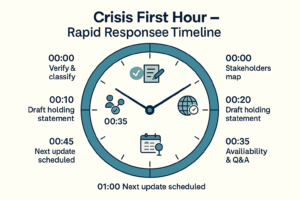
00:00–00:10 — Confirm the peg. What happened? What’s verified? Which angle from the bank fits? Green/amber/red?
00:10–00:30 — Draft quotes + proof. Pull 1–3 numbers, add limitations, write a 2–3 sentence quote in plain English.
00:30–00:45 — Package assets. Factsheet link, one chart (SVG + PNG@2x), availability, and contact.
00:45–01:00 — Targeted outreach. 6–10 reporters who actively cover the beat; no bcc blasts.
01:00–01:30 — Be reachable. Hold a 30‑minute window for callbacks; prepare a 5‑minute briefing doc for spokespeople.
Outreach That Helps Reporters File (Templates)
Subject: Quick, verified context on [news peg]—two numbers + 10‑min call?
Hi [Name],
Two numbers we can verify today: 1) [metric, number, time‑window, source]; 2) [metric, number, time‑window, source]. Happy to share a chart and a 10‑minute call with [Title, Name] on how this affects [their audience]. We’ll also flag what the data doesn’t show so readers aren’t misled. Available [two time slots].
If offering a byline or explainer
Working title: “What [news] actually changes for [audience] in the next 30 days.”
Deck: 600–800 words, three charts, clear limitations, no product pitch.
For social/X thread (owned amplification)
- What happened
- What’s new vs. noise
- Two numbers
- What to watch next
- Link to the proof pack
Style Guide for Quotes Editors Keep
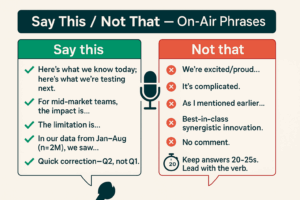
- Use verb‑first, plain English. One idea per sentence.
- Quantify impact. “For mid‑market retailers, this likely shifts returns by 3–5% this quarter.”
- State the limit. “We don’t see SMB data yet; expect variance.”
- Avoid victory laps. Replace “we’re excited/proud” with what readers can do next.
Measurement: What “Working” Looks Like
Track results like a product launch:
- Time to first callback (minutes).
- Quote acceptance rate (# stories that used your quote ÷ # pitches).
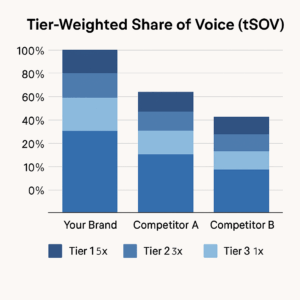
- Tier and relevance (A/B/C outlets mapped to your ICP).
- Link quality (dofollow, anchor, referral traffic).
- Readability (Flesch score of quotes and explainers).
- Accuracy feedback from reporters (zero corrections is the goal).
Feed learnings back into the angle bank and proof pack.
Common Pitfalls (and Fixes)
- Spray‑and‑pray lists. → Keep <15 reporters per peg; tailor the first sentence to their last three stories.
- Hot takes without data. → Run a micro‑query or cite reputable external sources with clear attribution.
- Slow legal review. → Pre‑approve specific data fields; maintain a “safe stats” library.
- Over‑talking. → Offer a 10‑minute slot and stop at 8 unless asked to continue.
- Silence after send. → Hold an on‑call window and publish a short owned explainer even if no coverage lands; it powers future outreach.
Ethics Checklist (Print This)
Conclusion
Rapid response is a service to editors and readers. If you can’t help a reporter publish a clearer, more accurate story today, you don’t need to be in the story today. Build the system—relevance map, angle bank, proof pack, guardrails, and delivery pipeline—and you’ll stand out in any cycle without ever crossing into newsjacking.

Add comment