
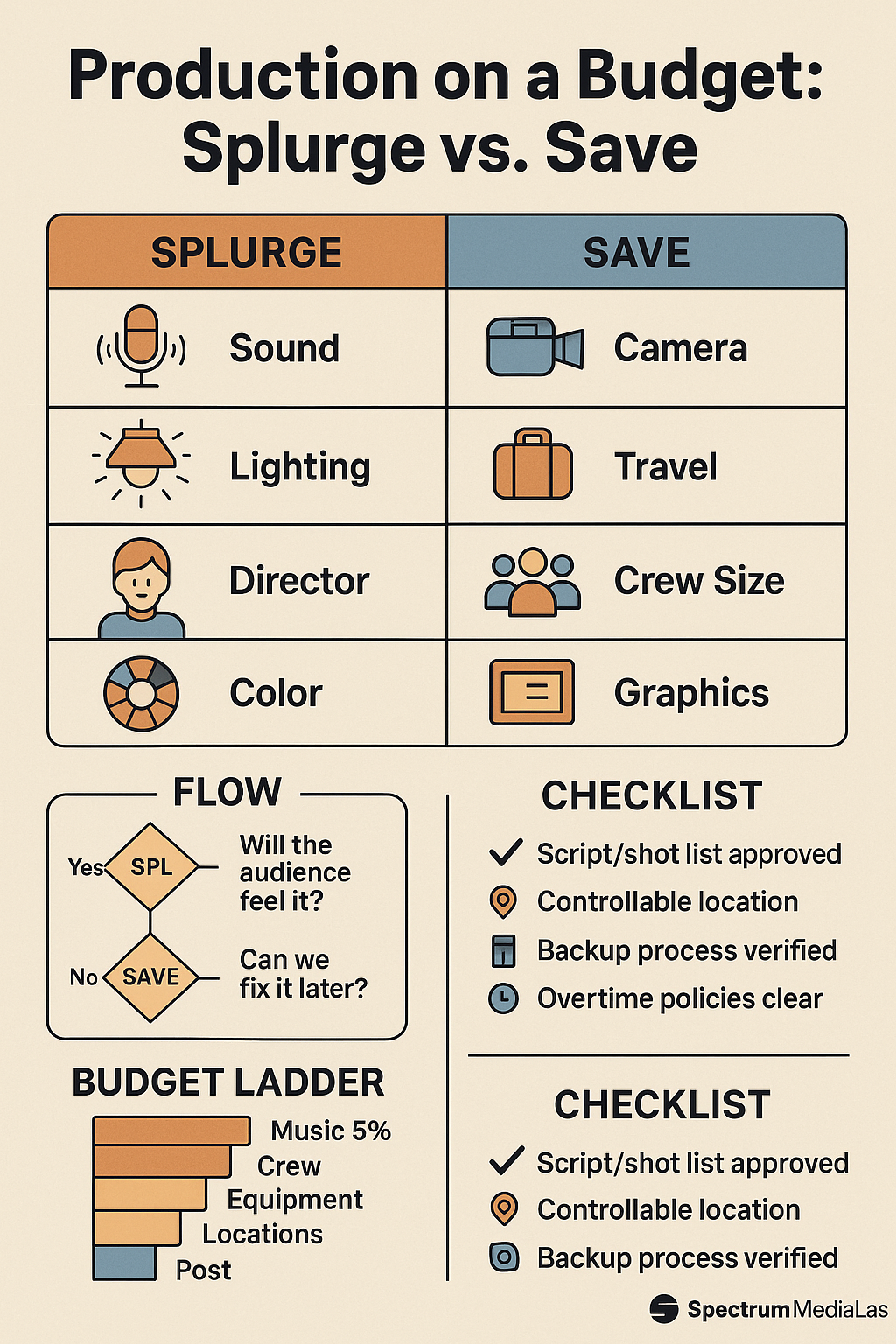
You don’t buy great production values—you allocate for them. On lean budgets, the winners aren’t the teams with the newest camera; they’re the teams that put money where audiences feel it and cut where risk is low or quality is replaceable in post. Here’s a pragmatic, battle-tested guide for SpectrumMediaLabs on when to spend, when to save, and how to design a budget that survives real-world chaos.
A simple framework: Impact × Variance × Replaceability
Before you move a dollar, score each line item on three axes:
- Perceived Impact – Will the audience notice this choice (and will it affect watch time, trust, conversion)?
- Variance/Risk – If we underfund this, how likely is it to break the shoot (noise, focus, schedule slips)?
- Replaceability – If we cheap out now, can we fix it later in post or with a pickup?
Splurge on items with high impact + high variance + low replaceability.
Save on items with low impact + low variance or high replaceability.
Where to splurge (and why)
1) Location sound & voice
Bad sound is the fastest way to look cheap. It also has high variance (rooms, HVAC, traffic) and low replaceability (noise removal helps, but never truly fixes).
Spend on: a dedicated sound recordist, quality lavs + shotgun, proper mounting, room treatment (blankets, carpets), a quiet location, and VO talent for key lines.
Skip: letter-boxed “we’ll fix it in post.” You won’t.
2) Performance direction (on-camera and VO)
A strong take beats an extra lens every time. If story hinges on a spokesperson, founder, or actor, hire a director/coach who can shape pacing, energy, and clarity.
Spend on: rehearsal time, table reads, coach, second take for safety.
Save on: extra B-roll you’ll never use.
3) Script, storyboard, and schedule
Minutes in pre-pro are hours saved on set. Clarity here eliminates meandering coverage and indecision.
Spend on: a sharp script editor, beat-level storyboard, locked shot list with durations, AD for schedule discipline.
Save on: nebulous “we’ll try options” time blocks.
4) Lighting for faces (gaffer + modifiers)
Cameras are good. Skin still needs shaping. Faces are where trust lives; don’t trust built-in LEDs or overhead fluorescents.
Spend on: a gaffer, diffusion, negative fill, flags, a big soft source, and power distribution.
Save on: top-tier camera body. A previous-gen mid-tier body under good light beats the flagship under bad light.
5) Controlled location over “cool” location
A visually average quiet, controllable space beats a gorgeous but noisy café that ruins your takes.
Spend on: studio/daylight-controllable room, sound blankets, lockups to prevent walk-throughs.
Save on: expensive set dressing; compose tighter and use depth, not clutter.
6) Color finishing on hero deliverables
A short session with a real colorist can rescue skin tones, unify mixed sources, and elevate perceived polish.
Spend on: half-day/one-day grade for the master cut(s), calibrated monitoring.
Save on: grading every derivative; conform derivatives from the graded master.
7) Music rights (and stems)
The wrong license can get you pulled; the right track lifts emotion. Also, stems let you breathe VO.
Spend on: clear sync and master rights for your channels/territories/term; a track that fits story; stems + :30/:15/:06 cuts.
Save on: bespoke composition if a strong library track will do.
8) Data wrangling & backup (DIT mindset)
Losing a card is a reshoot. That’s pure waste.
Spend on: checksum ingest, dual backups, verified file structure, clear naming.
Save on: ultra-fancy carts; a disciplined DIT on a laptop is plenty for small shoots.
9) Insurance, releases, and permits
Not sexy. Also non-optional.
Spend on: COIs, location permits when needed, model/property releases, gear insurance.
Save on: nothing here—risk is asymmetric.
Where to save (without hurting quality)
1) Camera bodies & brand chase
Rent last-gen bodies or B-cameras with similar color science. Put the delta into glass or lighting—or time.
2) Excess crew layering
Lean crews reduce overhead and communication drag.
- Combine Producer/AD, DP/Operator, Gaffer/Swing for small shoots.
- Bring specialists only where they change outcomes (sound, gaffer).
3) Gear you can rent for a day
Own the kit you use every week; rent the rest. Specialty items (motorized sliders, probe lenses, smoke machines) are perfect rentals.
4) Travel
Remote-direct with a local crew; route video village over Zoom/Venue apps. Flights and per diems evaporate budget.
5) Set builds & props
Favor practical locations and modular props. Keep a minimal brand kit (tabletop, backgrounds, a few signature objects) that recombines across shoots.
6) Motion graphics complexity
Use brand-ready templates and MOGRTs with data-driven fields. Save fully bespoke sequences for high-stakes hero edits.
7) Coverage for the sake of coverage
Shoot decisive coverage, not “just in case.” Every extra setup steals time from performance and sound.
8) Catering
Feed the crew well; keep it simple. Energy matters, not Instagram-worthy.
Budget ladders: where the dollars actually go
Below are sample allocations (percent of total) that hold up across verticals. Adjust 5–10% for your realities.
A) Short-form day (UGC-adjacent founder piece, 1 location)
- Pre-pro (script/board/schedule): 15%
- Talent/performance coaching: 10%
- Crew (DP/GAFFER/SOUND): 30%
- Lighting & grip rental: 10%
- Camera & lenses: 8%
- Location & permits: 7%
- Post (edit, mix, light grade): 15%
- Music/license: 3%
- Contingency: 2%
Splurge knobs: sound, gaffer, coaching. Save knobs: camera tier, motion gfx, set dressing.
B) Interview + B-roll (brand doc vignette)
- Pre-pro + research/interview prep: 15%
- Director/Producer/AD: 10%
- Crew (DP, Gaffer, Sound, AC): 32%
- Lighting & grip: 12%
- Camera & lenses (prime set): 8%
- Location(s): 8%
- Post (edit, color session, mix): 12%
- Music/license: 2%
- Contingency: 1%
Splurge knobs: interview lighting, sound isolation, color session. Save knobs: travel (go local), camera body tier.
C) Product tabletop (macro details, packshots)
- Pre-pro + shot engineering: 12%
- Director/DP (one role), Gaffer, Grip: 30%
- Lighting modifiers/flags/turntable: 15%
- Lens/specialty rental (macro/probe): 12%
- Art/props/surfaces: 10%
- Post (cleanup, light FX, grade): 16%
- Contingency: 5%
Splurge knobs: lighting control, optics. Save knobs: crew size (tight unit), location (garage/studio, not loft).
The “free money” moves (quality that costs little)
- Table read on Zoom (30–45 min). Tighten lines, remove tongue-twisters, clarify beats.
- Room tone & mic discipline. Slate it, save it; 60 seconds of tone saves hours in post.
- ND filters and diffusion. Cheap tools that instantly elevate images.
- Shot list with durations. Add a time next to each shot; when you’re behind, you know what to cut.
- File naming & proxies on set. Prevents chaos later.
- End-card template. Keeps brand polish consistent across dozens of deliverables.
Decision tree: spend or save?
- Will the audience feel this choice in first 5 seconds?
- Yes → Candidate to spend.
- If it fails, does the shoot fail? (sound, power, performance)
- Yes → spend.
- Can we fix or fake it later? (graphic polish, extra crop)
- Yes → save.
- Does it multiply other dollars? (storyboard that prevents reshoots, gaffer that saves post)
- Yes → spend.
Negotiation & vendor tactics (without burning bridges)
- Quote two versions: “lean” and “ideal.” It invites vendors to solve instead of defend.
- Pre-approve overtime rules (breaks, meal penalties) and kill fees.
- Bundle days (shoot + prep + post) with a single lead to reduce context cost.
- Ask for kit-rate caps (sound and grip often have flexible packages).
- Lock deliverables to a Minimum Viable Asset Set (MVAS); anything beyond triggers a change order.
- Hold dates with deposits, not vibes.
Post strategy: where savings compound
- Edit from a performance string-out. Choosing “the take” early collapses indecision and music thrash.
- Templated lower-thirds and captions (brand kit, auto-sized text).
- Color once, conform many. Grade the master, version downstream from that.
- Sound mix standards: LUFS targets, stem deliverables (DIA/MUS/SFX); one pass by a mixer if dialog is messy.
- Music first, not last. Cutting to the actual track reduces re-edits.
A one-page budget template (copy/paste)
Project: ______________________  Date: _________  Producer: ___________

GOAL (audience + outcome): ____________________________________________

MVAS (must-ship deliverables):
1) __________________  2) __________________  3) ______________________

SPLURGE ITEMS (why):
- Sound (variance + irreplaceable) – $________
- Performance direction/rehearsal – $________
- Lighting (gaffer + modifiers) – $________
- Controlled location / sound treatment – $________
- Color session (hero cuts only) – $________
- Music license (channels/territories/term) – $________

SAVE ITEMS (how):
- Camera body tier / rentals – $________
- Crew consolidation – $________
- Remote direction / local crew – $________
- Templates (graphics/end-card) – $________

CONTINGENCY (10%): $________

KEY RISKS & MITIGATIONS:
1) _________________________________________________________________
2) _________________________________________________________________
3) _________________________________________________________________
QA checklist (budget’s best friend)
- Script/storyboard approved; shot list timed; MVAS locked.
- Sound plan tested (room, lav placement, backup recorder).
- Lighting diagram + power plan; controllable location confirmed.
- Release/permit/insurance in hand.
- Backup workflow verified (checksum + dual copy).
- End-card + lower-third templates loaded.
- Overtime and meal rules clear to all leads.
- Post schedule tied to business dates (launch, embargo).
Bottom line
On a constrained budget, chase felt quality (sound, performance, faces) and process leverage (pre-pro, schedule, color on heroes, data integrity). De-emphasize the gear chase, travel bloat, and ornamental graphics. The result is the same look and trust you’d expect from a bigger spend—achieved by intentionally splurging on the few things the audience can’t ignore and saving on everything else.

Add comment