
Short-form video (Reels, TikTok, Shorts) isn’t “mini TV.” It’s decision theater: users decide every second whether to keep watching. For SpectrumMediaLabs, a good storyboard does three things: (1) earns attention in the first 2–3 seconds, (2) sustains curiosity with intentional pacing, and (3) lands a clear micro-win plus a call-to-action. This playbook gives you beat maps, hook formulas, CTA placement rules, and copy-paste templates you can ship today.
Principles that actually move retention
- One promise per clip. If your storyboard can’t express its value in one sentence, you have two videos mashed together.
- Value first, brand second. Earn 5–8 seconds of watch time before any self-promo.
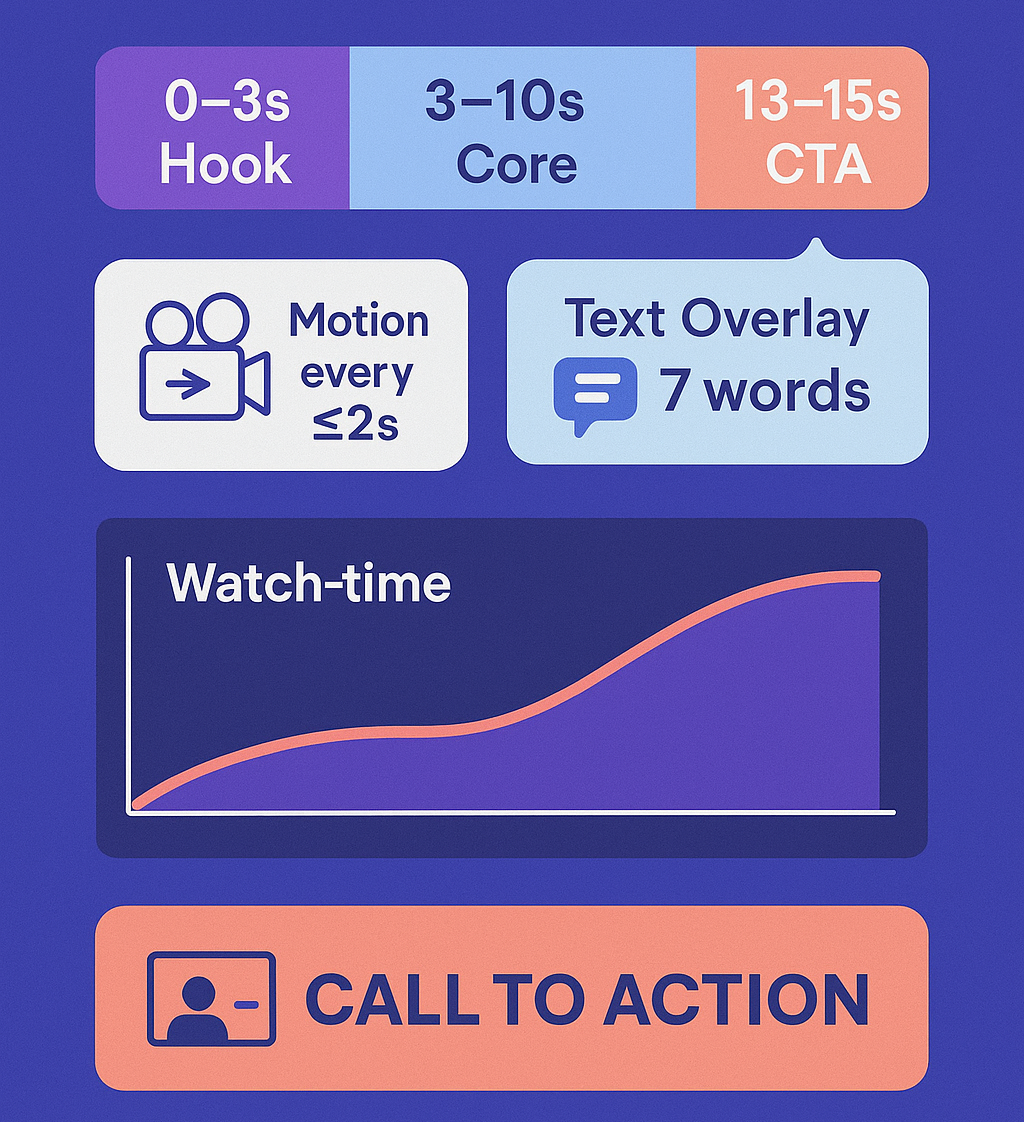
- Motion every ≤2 seconds. A cut, push-in, overlay, caption change, prop, or hand movement—something must change.
- Text ≠ transcript. On-screen text carries the argument; captions carry words.
- Every beat tees up the next. End each segment with a question or unresolved image (micro-cliffhanger).
Beat maps by duration
Use these as default story skeletons; swap beats, don’t add more.
6–10 seconds (micro-tease)
- 0–2s Hook: pattern interrupt + bold claim.
- 2–6s Proof: one visual or stat (no narration needed).
- 6–8s CTA: soft ask (“save for later”) or visual tag.
12–15 seconds (standard)
- 0–3s Hook: problem flip (“You’re wasting edits on…”)
- 3–10s Core: 2–3 rapid beats (tip, step, reveal).
- 10–13s Proof/Payoff: before/after, number, or demo.
- 13–15s CTA: single directive tied to payoff.
20–30 seconds (explain/demo)
- 0–3s Hook
- 3–8s Setup: context in one line (who/when/why).
- 8–20s Body: 3 steps or 3 reasons, each with a visual receipt.
- 20–27s Payoff: result, transformation, or summarized checklist.
- 27–30s CTA: next micro-action (“comment ‘template’,” “watch part 2,” “visit link in bio”).
45–60 seconds (story/case)
- 0–3s Hook
- 3–12s Stakes: what could go wrong/right.
- 12–40s Journey: decision → obstacle → solution (one beat each).
- 40–55s Outcome: metric or tangible change.
- 55–60s CTA: subscribe/follow or long-form handoff.
Hook engineering (with examples)
Choose one hook archetype, then script variants:
- Contrarian: “Stop A/B testing thumbnails—test hooks.”
- Pattern interrupt (visual): start mid-action (slam a stack of rejected drafts).
- Open loop (question): “If you had 3 seconds to triple watch time, what would you show?”
- Hyper-specific promise: “The 15-second storyboard we use to cut rework by 30%.”
- Negative outcome: “Three words that kill your hook every time.”
- Mini-myth bust: “No, you don’t need a voiceover for retention.”
- Fast before/after: flash result first, then “how.”
- Numbered sequence: “3 cuts in 7 seconds—watch.”
- Time pressure: “If you can’t write this in 60 seconds, don’t hit record.”
- Challenge/interaction: “Comment ‘audit’ and I’ll DM our hook checklist.”
Rule of two: Pair a verbal hook (caption or VO) with a visual contradiction or reveal in frame one.
Pacing: how fast is fast enough?
- Shot length: start at 0.7–1.2 s per shot for the first 5 seconds; relax to 1.5–2.0 s afterward.
- Tempo ladder: fast (0–3s) → steady (3–10s) → pulse (quick spike at 10–12s) → steady to CTA.
- Cut types to vary without chaos: hard cut, punch-in (5–8%), whip, on-beat text swap, prop enter/exit, J-cut for audio continuity.
- B-roll rule: at least one relevant B-roll in the first 6 seconds; never stack more than two A-roll talking shots in a row.
- Caption rhythm: new on-screen text every 1–2 seconds, max 7 words per card.
CTA strategy for short-form
Your CTA should match the value delivered:
- Utility tip → “Save” or “Share.”
- Teaser of longer story → “Full breakdown on our site/YouTube” (show URL or handle visually).
- Template/tool → “Comment ‘template’/‘guide’ for the link.”
- Purchase intent → “Link in bio / tap product tag”—only after a concrete payoff.
Placement: For ≤15s clips, CTAs at 13–15s (end card). For 20–30s, use mid-CTA at 10–12s (“want the file? keep watching”) and an end card.
Design: Keep a single CTA per video. Use consistent end-card template with logo, handle, and one directive.
The 4-panel storyboard card (use this for every shot)
For each beat, fill four fields. This prevents “pretty but empty” edits.
- Frame/Visual – what’s literally on screen (camera, prop, text overlay).
- Audio – VO/script line or key sound; note music cue.
- On-Screen Text – the argument, not subtitles (≤7 words).
- Edit/Pacing Note – cut type, duration, transition, effect.
Example (15-second “hook tips” video)
- Beat 1 (0–2s)
- Visual: smash-cut stack of rejected thumbnails; bold overlay “Stop this.”
- Audio: “Stop A/B testing thumbnails…”
- Text: “Stop A/B testing thumbnails”
- Edit: 0.8s hard cut + bass swell
- Beat 2 (2–5s)
- Visual: screen-record chart with high first-frame drop-off
- Audio: “…if your first 2 seconds are weak.”
- Text: “Fix your first 2s”
- Edit: punch-in on graph spike
- Beat 3 (5–10s)
- Visual: presenter demoing three hook frames (contrarian, open loop, result-first)
- Audio: “Use one of these 3 hooks.”
- Text: “3 hooks that work”
- Edit: on-beat swipe, 1.2s each
- Beat 4 (10–13s)
- Visual: before/after retention curve
- Audio: “They lifted hold by 28%.”
- Text: “+28% hold”
- Edit: overlay number pop
- Beat 5 (13–15s)
- Visual: branded end card
- Audio: “Comment ‘hook’ for the checklist.”
- Text: “Comment ‘hook’ for the checklist”
- Edit: music button + 1.1s linger
Multi-platform specs that affect storyboards
- Safe zones: keep critical text inside the center 80% (UI overlays differ per app).
- Aspect & export: default 9:16, but plan crop-safe 4:5 and 1:1 by keeping the subject centered.
- Captions: always on; burn-in for higher completion; sentence case, 48–72 px equivalent on mobile.
- Audio: normalize to -14 LUFS, limit peaks at -1 dB; punch SFX in the first second.
- Accessibility: color contrast ≥ 4.5:1, avoid flashing >3/sec.
Measuring what matters (so you iterate the storyboard, not just the cut)
- 3-second hold rate: % who stay past 3s (proxy for hook). Target ≥65%.
- 10-second hold rate: early engagement stability. Target ≥45% (for 15–30s videos).
- Average watch time / completion: compare to clip length; aim ≥70% completion for ≤15s.
- Replays: indicator of novelty; chase save/share + replay, not just views.
- CTA conversion: comments with keyword, link CTR, product taps—match to the CTA type used.
Iteration plan: First A/B the first frame (visual hook), then on-screen text wording, then beat order. Don’t micro-tweak color before testing those.
Templates you can paste into your tool
1) One-page storyboard (Markdown)
# Title:
## Promise (one line):
## Length: 15s | 30s | 60s
## CTA: (one)

| # | Time | Visual (what we see) | Audio (VO/SFX) | On-screen text (≤7w) | Edit/Pacing |
|---|------|-----------------------|----------------|----------------------|-------------|
| 1 | 0–2  |                       |                |                      |             |
| 2 | 2–5  |                       |                |                      |             |
| 3 | 5–10 |                       |                |                      |             |
| 4 | 10–13|                       |                |                      |             |
| 5 | 13–15|                       |                |                      |             |
2) Hook generator (fill-in blanks)
- Contrarian: “Stop ___ if ___.”
- Open loop: “What happens if you ___ in 10 seconds?”
- Result-first: “We cut edit time by ___—here’s the 1 change.”
- Myth bust: “You don’t need ___ to get ___.”
- Challenge: “Comment ‘___’ and I’ll send the template.”
3) End-card checklist
- Logo/handle present
- Single CTA aligned to payoff
- Subtle motion (2–3 elements)
- Duration 1.0–1.5s linger, no new info after the CTA appears
QA before you export
- Hook visible in frame 1 (freeze-frame test).
- First 5s contain ≥3 visual changes.
- On-screen text cards ≤7 words; captions synced; no typos.
- Sound design: intro sting or beat drop ≤0.7s; VO clear at -14 LUFS.
- Rights cleared for all visuals/music (logs saved).
- CTA matches value; end-card readable within one glance.
How AI can help (without wrecking taste)
- Pre-viz: generate three visual frames for the hook (photo/illustration prompts).
- Script assist: draft alternatives for on-screen text at ≤7 words with tone tokens.
- Auto-captions + language variants: burn-in captions, then translate; keep line length.
- Retention audit: detect dead seconds (no visual change >2s) and suggest cut points.
Guardrails: never fabricate claims; log citations for numbers shown; run a brand-term spellcheck before render.
30/60/90 rollout for SpectrumMediaLabs
Days 1–30
- Adopt the 4-panel storyboard card for all shorts.
- Build a 12–15s template with locked end-card and caption styles.
- Run a first-frame A/B on three live posts; benchmark 3-second hold.
Days 31–60
- Create a hook library (20 proven openers) and a B-roll bank tied to beats (graphs, gestures, prop shots).
- Automate the QA checklist (text length, contrast, caption presence).
- Launch a weekly retention review to swap beat orders, not just visuals.
Days 61–90
- Ship multilingual variants of one top performer; measure save/share vs baseline.
- Formalize CTA taxonomy (save/share/comment/link) and match to goals per series.
- Publish a “Short-Form Bible” with beat maps, hook archetypes, and end-card rules.
Bottom line
Great short-form comes from decisions on paper: which promise, which first frame, which beat order, which single CTA. Storyboard those decisions, enforce pacing that never lets a second go dead, and you’ll see watch-time, replays, and conversions climb—without adding editing hours.

Add comment