
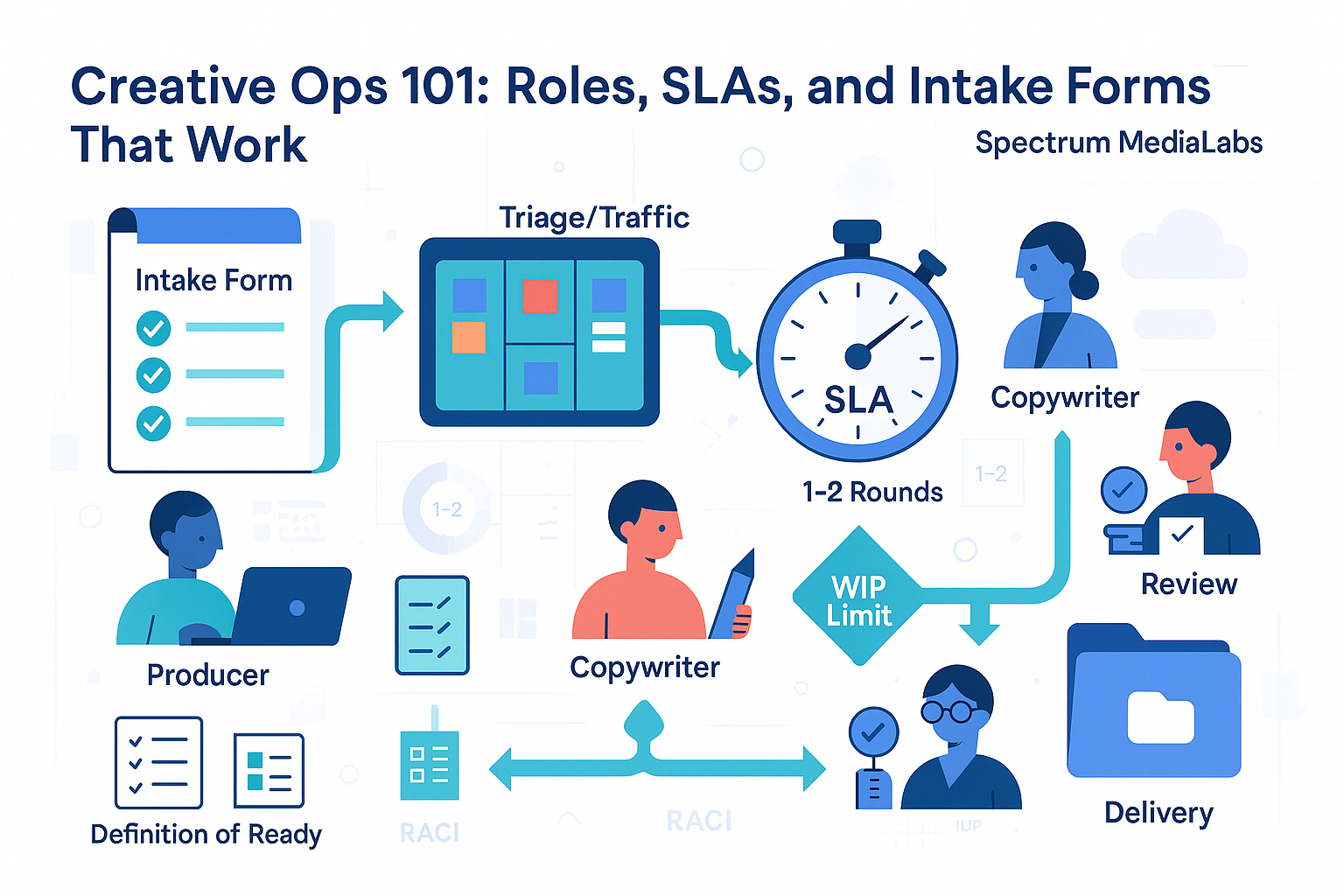
High-performing creative teams don’t run on heroic effort—they run on clear roles, explicit service levels, and an intake process that prevents chaos before it starts. For SpectrumMediaLabs, codifying these three pillars will reduce cycle time, raise quality, and make capacity (finally) predictable. This guide is a practical blueprint you can adopt as-is or adapt to your org’s quirks.
Why Creative Ops Exists (and What “Good” Looks Like)
Purpose: Turn messy demand into reliable, on-brand outcomes at known cost and speed.
Outcomes you should measure:
- Cycle time: request → approved delivery
- Hit-rate on SLAs: % jobs delivered within target window
- Rework rate: % assets requiring unplanned edits after “final”
- Throughput: completed requests per week, by type
- Stakeholder CSAT/NPS: post-delivery 1–2 question pulse
Aim for >90% SLA compliance, <15% rework, and predictable weekly throughput by category.
1) Roles & Responsibilities You Actually Need
Design titles however you like; what matters is who owns which decision at which step. Below is a lean operating model that scales from 8 to 80 people.
Core
- Creative Operations Lead (Owner): Designs process, owns capacity planning, SLA governance, tooling, and metrics. Escalation POC.
- Traffic/Intake Manager (Gatekeeper): Triage, prioritization, queue health, WIP limits, daily assignments.
- Producers/Project Managers (Orchestrators): Scope, timeline, risk, cross-functional syncs. One producer can run several small jobs or one complex campaign.
- Discipline Leads (Quality Owners): Design Lead, Copy Lead, Motion/Video Lead, Dev Lead. Set craft standards, review criteria, and approve “final.”
- Creative/Content Specialists (Makers): Designers, writers, editors, animators, developers.
Partners & Control Points
- Brand/Legal/Compliance Reviewers (Approvers): Govern policy and risk; time-boxed reviews.
- Marketing/Business Requesters (Customers): Provide complete briefs, accept deliverables; accountable for inputs and review speed.
- Insights/Analytics (Advisors): Supply audience, performance, and testing guidance.
- Tools Admin/Automation Engineer (Enablers): Maintain PM system, DAM, templates, and automations.
RACI by Lifecycle Stage (condensed)
| Stage | Ops Lead | Traffic | Producer | Discipline Lead | Maker | Brand/Legal | Requester |
|---|---|---|---|---|---|---|---|
| Intake & Triage | A | R | C | C | I | I | R |
| Scoping & SLA Commit | A | C | R | C | I | I | R |
| Briefing & Kickoff | C | C | R | R | I | I | R |
| Production | I | C | R | A | R | I | I |
| Review & QA | C | I | R | A | R | A/C | C |
| Delivery | C | C | R | A | R | I | A |
| Archive & Measure | A | C | R | C | I | I | I |
A = Accountable, R = Responsible, C = Consulted, I = Informed.
2) SLAs That Drive the Right Behavior
SLAs are agreements between Ops and Requesters. They protect the team from “hair-on-fire” chaos and protect stakeholders from black-box schedules.
Build a Service Catalog
Classify work by complexity and channel (e.g., social static, email, landing page, 15s edit, motion graphic, long-form article). For each class, publish:
- Definition of Ready (DoR): mandatory inputs before the clock starts (brief, assets, approvals, usage rights).
- Turnaround Targets: business days from “Ready” to “Delivery v1.”
- Review Windows: how long approvers have to respond.
- Revision Allowance: included rounds before change order.
- Rush Rules & Fees: what qualifies and how it’s handled.
- Dependencies: what pauses the SLA (e.g., awaiting legal).
Example (extract):
| Work Type | DoR | TAT (v1) | Revisions Included | Review Window | Notes |
|---|---|---|---|---|---|
| Social Static (1–2 sizes) | brief + copy + brand assets | 2d | 1 | 24h | 1 concept |
| Email Header + Body | brief + offer + links + legal | 3d | 2 | 48h | 2 variants |
| 15s Motion (existing toolkit) | script + footage + music license | 5d | 1 | 48h | Toolkit only |
| New Landing Page (templated) | brief + copy deck + assets + tracking plan | 7d | 2 | 48h | No net-new modules |
Non-negotiables to Put in Your SLA
- Clock Start: “Time starts when DoR is met and Traffic marks ‘Ready.’”
- Stops/Pauses: “Clock pauses awaiting stakeholder feedback or approvals.”
- Fast Track: “Rush (<50% of standard TAT) requires Ops Lead approval; allocated capacity ≤15% weekly WIP.”
- Change Orders: “Material scope changes reset the SLA; Producer issues updated estimate.”
- Escalation Path: “If SLA breach is likely, Producer notifies Requester ≥1 business day prior.”
3) Intake Forms That Prevent Rework
Most rework is caused by incomplete briefs. Your form should be one screen, conditional, and enforce the DoR.
Minimum Required Fields (for 90% of jobs)
- Business Objective: what success looks like (e.g., CTR +20%, signups +10%).
- Audience & Stage: who and funnel stage (awareness/consideration/convert).
- Channel & Format: e.g., IG static, HTML email, LP template X, 15s edit.
- Deliverables & Sizes: list with quantities (e.g., 1080×1080, 1080×1920).
- Key Message & Must-Say: the irreducible point + non-negotiable copy.
- Tone/Brand Nuances: e.g., “no slang,” “expert, friendly.”
- References & Do-Not-Use: past winners, brand guardrails to avoid.
- Assets: copy doc, logos, footage, product shots; rights/credits status.
- Deadlines: desired and hard stop; reason (campaign date, PR tie-in).
- Approvers: names + emails; who signs off creative vs. legal.
- Budget (if external costs): stock, VO, translation, development.
- Measurement Plan: KPI, data source, and test plan if applicable.
“Definition of Ready” Checklist (auto-validate)
- All required fields present
- Assets uploaded and rights verified
- Approver availability within the review window
- Legal/brand pre-requirements attached (if regulated category)
If any box is false, show: “This request isn’t Ready. Here’s what’s missing.”
Copy-paste Intake Template (JSON)
{
  "title": "",
  "business_objective": "",
  "audience": {"segment": "", "funnel_stage": "awareness|consideration|conversion"},
  "channel_format": "ig_static|email|lp_template_x|video_15s",
  "deliverables": [{"name": "", "size": ""}],
  "key_message": "",
  "must_say": "",
  "tone": "",
  "references": {"do_use": [], "do_not_use": []},
  "assets": [{"type": "logo|footage|copy|product_shot", "url": "", "rights": "cleared|pending"}],
  "deadline": {"requested": "YYYY-MM-DD", "hard_stop": "YYYY-MM-DD", "reason": ""},
  "approvers": [{"name": "", "email": "", "role": "brand|legal|business"}],
  "budget_external": 0,
  "measurement": {"kpi": "", "source": ""},
  "definition_of_ready": {"complete": false, "missing": []}
}
4) The Flow: From Demand to Delivery
- Submit: Requester completes the intake form; system validates DoR.
- Triage (Daily): Traffic assigns priority (P0–P3), sets due date per SLA, checks WIP limits.
- Scope & Commit: Producer confirms effort, risks, and SLA compliance; pushes plan to stakeholders.
- Kickoff: Discipline Lead reviews brief; align on concept options, rounds, and QA plan.
- Production: Makers execute; Producer tracks blockers; Ops monitors queue health.
- Review: Brand/Legal review within time box; comments labeled (“policy,” “preference,” “blocking”).
- QA: File specs, links, accessibility, localization checks.
- Delivery & Archive: Final assets to DAM with metadata; post-delivery pulse survey triggers.
- Measure: Tie outcomes to the request (UTMs, test IDs); log learnings into a playbook.
WIP Limits: Cap in-progress items per role (e.g., Designer: 3, Copywriter: 4). This alone can cut cycle time 20–40%.
5) Capacity & Prioritization (Without Guesswork)
- Service Points: Assign points per catalog item (e.g., Social Static=2, Email=5, 15s Edit=8, LP=13). Calibrate by observing 2–3 sprints.
- Arrival vs. Throughput: Compare weekly incoming points vs. completed points; adjust SLAs or staffing before queues bloat.
- Little’s Law for sanity checks: Average WIP ≈ Throughput × Cycle Time. If WIP balloons, either limit starts or add capacity.
- Priority Policy:
- P0: Legal/compliance or tier-1 incidents → preemptive.
- P1: Time-bound campaigns with revenue impact.
- P2: Standard marketing ops.
- P3: Experiments/“nice to have.”
6) Metrics & Reviews
Weekly Ops Dashboard
- SLA Compliance by work type
- Queue size & aging (how many items older than SLA/2)
- WIP per role vs. limit
- Rework rate & causes (brief quality, late feedback, scope creep)
- Stakeholder CSAT (1–5) and verbatims
Cadence
- Daily 15-min Traffic Standup: queue health, blockers, reassignment.
- Weekly Ops Review (45-min): metrics, missed SLAs, root causes, corrective actions.
- Monthly QBR with Stakeholders: trend lines, wins, playbook updates.
7) Templates You Can Ship Today
SLA Snippet (put this in your handbook)
Clock Start: The SLA begins only when the request meets the Definition of Ready and Traffic marks it “Ready.”
Pauses: The SLA pauses while awaiting stakeholder feedback, legal approvals, or new assets.
Revisions: Each request includes the stated number of rounds. Additional rounds require a change order.
Rush Policy: Rush work (<50% standard TAT) is limited to 15% of weekly capacity and requires Ops Lead approval.
Escalation: If a breach is likely, the Producer notifies the Requester and Traffic at least one business day in advance to agree on options (scope trade, date move, or add capacity).
Review Labeling (quality of feedback)
- Blocking: must be addressed to ship (policy, factual error)
- Strong: materially improves outcome
- Preference: optional style choices
QA Checklist (excerpt)
- Specs match brief (sizes, formats, codecs)
- Copy typos, product names, and legal lines verified
- Accessibility (contrast, alt text, captions, readable type)
- Links/UTMs correct and live
- Localization (dates, currencies, idioms) validated
8) Rollout Plan (30/60/90)
Days 1–30
- Draft service catalog and DoR; socialize with requesters
- Implement a single intake form with validation
- Stand up a kanban board with WIP limits and a daily traffic standup
- Pilot SLAs on two work types (e.g., Social Static, Email)
Days 31–60
- Extend catalog to motion/LP; add QA checklist and review labels
- Launch weekly Ops dashboard; begin measuring SLA compliance and rework
- Train brand/legal on review windows and escalation path
Days 61–90
- Tune points & capacity; freeze “rush” budget at ≤15% WIP
- Publish playbook of winning patterns and common pitfalls
- Formalize QBR with stakeholders and institute post-mortems for any SLA misses
9) Common Failure Modes (and Fixes)
- SLA Theater: You publish targets but don’t enforce DoR or review windows.
Fix: Auto-pause clocks, return not-ready requests with a missing-items list. - Role Ambiguity: Two approvers veto each other.
Fix: Single “A” for each stage; document the tie-breaker. - Intake Sprawl: Multiple email/slack entry points.
Fix: One front door; anything else gets redirected. - Endless Revisions: Preference edits masquerade as blockers.
Fix: Label feedback; count revision rounds; require trade-offs for extras. - Permanent Rush: Everything is P0.
Fix: Cap rush capacity; publish costs/impact; require executive sign-off for exceeding the cap.
10) What This Unlocks for SpectrumMediaLabs
- Predictable delivery that sales/marketing can plan around
- Happier creatives (less thrash, fewer context switches)
- Measurable quality improvements and lower rework
- Data to support staffing and vendor decisions
- A shared language with stakeholders that reduces drama and email ping-pong
Appendix: One-Page Intake (form fields to mirror in your tool)
- Request title
- Business objective (free text + dropdown reason)
- Audience (segment + funnel stage)
- Channel/format (select)
- Deliverables (repeatable group: name/size/qty)
- Key message + Must-say (separate fields)
- Assets (file upload + rights status)
- Deadline (requested/hard stop + reason)
- Approvers (name/email/role)
- Budget (optional)
- Measurement (KPI + data source)
- DoR auto-check (computed; blocks submission if false)
Ship this, enforce it, and iterate monthly. You’ll see SLA compliance climb within two sprints—and the team’s creative energy redirected from firefighting to craft.

Add comment