
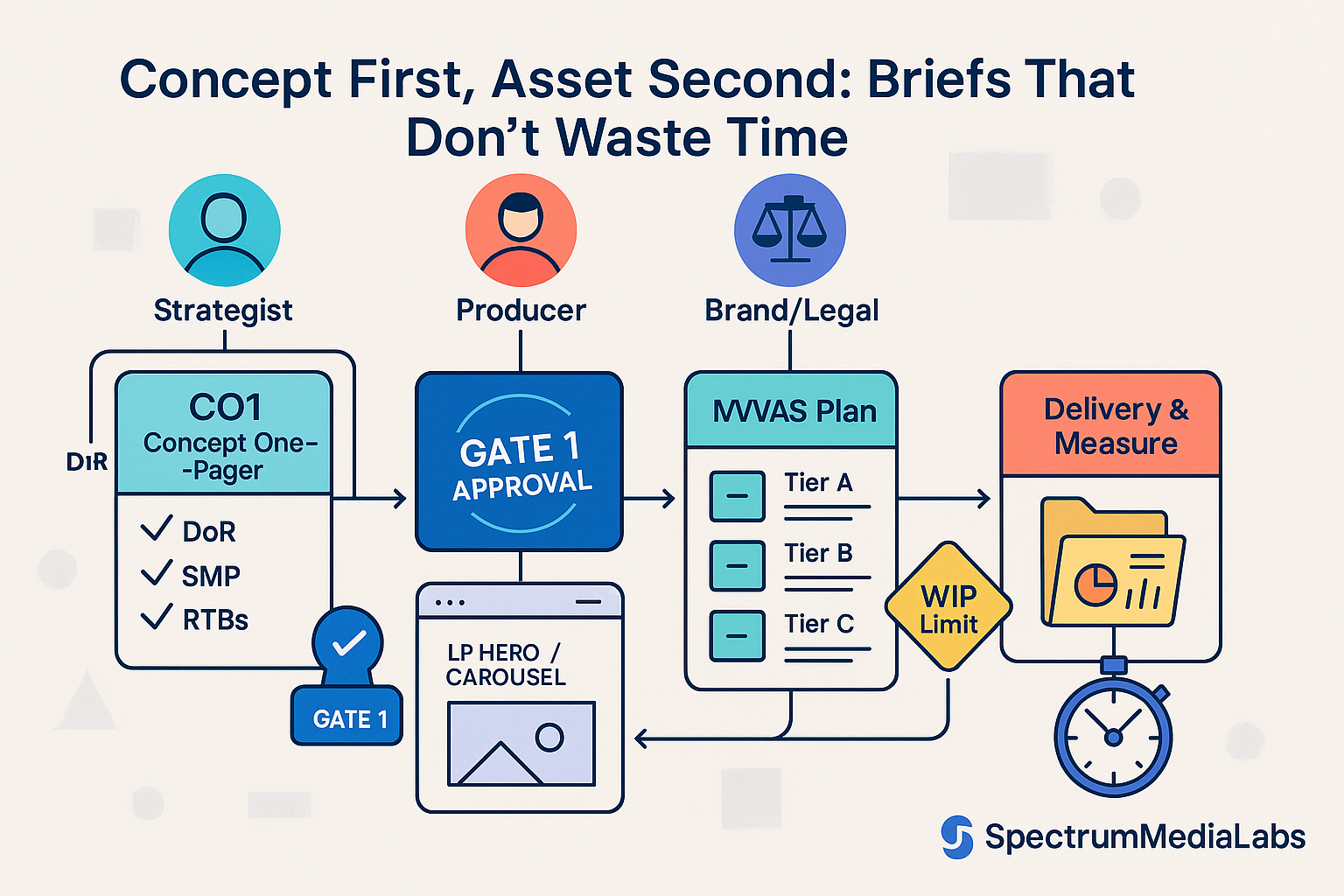
Most creative teams drown in perfectly executed assets that never had a strong idea behind them. The problem isn’t design or craft; it’s sequencing. When you start with files instead of a unifying concept, you optimize for throughput—not impact. For SpectrumMediaLabs, flipping the order to concept first, asset second cuts rework, aligns stakeholders, and makes creative more repeatable without making it generic.
Why “asset-first” burns cycles
Three predictable failure modes show up when teams jump straight to making:
- Misdiagnosed problem. Beautiful banners for a funnel issue that’s really a positioning issue. Revisions pile up because no execution can solve the wrong problem.
- Incoherent story. Each channel team interprets the brief differently; you ship fragments, not a narrative.
- Infinite scope creep. Without a single idea to protect, every stakeholder request feels reasonable. You end with 27 sizes and a moving deadline.
Symptoms: revision rounds >2, late-stage copy surgery, “Franken-assets,” and post-mortems that read “we should have aligned earlier.”
Define “concept” (so you can approve it)
A concept isn’t a mood board or a tag line. It’s a defendable decision about how we’ll change a specific audience’s mind to achieve a business outcome. Write it so it can be approved before any file work begins.
A solid concept has seven parts:
- Problem & Objective – the business outcome, framed as a behavior change.
- Audience & Insight – who, and the non-obvious truth we’re leveraging.
- Single-Minded Proposition (SMP) – the one sentence we want remembered.
- Reasons to Believe (RTBs) – 2–3 proofs we can show, not tell.
- Creative Territory – how it looks/sounds: the governing metaphor or device.
- Tone & Guardrails – musts/must-nots (brand, legal, cultural).
- Success Measures – what good looks like and how we’ll know quickly.
If you can’t capture those on one page, you’re not ready for assets.
The Concept One-Pager (CO1)
Use this as your approval artifact. Keep it to a single screen so busy stakeholders actually read it.
Context & Problem
- Funnel stage, current performance, what’s blocking growth.
Objective (SMART)
- “Increase free-trial starts by 15% in Q4 among data-savvy PMs.”
Audience & Insight
- Audience: “Mid-market PMs who own roadmap but not budget.”
- Insight: “They trust peers’ screenshots more than vendor claims.”
SMP
- “Ship confidently with evidence you can show your CFO.”
RTBs
- Live ROI dashboard, SOC2 reports, case studies with named logos.
Creative Territory
- “Receipts”: real artifacts as proof (dashboards, emails, budgets), framed like exhibits.
Tone & Guardrails
- Tone: expert, minimal hype, no slang.
- Guardrails: no competitor callouts; approvals required for named logos.
Channel Spine (priority order)
- Product landing refresh (hero + 3 exhibits)
- Social proof thread (LinkedIn carousel)
- 15s cutdown (caption-led, subtitled)
- Retargeting banners (3 sizes) pointing back to exhibits
Measures
- LP CVR +20%, CTR +30% on proof carousels, demo requests +10%.
Approvals & SLA
- Approvers: Marketing lead (A), Brand (C), Legal (C).
- SLA: 48h to approve CO1 or request one documented change.
Stage-gates: lock the idea before you open Figma
Gate 0 – Intake → CO1 Draft (≤1 day)
Traffic confirms the brief meets Definition of Ready (DoR). Strategist/producer drafts the CO1.
Gate 1 – Concept Alignment (≤48h)
Single meeting (30–45 min) to approve the CO1. Decision options: Approve / Approve with one change / Reject with rationale. If approved, convert to a Concept ID in your PM tool and attach all future assets to it.
Gate 2 – Prototype (≤3 days)
Create one channel prototype that demonstrates the idea (LP hero or social carousel). No polishing, just fidelity sufficient to validate the concept.
Gate 3 – Asset Plan & Production
Agree the minimum viable asset set (MVAS) for launch. Freeze scope. Produce.
This cadence prevents a month of “almost there” comps. You argue about the idea early, not the gradient late.
Roles & Responsibilities (RACI for concept work)
- Concept Lead (A/R): often the Strategist or Senior Copy—owns the CO1 and the SMP.
- Producer (R): stage-gates, deadlines, and scope control; enforces SLAs.
- Discipline Leads (C/A for craft): ensure the concept is actually executable.
- Brand/Legal (C): guardrails at Gate 1; final check at Gate 3.
- Requester/Business Owner (A at Gate 1, I thereafter): approves the idea, not each pixel.
A quick scoring rubric (pass/fail in 10 minutes)
Rate 0–5 on each, require ≥18/25 to proceed:
- Clarity: Could a new teammate explain the SMP after one read?
- Relevance: Does the insight map to the audience’s actual anxieties?
- Distinctiveness: Would we confuse this with a competitor?
- Feasibility: Can we show the RTBs with existing assets/rights?
- Channel Fit: Can one spine extend to our top two channels without contortions?
If it fails, fix the idea—not the layout.
Asset planning after concept approval
Shift from “how many things can we make?” to “what’s the smallest set that proves the idea?” Use this three-tier map:
- Must-ship (Tier A): the spine (e.g., LP hero, 1 carousel, 1 cutdown).
- Should-ship (Tier B): two formats that compound reach (e.g., email update, retargeting banners).
- Nice-to-have (Tier C): variants gated by performance.
Rule of thumb: if Tiers A+B don’t move the needle in two weeks, Tiers C never ship. Iterate the concept or pivot.
The brief that creatives actually want
Replace bloated 6-page PDFs with a two-panel doc:
Panel 1 – CO1 (unchanged)
The approved concept verbatim.
Panel 2 – Execution spec (per asset)
- Asset name & channel
- Mandatories (logo, CTA, legal lines)
- Copy floor/ceiling (e.g., “headline ≤7 words”)
- Technical spec (size, format, duration)
- Examples to emulate/avoid (links)
- Reviewers & rounds included (e.g., 1 round)
- Due date (aligned to SLA)
Creatives don’t need 3 pages of context; they need the decision you made about the idea, and the constraints that keep them fast.
Definition of Ready (DoR) for concept work
The clock does not start until all are true:
- Business objective stated and measurable
- Audience segment + insight described in one sentence each
- RTBs named and available (links or files with rights)
- Guardrails listed (brand, legal, claims)
- Approver identified and calendar-available within 48h
If DoR fails, the request is returned with a generated “missing items” list. No exceptions.
How AI fits (without derailing craft)
- Before Gate 1: Use retrieval-augmented prompts to mine case studies, research, and performance logs to draft candidate SMPs and RTBs.
- Between Gate 1 & 2: Generate one quick prototype variation to test message framing (not 20 pretty mocks).
- After Gate 3: Automate derivative sizes/versions under the frozen concept. Guardrails and rights checks run automatically.
The sequencing matters. AI multiplies a good concept and quickly exposes a weak one.
Metrics that prove this works
Track these on your weekly dashboard:
- Concept approval lead time: intake → Gate 1 decision
- Concept acceptance rate: approved on first pass
- Rework rate post-Gate 1: unplanned rounds after concept lock
- Asset ratio: Tier A/B shipped vs. Tier C shipped
- Lift vs. baseline: CVR/CTR or watch-through for concept-driven launches
Targets after two sprints: ≥80% acceptance on first pass, ≤15% rework, Tier C ≤20% of shipped items.
30/60/90 rollout
Days 1–30
- Publish the CO1 template and DoR; train requesters in a 45-minute clinic.
- Pilot the Gate 1 meeting on one product line with a hard 48h SLA.
- Add a “Concept ID” field to your PM tool; make it mandatory.
Days 31–60
- Introduce the scoring rubric; require ≥18/25 to proceed.
- Stand up the single-prototype rule at Gate 2.
- Start reporting acceptance rate and post-Gate-1 rework.
Days 61–90
- Tie spend to concepts (not assets) in your budgeting sheet.
- Turn high performers into reusable playbooks (“exhibit-proof spine,” “myth-bust spine”).
- Make CO1 the first page of every brief and the first slide of every creative review.
Copy-paste templates
CO1 (One-Pager)
Context & Problem
…
Objective (SMART)
…
Audience & Insight
- Audience: …
- Insight: …
SMP
…
RTBs
- …
- …
- …
Creative Territory
…
Tone & Guardrails
- Tone: …
- Must-nots: …
Channel Spine (priority)
- … 2) … 3) …
Measures
Primary: … | Secondary: …
Approvals & SLA
Approver: … | SLA: 48h
Execution Spec (per asset)
- Asset: e.g., LinkedIn carousel (6 cards)
- Mandatories: logo, CTA, legal line
- Copy limits: H1 ≤7 words, body ≤20 per card
- Tech: 1080×1080, MP4 for motion variant, captions burned-in
- References: [link], [avoid link]
- Review: 1 round included, review window 24h
- Due: YYYY-MM-DD
DoR checklist (auto-validate)
- Objective measurable
- Audience + insight stated
- RTBs accessible with rights
- Guardrails listed
- Approver confirmed & available ≤48h
Put the idea in writing, get consent on that, and only then open design tools. SpectrumMediaLabs will ship fewer assets, faster—and they’ll work harder because they all serve one sharp thought rather than many fuzzy requests.

Add comment