
Thesis: Accessibility (a11y) is not compliance overhead; it is a growth engine. Done well, it expands reach, increases conversion, improves retention, and reduces risk—compounding into lower CAC and higher LTV. Treat it like a system: objectives → patterns → instrumentation → governance.
1) The A11y→Growth Model
Map accessibility work to business levers:
| Funnel stage | Constraint removed by a11y | What to ship | Primary KPI | Guardrails |
|---|---|---|---|---|
| Reach | Crawlability, mobile readability, media barriers | semantic HTML, captions/transcripts, contrast & responsive type | Organic sessions, non‑brand clicks, CWV | CLS ≤ 0.1, LCP ≤ 2.5s, contrast ≥ 4.5:1 |
| Convert | Form friction, unclear focus, keyboard traps | labels, inline errors, focus order, sticky CTA, input types | Form completion, checkout CVR, time‑to‑task | error rate, latency p95 < 200ms |
| Retain | Fatigue, motion sensitivity, unreadable data | reduced motion, dark‑mode OK, table nav, status announcements | Day‑7 activation, task success, NPS | complaint rate, refunds |
| Expand | Exclusion of cohorts, lack of artifacts | alt text policies, inclusive copy, transcripts for shareability | Share rate, referral CVR | accessibility score, QA defects |
2) High‑Impact Pattern Library (v1.0)
Foundations
- Semantic HTML & landmarks (
header,main,nav,footer,aside) + correct heading hierarchy. - Visible focus with 3:1 contrast; logical tab order; skip to content link.
- Color & type: contrast ≥ 4.5:1, min 16px body with responsive scale; avoid color‑only meaning.
- Keyboard operability: every control tabbable; modals trap/focus; ESC closes.
Forms
5) Labels & descriptions (label for=, aria-describedby); helpful examples.
6) Inline validation (on blur/keystroke) + error summary linking to fields.
7) Input types & masks (email, tel, number) + mobile keyboards; reasonable defaults.
8) Accessible button states: disabled, loading, success (with aria‑live).
Media & Feedback
9) Captions + transcripts for video/audio; alt text policy (see §6).
10) Status updates with aria-live (polite/assertive) for async actions.
11) Reduced motion variants (prefers-reduced-motion) and duration < 200ms.
12) Touch targets ≥ 44×44 px; reachable sticky CTAs; no content cover on mobile.
Performance as Accessibility
13) Budget for LCP ≤ 2.5s, INP ≤ 200ms, CLS ≤ 0.1; image compression, lazyload, font‑display swap.
3) Measurement & Experimentation
Objectives (examples):
- +8–15% relative form completion on mobile checkout
- +5–10% increase in non‑brand organic clicks (semantics + CWV)
- −20% reduction in support tickets tied to errors/access issues
Instrumentation:
- GA4/Amplitude events:
form_error:{field},focus_trap_detected,aria_live_fired,caption_used,prefers_reduced_motionsegment. - Technical: Lighthouse a11y score, axe‑core CI, CWV field data.
Experiment design (defensible):
- Pre‑register MDE and power (80–90%); avoid peeking or use α‑spending.
- Invariants: allocation (SRM), eligibility, device mix.
- Decision rule: ship if CI lower bound ≥ 0 and ≥ business MDE.
4) 12‑Week Plan (from audit to lift)
Weeks 1–2: Baseline — WCAG 2.2 AA audit, analytics mapping, user sessions: keyboard‑only + screen readers (NVDA/VoiceOver). Publish budgets (contrast, CWV).
Weeks 3–4: Foundations — landmarks, headings, focus, skip link, nav order.
Weeks 5–6: Forms — labels, errors, masks, input types, error summary; copy for privacy/risk.
Weeks 7–8: Media & Motion — captions/transcripts, alt text policy, reduced‑motion variants.
Weeks 9–10: Performance — image pipeline, font loading, lazyload, INP fixes.
Weeks 11–12: Experiments — 2–3 A/Bs targeting checkout/mobile forms; publish Accessibility Statement and governance.
5) Governance: Accessibility OS
- RACI — Design (tokens, contrast), Eng (components/tests), Content (alt/captions), QA (axe + manual), PM (budgets, OKRs).
- Definition of Done includes: semantic roles, focus order, keyboard path, labels, error summary, reduced motion, CWV check.
- CI — axe‑core/pa11y, Lighthouse CI; fail PR if severity ≥ medium.
- Design tokens — color ramps with guaranteed contrast; spacing & type scales.
- Component library — pre‑vetted a11y patterns (modal, tooltip, toast, table, form fields).
6) Alt Text & Inclusive Copy Cheatsheet
Alt text pattern = What + Context + Purpose.
- “Line chart showing sign‑ups rising from 200 to 500 between Jan–Mar.”
- Decorative images:
alt=""(empty) +role="presentation".
Microcopy
- Risk: “We only email receipts; no marketing without consent.”
- Progress: “Step 2 of 3, about 45 seconds left.”
- Error: “Card number is 4 digits short — add the remaining digits.”
7) ROI Model (quick math)
Let S = monthly sessions, CR = baseline conversion rate, L = relative lift from a11y, AOV = average order value.
Monthly revenue lift ≈ S × (CR × (1+L) − CR) × AOV = S × CR × L × AOV
Example: S=100,000; CR=2.5% (0.025); L=+8% (0.08); AOV=$120.
Lift = 100,000 × 0.025 × 0.08 × 120 = 100,000 × 0.002 × 120 = $24,000/mo.
8) Checklists (condensed)
Design — contrast tokens; visible focus; states for hover/focus/active/disabled; motion‑reduced variants; min touch 44×44.
Content — H1–H3 structure; plain‑language summaries; alt text; captions/transcripts; error/help text.
Dev — roles/ARIA minimal; keyboard paths; aria-live for async; input types; INP/LCP budgets.
QA — keyboard walkthrough; screen reader smoke; zoom 200%; high contrast mode; axe report ≤ minor.
9) Page & Component Patterns (paste‑ready)
Pricing page — pricing drivers explainer, table headers scope (scope="col"), row headers (scope="row"), comparison summaries.
Modal — aria-modal="true", labelled by title id, focus trap, ESC closes, return focus on close.
Data table — keyboard sortable headers, sticky first column, caption explaining purpose.
10) SEO Kit
- Title (≤60): Accessibility as a Growth Strategy
- Meta (≤160): Accessibility expands reach, boosts conversion, and reduces risk. A practical playbook with patterns, metrics, and a 12‑week plan.
- Slug:
/accessibility-as-a-growth-strategy - Keywords: accessibility growth, a11y conversion, inclusive design ROI, accessible forms, captions transcripts seo, core web vitals accessibility, reduced motion, keyboard navigation, alt text policy, accessibility statement template
11) Comms Kit
LinkedIn post:
Accessibility is a growth lever, not a checkbox. The teams that win tie a11y to conversion math: clearer focus, better forms, faster pages. Ship landmarks/focus first, then forms and captions. Size your tests for a real MDE and watch checkout completion and non‑brand clicks climb. Want the 12‑week plan? DM SYSTEM.
Carousel (10 slides):
- Accessibility as a Growth Strategy
- A11y→Growth model (Reach/Convert/Retain/Expand)
- Foundations: landmarks, headings, focus
- Forms that finish
- Media: captions/transcripts
- Motion & comfort
- Performance as accessibility (CWV)
- Measurement & guardrails
- 12‑week roadmap
- CTA: Get the checklist
Reel (60–75s) script (hook→3 points→close):
Hook: “Accessibility is how you grow without adding more ads.”
- Foundations make Google and users happier (semantics + CWV).
- Forms with labels and inline fixes lift completion fast.
- Captions & transcripts multiply reach.
Close: “We run a11y as CRO. Comment SYSTEM for the plan.”
12) Image Briefs
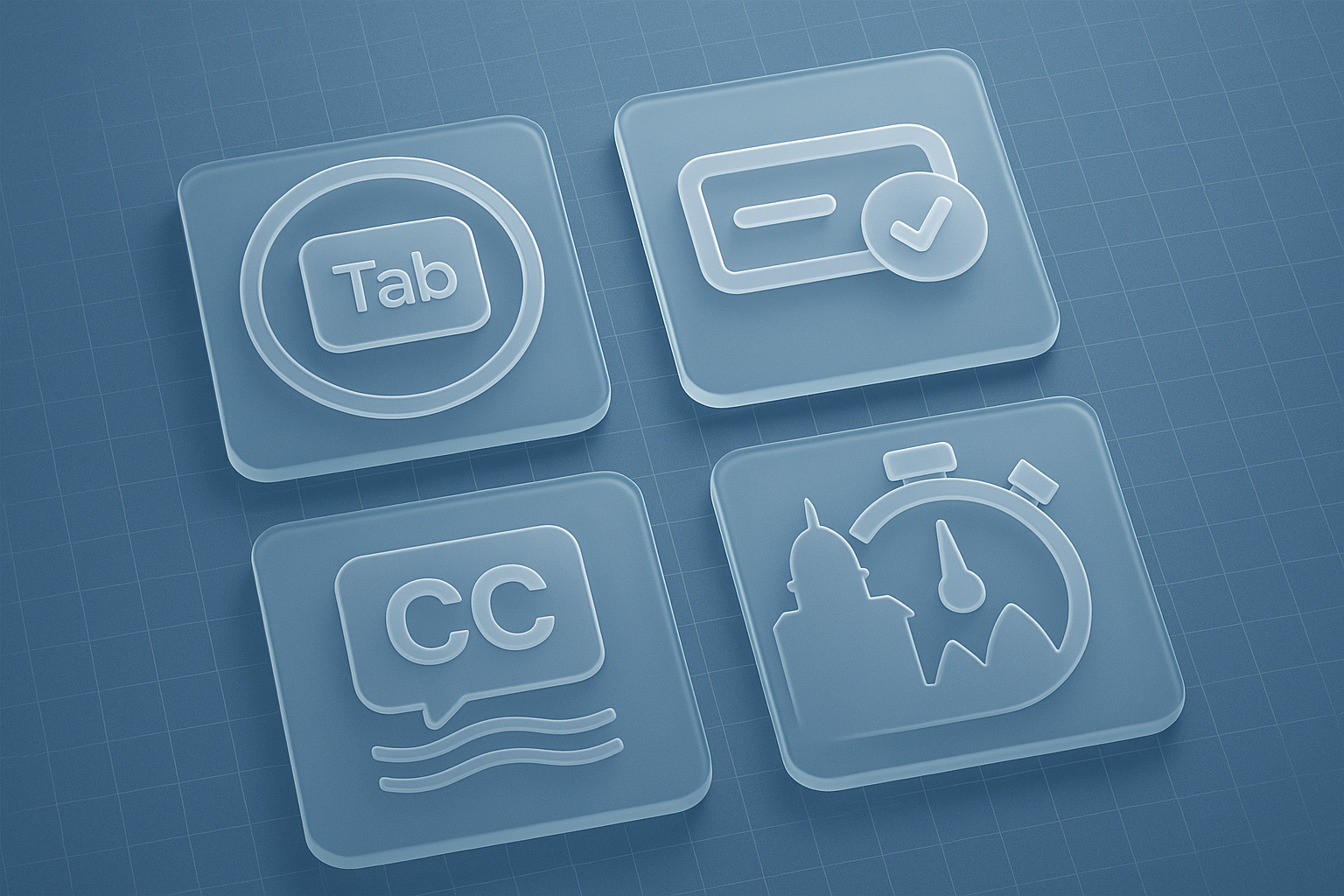
- Blog cover: Editorial 3D, translucent glass blocks showing a focus ring, label+input, captions icon, speed gauge. Blueprint background, cool palette, no text.
- Carousel tiles: Minimal icons for landmarks, keyboard, forms, captions, motion, speed.
Bottom line: Accessibility compounds. Start with foundations, fix forms, add media artifacts, enforce performance—and measure the lift. That’s growth, by design.






Add comment