
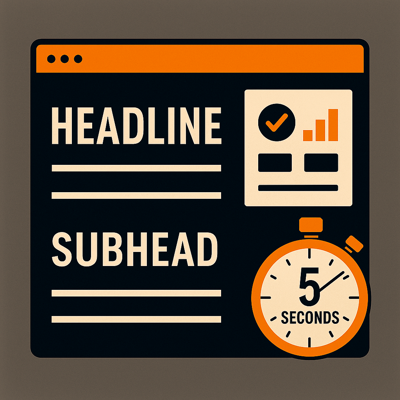
In the digital age, attention is both scarce and fleeting. Studies show that visitors form an impression of a website in less than five seconds. That means your headlines, subheads, and proof points aren’t just copy—they’re your conversion engine. If your value isn’t clear instantly, you’ve already lost.
Why 5 Seconds Matter
Visitors rarely read word-for-word. Instead, they scan. In those first moments, they’re answering three questions:
- What is this?
- Why should I care?
- Can I trust it?
If your headline fails to communicate the what, your subhead fails to clarify the why, or your proof fails to validate trust, you risk abandonment before the user even scrolls.
The Headline: Declare Value, Not Features
Too many headlines default to vague taglines or product categories. Instead, craft headlines that:
- Declare the primary outcome (e.g., “Cut reporting time in half”).
- Use clear, simple language free of jargon.
- Avoid internal language that makes sense only inside the company.
Bad headline: “Revolutionizing the Future of Work.”
Good headline: “Automate 80% of your team’s manual reporting.”
The Subhead: Clarify and Contextualize
The subhead supports the headline by answering “how” and “for whom.”
- Provide context: Who benefits most?
- Add clarity: What category are you in?
- Anchor expectations: Set the frame for the value offered.
Example:
Headline: “Automate 80% of your team’s manual reporting.”
Subhead: “Our SaaS platform integrates with 200+ tools so your analysts focus on insights, not spreadsheets.”
The Proof: Build Trust Instantly
Visitors don’t just want claims; they want evidence. In the first five seconds, include at least one proof element:
- Logos: Recognizable customers or partners.
- Stats: Metrics that quantify impact.
- Quotes: A concise customer testimonial.
- Badges: Security or compliance signals (ISO, SOC2, etc.).
Proof should be scannable and visual, not buried in long paragraphs.
Structuring the 5-Second Window
The top of a page should follow a simple flow:
- Headline: Outcome in plain language.
- Subhead: Context, category, and mechanism.
- Proof: Visual evidence to support the claim.
- CTA: A clear, low-friction next step.
This formula ensures that even a distracted visitor walks away understanding what you do, why it matters, and why they should trust you.
Common Mistakes
- Feature-driven headlines that don’t communicate outcomes.
- Subheads full of jargon that confuse rather than clarify.
- Proof hidden below the fold, where most users will never see it.
- Overcrowding—too many competing elements create cognitive overload.
Final Thought
Value communication is not about clever wordplay. It’s about clarity, speed, and credibility. When your headlines, subheads, and proof work together within five seconds, you don’t just capture attention—you earn permission to continue the conversation.







Add comment