
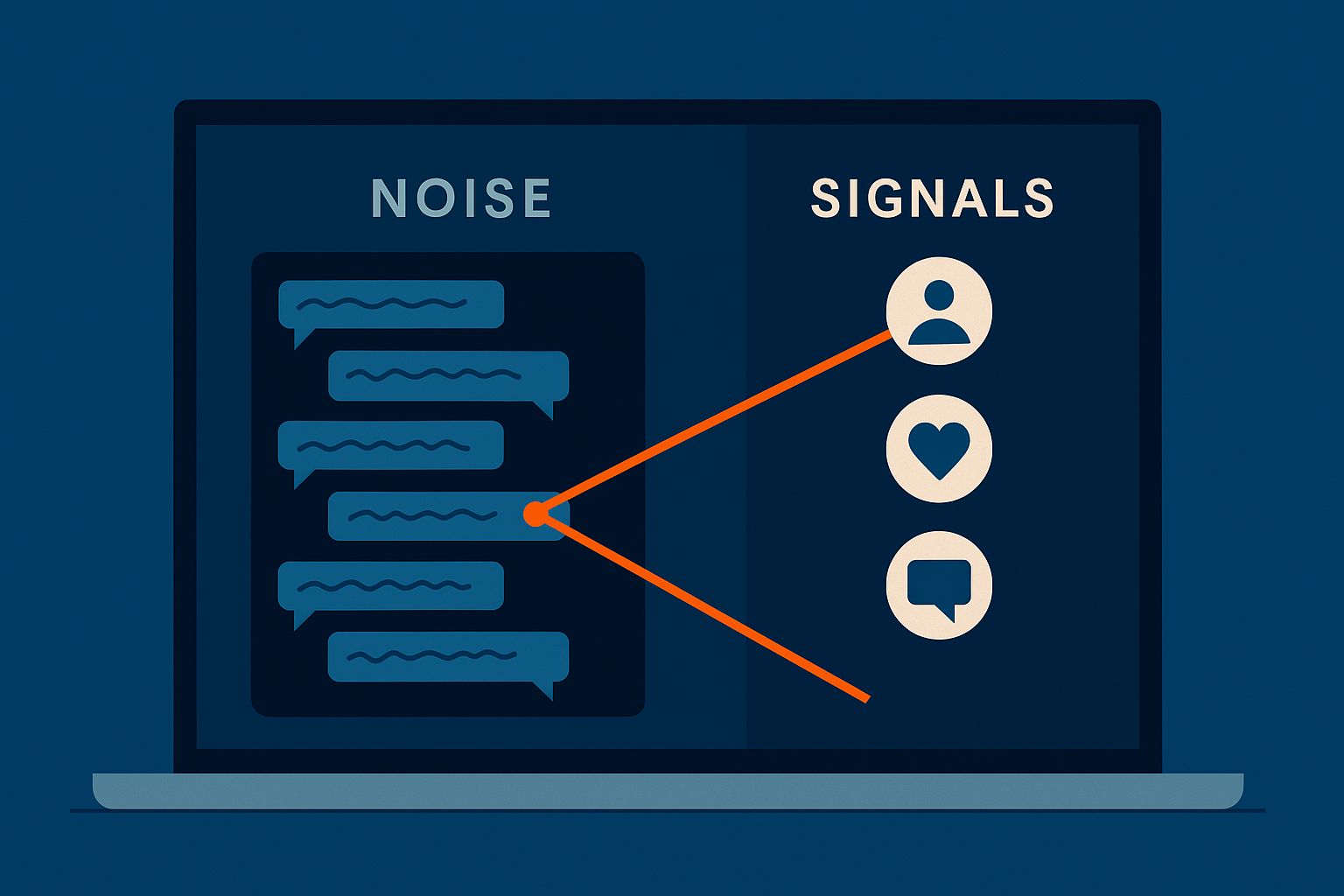
Every marketer knows the power of social listening. With the right tools, you can track mentions, monitor sentiment, and stay ahead of industry trends. But in many organizations, social listening has quietly shifted from being a strategic asset to an anxiety engine. Teams drown in dashboards, obsess over every negative comment, and mistake noise for signal.
It doesn’t have to be this way. Social listening, when reframed, is not about reacting to every whisper—it’s about surfacing insights that shape strategy, not stress.
The Trap: When Listening Turns Into Panic
Why do so many teams struggle with social listening?
- Volume over value — Dashboards report every mention, regardless of relevance.
- Reactive mindset — Negative comments trigger fire drills instead of structured responses.
- Vanity metrics — Brands track how much they’re mentioned, not whether those mentions matter.
The result: teams spend hours staring at sentiment graphs while missing the deeper patterns that could actually inform their decisions.
Principle 1: Define Strategic Listening Goals
Not all mentions deserve equal weight. Effective social listening starts by aligning with core business questions:
- Customer insight: What pain points are surfacing repeatedly?
- Competitive intelligence: Where are rivals gaining traction?
- Trend spotting: What new behaviors or topics are emerging in your category?
- Crisis detection: Which signals actually warrant escalation?
By focusing on goals, you turn an infinite feed into a curated dataset.
Principle 2: Separate Signal from Noise
Tools can scrape everything, but the strategist’s job is to filter.
- Keyword mapping: Build precise lists to filter out irrelevant chatter.
- Context tagging: Classify mentions by theme (support issue, feature request, competitor reference).
- Weighted metrics: Track not just volume but relevance and potential impact.
Instead of asking “How many mentions did we get?”, ask “Which 10 mentions should drive our next decision?”
Principle 3: Turn Listening into Action
Social listening earns its keep only when insights fuel execution. For example:
- Product teams use feature request mentions to prioritize roadmaps.
- Marketing teams identify phrasing customers naturally use and fold it into messaging.
- Sales teams track competitor dissatisfaction signals and arm reps with counter-messaging.
The value lies not in the dashboard itself, but in the decisions it unlocks.
Principle 4: Create Rituals, Not Panic
Constant monitoring creates stress. Instead, design rhythms:
- Weekly intelligence reports summarizing signals by category.
- Quarterly trend reviews to surface emerging themes.
- Crisis alerts only when thresholds are crossed (not for every negative tweet).
This shifts the team from firefighting to pattern recognition.
Case Example
A fintech startup was tracking every single mention of its brand name, creating daily anxiety spikes. After resetting its social listening practice, it narrowed focus to:
- customer complaints tagged “support,”
- competitor comparisons in niche forums,
- monthly trend reviews.
Within one quarter, they reduced noise by 80%, increased product roadmap alignment, and saw higher confidence in messaging decisions.
Final Thought
Social listening is not about hearing everything—it’s about hearing the right things. When reframed as a strategic tool, it stops creating anxiety and starts fueling clarity, focus, and growth.
In a world of endless chatter, the brands that win aren’t those who listen the loudest, but those who listen the smartest.




Add comment