
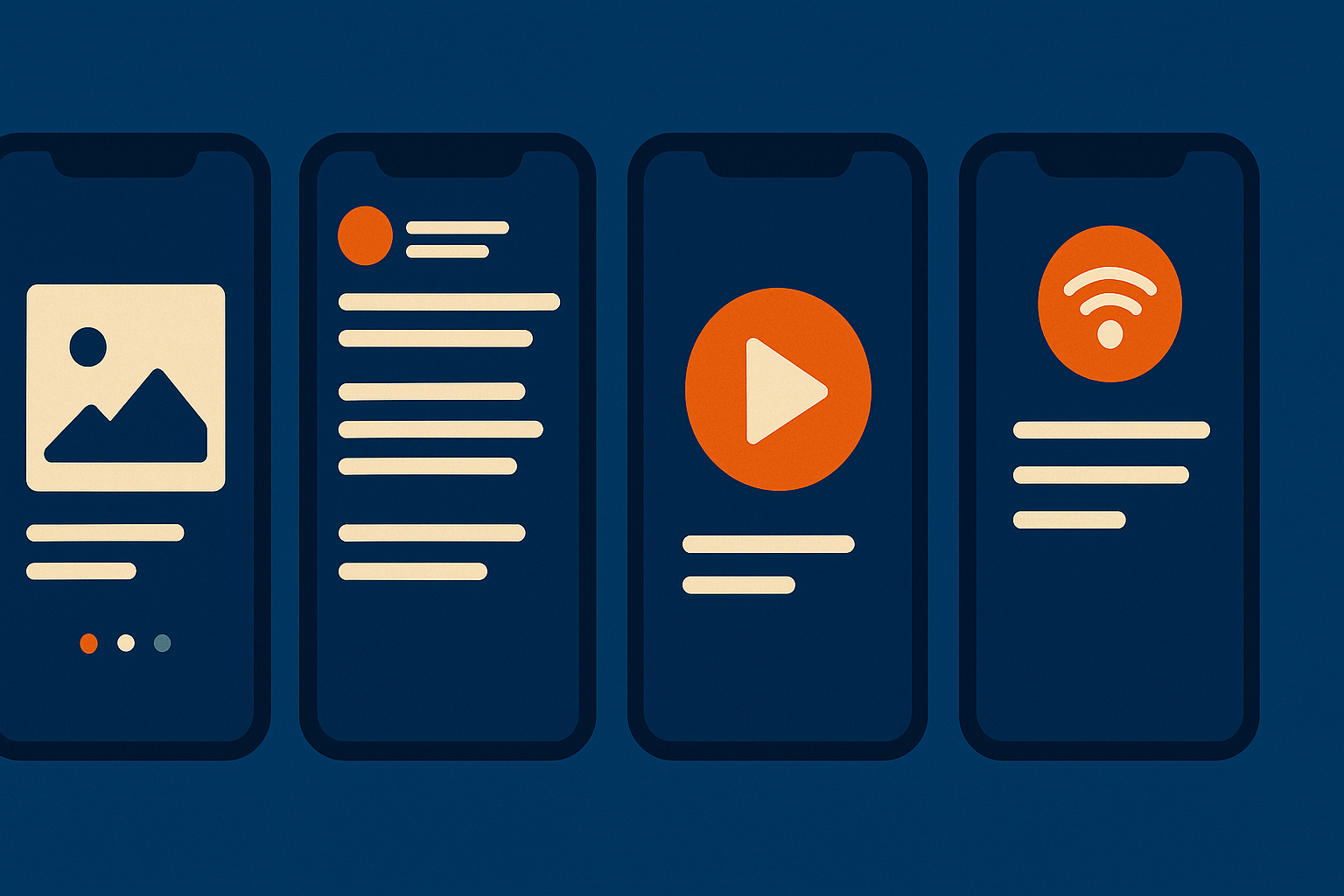
Marketers don’t win social by posting more. They win by speaking the platform’s native language. Audiences scroll at the speed of instinct; the thumb decides in milliseconds whether a post “belongs” to the feed. That’s why the brands breaking through aren’t reinventing the wheel every week—they’re mastering native formats and exploiting each platform’s primitives: carousels, threads, shorts, lives.
This isn’t about hacks. It’s about treating formats as design systems with constraints that make ideas sharper, simpler, and easier to distribute at scale.
Why Native Formats Outperform Generic Posts
- Algorithmic affinity. Platforms prioritize units that maximize session time (e.g., watch time on Shorts, dwell time on carousels). Native formats map directly to those goals.
- Mental model alignment. Users come in expecting a certain rhythm: swipe → payoff (carousel), tap → reveal (thread), hook → loop (short). Breaking the rhythm costs attention.
- Production leverage. Once you codify a format, your team can ship reliable, high-quality iterations without reinventing creative from scratch.
The Format→Objective Map
Tie business goals to formats instead of starting with “what should we post?”
| Objective | Best-fit Format | Why it Works |
|---|---|---|
| Educate & position | Carousels | Multi-step logic; saves/forwards drive distribution |
| Break news, narrate POV | Threads | Serialized storytelling; easy quote-and-reply |
| Reach new audiences fast | Shorts | High discovery; tight hooks; remix culture |
| Build trust & community | Lives | Unscripted depth; Q&A; social proof in real time |
Carousels: Teach to Be Saved
Where: LinkedIn, Instagram
Success signal: Saves and shares (not just likes)
Structure blueprint (10 slides):
- Slide 1 – Hook headline: One promise; no jargon (“Stop Paying for Clicks That Never Convert”).
- Slides 2–3 – Context: The costly status quo (+ a quick visual).
- Slides 4–8 – Steps/Framework: Numbered, skimmable, one idea per slide.
- Slide 9 – Proof: Mini case or chart; make it legible at 1× zoom.
- Slide 10 – Action: A practical checklist; no hard sell.
Design rules:
- 1–2 fonts, oversized typography, 12–16 word max per slide.
- Use progress indicators (1/10…10/10) to increase completion.
- Contrast first; color second. White/very dark backgrounds beat gradients for legibility.
- Export at platform-native aspect ratios (1080×1350 for IG; 1350×1080 or 1920×1080 for LinkedIn docs).
Editorial patterns that work:
- “X Mistakes You Can Fix Today”
- “From…To…” transformation sequences
- “Field Notes: What Surprised Us in 30 Interviews”
Threads: Opinion that Compounds
Where: X (Twitter), LinkedIn (multi-post chains)
Success signal: Replies and quotes (sparks conversation)
Narrative spine (7–12 posts):
- Lead post = thesis: a crisp, contestable claim (“Last-click isn’t wrong—it’s incomplete”).
- Evidence posts: 3–5 bullets with examples, numbers, or screenshots.
- Counterpoint: Anticipate objections; steelman the opposing view.
- Synthesis: Your framework; visual if possible (one chart beats three paragraphs).
- Soft CTA: Invite commentary, not clicks (“If you’ve seen different in B2B, reply with your data”).
Craft notes:
- 240 characters ≠ excuse to be vague. One idea per post; cut subordinate clauses.
- Pair 2–3 posts with alt-texted images for accessibility and search.
- Nest reply threads to create “choose your own depth” paths (e.g., link to a deep-dive sub-thread).
Shorts: Hooks, Loops, and Earned Watch Time
Where: TikTok, Reels, YouTube Shorts, LinkedIn native video
Success signal: Average watch time / % viewed (not views alone)
Beat sheet (0:00–0:30):
- 0:00–0:02 Hook: question, pattern interrupt, or result first (“We cut CAC 37% by…”)
- 0:03–0:07 Setup: who/what/why in 1 sentence
- 0:08–0:22 Payoff: 3 beats, each 3–4 seconds, with on-screen captions
- 0:23–0:30 Loop & CTA: recap + quick next step (“Comment ‘PLAYBOOK’ for the checklist”)
Production rules:
- Native captions (burned-in) with high-contrast backgrounds.
- 1:1 lighting and eye-line; phone mic with a $20 lav > echoey room.
- Jump cuts every 2–3 seconds; B-roll for verbs (“build,” “test,” “launch”).
- Avoid heavy subtitles that obscure the lower third (where platform UI lives).
Repeatable short formats:
- “Three mistakes in 30 seconds”
- “Rate this landing page (and why)”
- “One framework, one example, one caveat”
Lives: Real-Time Trust Engines
Where: YouTube, LinkedIn, Instagram, TikTok
Success signal: Concurrent viewers + retention at 5/15/30 min
Run-of-show (45–60 minutes):
- T-5: Go live early; greet early joiners, set expectations.
- 0–4 min: Cold open + agenda + why this matters now.
- 5–20: Core lesson or demo; keep slides sparse, spotlight faces.
- 20–35: Case study + chat questions (producer curates).
- 35–45: Live teardown or audience hot seats.
- 45–60: Summary + explicit next steps (download, survey, or next live).
Make Lives evergreen:
- Time-code chapters for replay SEO.
- Publish clips as Shorts; convert Q&A into threads/carousels.
- Capture questions → content backlog (FAQs, docs, sales enablement).
Native KPI North Stars (per format)
- Carousels: completion rate, saves, unique shares, profile click-through
- Threads: quotes/replies ratio, follow-through to sub-threads, list growth
- Shorts: average watch time, 95% views, swipe-away rate in first 3 seconds
- Lives: peak concurrent, retention at 15/30 minutes, post-live replay hours
Track format-native success, then connect to pipeline: add UTM discipline, capture soft conversions (saves, replies, DMs) as lead-ins to email/community.
The Content Factory: From One Idea to Four Natives
- Seed the idea: a field note, data point, or teardown.
- Draft the opinion: a two-sentence thesis that could headline a thread.
- Expand to teaching: turn the thesis into a 7–10 slide carousel.
- Perform it: script a 30–45s short; record B-roll while you’re at it.
- Host it: run a 30–60 min live to collect questions and objections.
Now you have four native assets stemming from one core idea—each optimized for the feed where it lives.
Creative QA Checklist (Ship Faster, Look Smarter)
- Hook clarity (first slide/frame/post passes the “so what?” test)
- One idea per unit (no Franken-posts)
- Legibility at 1× (fonts, line height, mobile first)
- Alt text & captions (accessibility = distribution)
- Brand minimalism (logo once; value everywhere)
- Native export (dimensions, duration, bitrate per platform)
Pitfalls (and How to Avoid Them)
- Cross-posting without adaptation. Resize, reframe, and re-hook per platform.
- Treating formats as decoration. Format is message delivery; design for it, not around it.
- Measuring only clicks. On-platform signals (saves, watch time) are leading indicators of revenue.
- Overproduction. Raw, clear, and useful beats glossy and vague—especially for Shorts and Lives.
Case Snapshot
A B2B analytics company rebuilt its social with a native-first stack: two LinkedIn carousels/week, one X thread, three Shorts, one monthly Live. Within 90 days, carousel saves grew 6×, thread replies 3×, Shorts averaged 74% watch completion, and live replays generated 18% of monthly demo requests. No net-new ideas—just native format mastery.
30-Day Execution Plan
Week 1 – Build templates (Carousel 10-slide master, Thread outline, Short beat sheet, Live run-of-show).
Week 2 – Ship one of each; instrument KPIs.
Week 3 – Kill/keep: double down on the top performer; produce two variants.
Week 4 – Add a monthly Live; clip it into 4 Shorts and 1 carousel recap.
Retro – Pick the one format with the steepest learning curve and commit to 8 consecutive reps next month.
Final Thought
Social is not one channel; it’s a set of languages. When you master the grammar of carousels, threads, shorts, and lives, you don’t fight the feed—you flow with it. The reward is compounding distribution, faster learning, and creative that actually gets consumed.



Add comment