
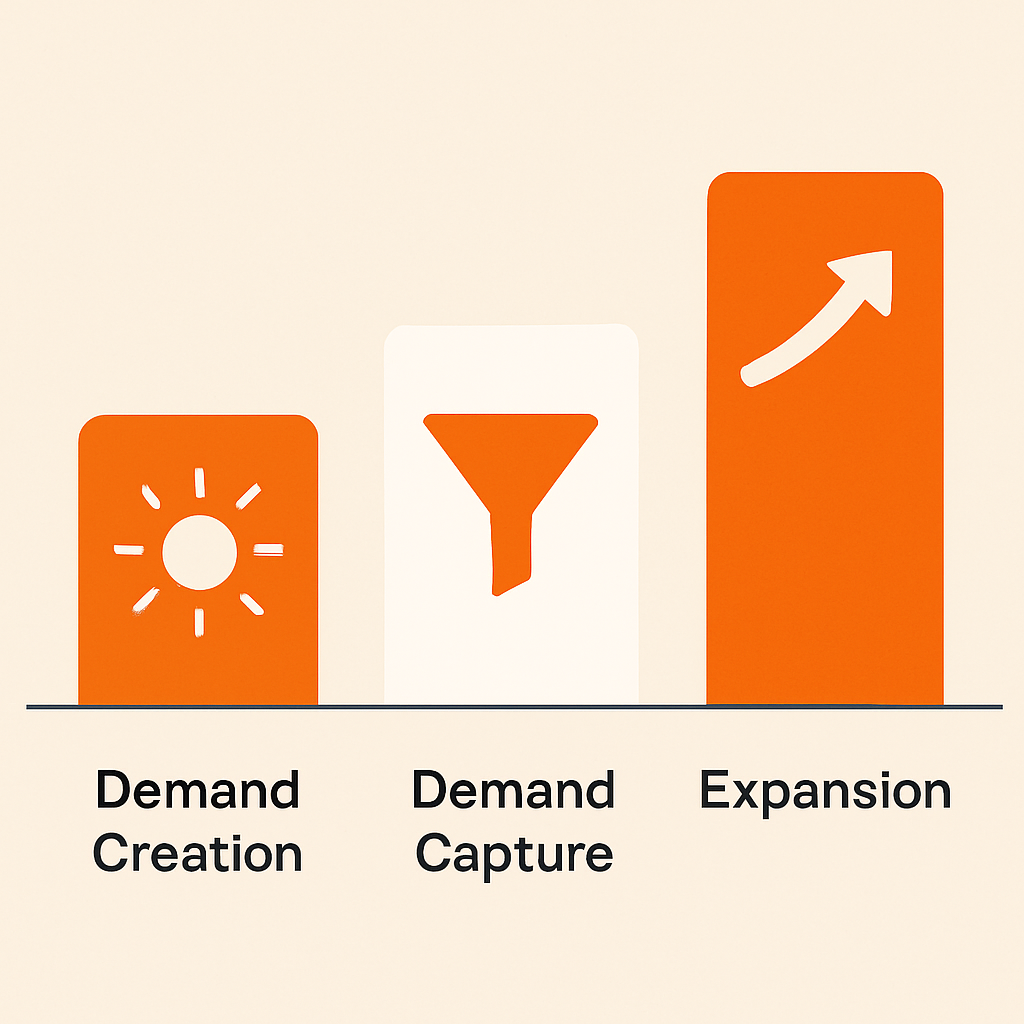
Go-to-market strategy is one of the most misunderstood aspects of building a company. Founders often treat it as a single launch moment — a press release, a website, and a few ad campaigns. In reality, GTM is not an event but a sequence. The difference between startups that scale and those that stall is rarely the quality of the product; it’s the discipline of sequencing demand creation, demand capture, and market expansion.
Why Sequencing Matters
Markets don’t adopt new products in straight lines. Early adopters behave differently than mainstream buyers, and strategies that work at one stage often fail at the next. A zero-to-one GTM requires not just activity but choreography: knowing what to do first, what to delay, and how to connect each phase into a compounding growth engine.
Without sequencing, companies burn resources generating awareness they can’t convert, or building funnels before anyone actually cares. Sequencing keeps momentum aligned with market readiness.
Stage 1: Demand Creation
The first hurdle is not conversion — it’s attention. If no one is searching for your solution, search ads and sales pitches won’t land. At this stage, the work is about creating language, narratives, and contexts that frame your product as the inevitable solution to a visible problem.
- Category education: Explain the problem in a way that redefines the buyer’s worldview.
- Narrative dominance: Control the conversation through thought leadership, content, and early community-building.
- Strategic signals: Partnerships, pilots, or endorsements that make the market curious.
The goal of demand creation is not leads; it’s belief. Until the market believes the problem is real and solvable, demand capture is impossible.
Stage 2: Demand Capture
Once awareness reaches a critical mass, the priority shifts to harvesting intent. This is where funnels, sales processes, and performance channels become effective.
- Positioning to intent: Align offers with how the market now searches, evaluates, and compares.
- Conversion design: Landing pages, demos, and onboarding optimized for clarity and speed.
- Commercial packaging: Good-better-best pricing, trial models, or guarantees that reduce friction.
Demand capture is about turning belief into action. Without it, awareness dissipates. Done well, it converts interest into early revenue streams that validate and fund expansion.
Stage 3: Expansion
With an engine that generates and captures demand, the final step is expansion — deepening share of wallet and widening the addressable market.
- Customer expansion: Upsells, cross-sells, and lifecycle marketing to grow existing accounts.
- Market expansion: Moving into new segments, geographies, or use cases.
- Channel expansion: Partner ecosystems, resellers, or integrations that extend reach.
Expansion without prior sequencing is dangerous. Companies that try to expand before proving capture often overextend and collapse. But when sequenced correctly, expansion compounds — turning early traction into market dominance.
The Zero-to-One GTM Flywheel
The sequencing of demand creation, capture, and expansion forms a flywheel. Each phase fuels the next: belief creates leads, leads fund expansion, expansion reinforces belief through proof of scale. The system is self-reinforcing once in motion, but fragile until each stage is respected.
Final Thought
Zero-to-one GTM is not about speed; it’s about rhythm. Moving too slowly means missed windows. Moving too quickly means building funnels on sand. The discipline lies in knowing when to ignite curiosity, when to monetize intent, and when to scale reach.
Great products die in noisy markets when founders confuse tactics for strategy. The ones that survive and thrive understand that GTM is not a launch; it is a sequence — demand, capture, and expansion, in that order.





Add comment