
Pricing is one of the most powerful levers a business can pull, yet it’s often treated as an afterthought. Founders obsess over product features, growth campaigns, or brand storytelling, while the pricing page is designed in a single afternoon. The irony? Pricing decisions impact revenue more directly than almost any marketing channel.
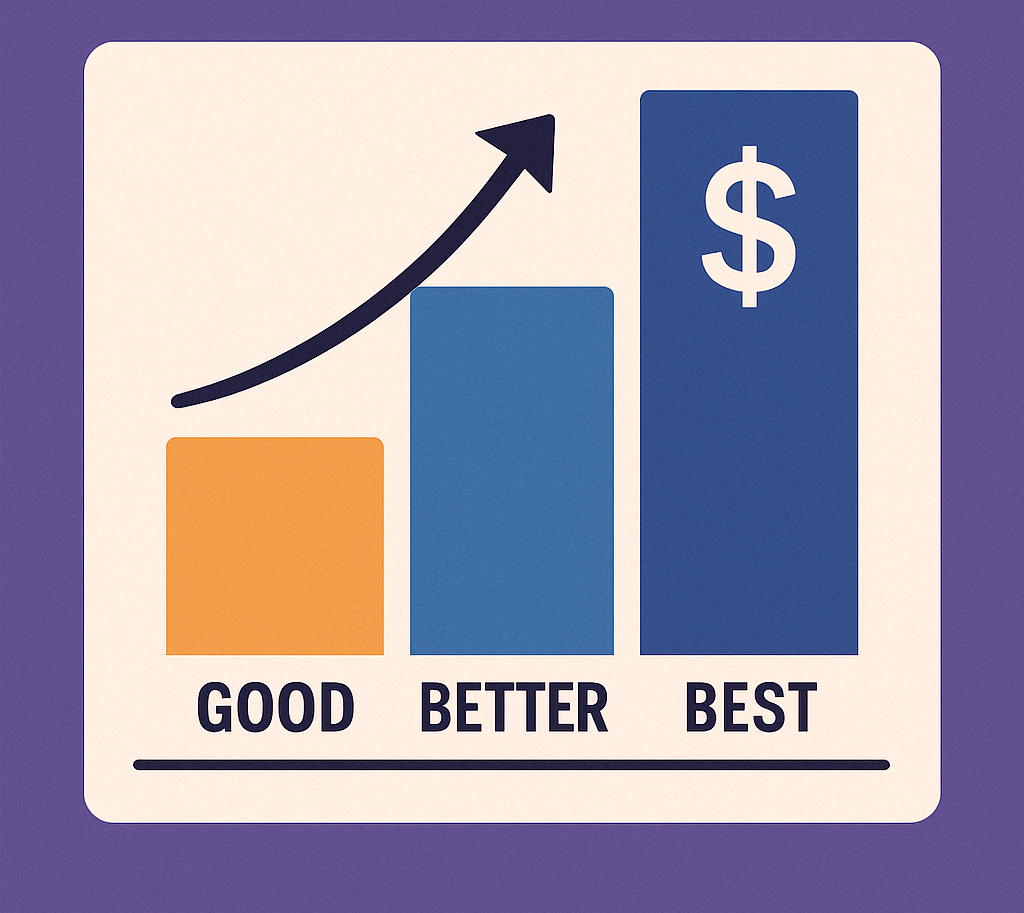
A common strategy across industries is the Good-Better-Best model: offering three tiers of value so customers can self-select. In theory, this approach widens the funnel, maximizes willingness to pay, and creates a natural upsell path. In practice, poorly executed Good-Better-Best (GBB) structures lead to cannibalization — where customers abandon higher-value tiers for the cheaper middle or entry-level option.
So how do you design a GBB architecture that increases revenue without eroding it?
The Psychology Behind Three Tiers
The GBB model works because of a cognitive bias known as extremeness aversion. Customers tend to avoid the cheapest and the most expensive options, gravitating toward the middle. This makes the “Better” tier the psychological anchor of your pricing strategy.
However, this bias can backfire. If the “Better” tier is too strong, premium buyers who would have paid for the “Best” downgrade themselves. If the “Good” tier is too generous, value-conscious buyers have no incentive to trade up. Your job in pricing architecture is to design each tier not just around features, but around behavioral economics.
Designing Without Cannibalization
1. Anchor with the Premium
Your top tier should set the reference point for value. Even if only a small percentage of customers choose it, the existence of a premium package frames the middle tier as more reasonable. This is why SaaS companies often display the “Best” plan first, highlighting its advanced features and ROI, even if most users never buy it.
2. Differentiate by Outcomes, Not Features
Too many businesses fall into the trap of stacking features like a buffet menu. The difference between “Better” and “Best” isn’t a checklist — it’s the size of the problem solved. For example, a basic plan might manage campaigns; a premium plan might directly lower acquisition costs by 25% through automation. Outcomes justify price gaps.
3. Engineer Friction in the Lower Tier
The “Good” tier should exist to capture budget-sensitive buyers, but it should never feel too comfortable. Limit usage, create soft caps, or exclude high-ROI features that naturally push customers upward as their needs grow. A free plan with unlimited access is not a “Good” tier; it’s a revenue leak.
4. Highlight the Middle as the Default
Since most customers will land in the “Better” tier, optimize its positioning. Mark it as “Most Popular,” emphasize its balance of cost and value, and present it visually as the safe choice. Done well, the middle tier becomes both a volume driver and a natural step toward the premium tier for ambitious buyers.
Avoiding the Cannibalization Trap
The key to preventing cannibalization is ensuring that each tier speaks to a different customer mindset:
- Good: Entry-level, budget-conscious, or trial users. Designed to introduce your ecosystem.
- Better: Growth-focused customers seeking efficiency and ROI. This is your revenue engine.
- Best: Ambitious or enterprise-level buyers who want strategic advantage, not just savings.
If two tiers overlap too heavily in audience or benefits, they will cannibalize each other. The solution is narrative clarity: each plan should tell a distinct story of progress.
Metrics That Matter
Designing the structure is one thing; monitoring its health is another. Watch these metrics closely:
- Upgrade rate: How many customers move from Good → Better → Best?
- Gross margin per tier: Are premium customers disproportionately profitable?
- Churn by tier: Are lower-tier users leaving before they can be upsold?
- Revenue distribution: If over 80% of revenue comes from one tier, re-balance your offering.
Final Thought
A strong pricing architecture doesn’t just capture demand — it creates it. By deliberately shaping how customers perceive value, you transform pricing from a passive decision into an active growth strategy. The Good-Better-Best framework remains one of the most effective tools in the marketer’s arsenal, but only when designed to guide customers upward, not sideways.
Clarity of audience, differentiation by outcomes, and ongoing optimization are what separate pricing that grows your business from pricing that silently erodes it.





Add comment