
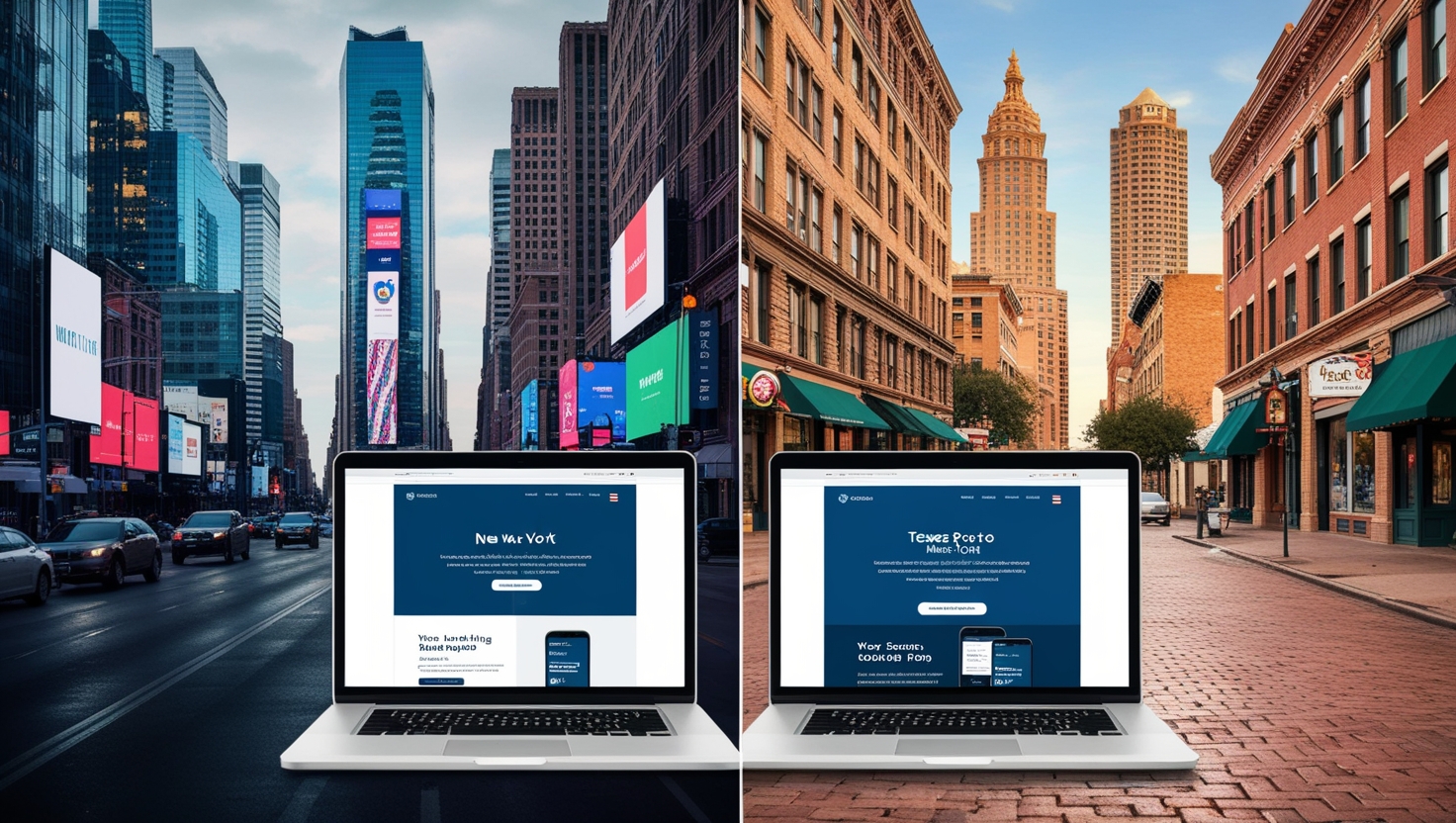
At first glance, your marketing funnel seems solid. The content is written in clear and fluent English. The visual design feels modern and clean. The product messaging is consistent across channels. You’ve even optimized the call-to-action using data from A/B tests.
And yet, despite all this careful preparation, something feels off.
Your campaign performs well in New York and Los Angeles, but in Dallas or Austin, engagement drops noticeably. Conversion rates fall flat. Users bounce sooner. Lead quality deteriorates.
You find yourself wondering what went wrong — especially since the language hasn’t changed.
But here’s the fundamental misunderstanding:
Speaking English does not mean speaking the same cultural language.
The Mistake Most Marketers Make When Expanding Across the U.S.
Many teams operate under the assumption that, since their audience resides within a single country and communicates in one language, there is no need to adapt anything beyond time zones or regional pricing.
This assumption, although convenient, is deeply flawed.
What resonates with an audience in Brooklyn may feel distant or even alienating to a buyer in suburban Texas. Humor, tone, visual cues, even the pace of the narrative — all of these elements carry emotional context that changes dramatically depending on geography, identity, and local business norms.
When your brand message lands without that cultural alignment, even if the copy is technically correct and grammatically perfect, the impact is neutral at best and alienating at worst.
Localization Is Not a Language Task — It Is a Trust-Building Strategy
Traditionally, localization has been treated as a logistical step in global marketing. Teams translate content into German, Spanish, or Japanese, update a few interface elements, and assume that adaptation is complete.
But true localization is not about translation.
It is about cultural resonance, behavioral nuance, and the emotional rhythm of your audience.
In other words, localization is not a checklist.
It is a form of strategic empathy — one that requires understanding not only how people read, but also how they interpret intent, perceive trust, and define professionalism.
What Actually Fails on a “Perfectly English” Page
Let’s consider a specific example. Your SaaS company launches a U.S.-wide campaign. The messaging is focused on innovation, disruption, and breaking industry rules — a tone that performs well with tech-savvy buyers on the West Coast.
Now that same landing page is served to visitors in Texas. The tone remains aggressive. The visuals feature bearded millennials with tattoos working in minimalist co-working spaces. The testimonials reference brands that are either unfamiliar or irrelevant to that region.
To your New York audience, this feels sharp and bold.
To your Texas prospects, it feels performative, vague, or even unserious.
What changed?
Not the product.
Not the offer.
Only the emotional alignment between the message and the local context.
The Silent Cost of Ignoring Intra-National Localization
In a global context, marketers accept that entering Japan requires rewriting everything from tone to UX flow. They accept that expansion into the Middle East involves rethinking trust signals, brand positioning, and customer onboarding.
But within the United States, these same marketers often pretend that regional culture doesn’t exist.
This oversight creates a gap that performance metrics eventually reveal.
If your cost per lead varies by 3x across regions, and your team continues to push the same creative everywhere, the problem is not your media spend. The problem is that you’re treating cultural nuance as noise — instead of what it actually is: an underutilized conversion lever.
What Effective Localization Looks Like Inside the U.S.
Let’s move from theory to implementation. If you want your brand to resonate equally well in Miami, Minneapolis, and Midland, you must be willing to customize with intention — not overcorrect with stereotypes.
Here are specific principles we apply with our clients:
1. Adapt tone without diluting the brand voice
You don’t need to rewrite everything, but you must recalibrate how certainty, confidence, and humor show up in your message. What feels assertive in California may come across as arrogant in Kentucky unless phrased with humility and practical clarity.
2. Reconsider the visual narrative
Stock images of urban creatives may appeal to designers in Chicago, but alienate traditional business owners in smaller Southern cities. Visual credibility is local. Make it familiar, not aspirational.
3. Adjust social proof to reflect local trust currency
Some audiences respond well to case studies featuring trendy startups. Others trust longevity, reliability, or endorsements from institutions. Don’t assume that all testimonials build confidence equally.
4. Reframe offers based on regional psychology
Buyers in high-velocity markets may respond to urgency, limited-time offers, or bold guarantees. Others prefer reassurance, longer consideration cycles, or community validation. A single CTA framework cannot serve both without adaptation.
Does This Mean You Need 50 Versions of Your Funnel?
Not necessarily.
Full-scale localization is resource-intensive. But even small shifts — tone, imagery, one-sentence intros — can create dramatic results when done intentionally.
You don’t need to localize every asset.
You need to localize the ones that matter most to the regions that are underperforming.
And with today’s tools — dynamic content modules, AI copy tuning, real-time testing — you can do this without adding massive operational complexity.
Final Reflection: Local Resonance Creates National Scale
If your funnel underperforms in a region where competitors are thriving, you are not just facing a pricing issue or a targeting problem.
You are likely facing a trust gap — one caused by cultural misalignment rather than technical error.
By treating localization not as a patch, but as a strategic layer of your brand architecture, you open the door to stronger engagement, better conversion, and longer-term loyalty.
Your audience may speak English.
But unless your brand speaks their version of that language — the one shaped by context, identity, and geography — your message won’t land where it matters most.
We help brands uncover the cultural gaps in their messaging and translate strategy into region-specific resonance — not just across countries, but within markets.
If your audience is English-speaking, but your results are all over the place, we should talk.







Add comment